

Courtesy: Cadence
Understanding Noise Reduction in Industrial Fans




Industrial fans are widely utilized across various sectors, including manufacturing, automotive, and energy production, playing a vital role in ventilation and cooling. However, a notable drawback of these powerful machines is the significant noise they produce, which can range from 70 to 120 decibels. A primary contributor to this noise is the aerodynamic turbulence created by the fan blades. Addressing the challenges posed by the noise generated by industrial fans is a continuing focus of research in this area.
One promising avenue for reducing this noise involves passive noise mitigation methods, such as modifying the trailing edges of the fan blades. By incorporating designs with features such as sawtooth or serrated edges, we can effectively reduce noise levels without compromising performance. Computational fluid dynamics (CFD) studies of industrial fan designs can help pinpoint the optimal configuration that enhances performance and minimizes operational noise.
In the webinar on CFD for Turbomachinery: Boost Performance & Control Noise, Antonis Karasavvidis, principal customer service engineer, and Domenico Mendicino, senior product engineering manager, examine a case study on the CFD analysis of industrial fan blades with serrated edges to understand how these modifications can effectively reduce the noise and enhance performance. This blog provides an overview of the case study presented in the webinar.
Overview: CFD Simulation of Industrial Fan with Serrated Edges
This case study examines the aerodynamic and acoustic performance of a ventilation fan, focusing on modifications to the blade design and their impact on airflow and noise characteristics under turbulent flow conditions. Starting with a baseline design, a ventilation fan was initially created using mean line design tools, achieving a blade tip Mach number of about 0.2. The design features a bell mouth at the inlet and blades constructed in three sections, utilizing NACA 65 profiles. This foundational design serves as a benchmark for subsequent modifications and performance evaluations.
Blade Variations and Design Enhancements
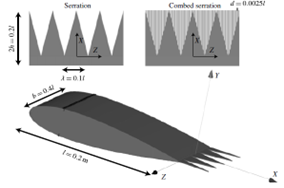
The study examines two types of serrated trailing edges added to the baseline design to achieve noise reduction and potential performance enhancements. These include:
- Variable Serration: A serration pattern applied with varying geometry along the blade’s trailing edge
- Uniform Serration: A consistent pattern cut along the trailing edge
Further enhancements include mechanical features such as embossing, pivots, and fillets, which are standard in this type of turbomachinery. Assessing these blade variations allows for comprehensive insight into their aerodynamic and acoustic effects.
Mesh Generation Workflow for Accurate Simulation
In this case study, Fidelity AutoGrid generates a high-quality, low-Reynolds-number mesh comprising approximately 2 million cells in approximately 20 seconds for the baseline design. This mesh is a structured multi-block grid with matching nodes on the periodic boundaries.
Given the complex geometries associated with the serrated trailing edges, an advanced mesh generation workflow was implemented, utilizing an unstructured mesh to capture the complex blade geometry while keeping the high-quality structured multi-block grid for most of the flow path. Utilizing Fidelity AutoGrid and ANSA, structured and unstructured grid strategies were combined to capture the intricate details efficiently.
Results of CFD Simulations
Using the GPU-enabled Fidelity Flow Solver, the simulations investigated the aerodynamic performance of the baseline design, uniform, and variable serrated blades. The solver provided rapid convergence within 200 iterations for the steady-state simulation and 3,600 time steps for an unsteady run with 10 inner iterations. Leveraging GPU acceleration on the Cadence Millennium platform provided high-fidelity results within minutes, even for the mixed-grid simulations.
The results indicated:
- Trailing Edge Effects: Serrations alter the pressure field near the trailing edges, particularly influencing the mixed-out flow downstream and the wake width
- Geometric Influence: Longer serration teeth facilitated enhanced energy exchange, correlating with improved aerodynamic performance
Additionally, the hub’s pivot and other mechanical features induced secondary flows, disrupting velocity profiles at the outlet and creating vortices, especially in the serrated configurations.

Noise Prediction and Analysis
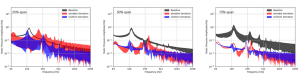
The study evaluated noise characteristics through pressure fluctuations downstream of the trailing edge using both stationary and moving probes at different span heights. Key findings include:
- Stationary Probes: Minor differences in noise levels at various heights, dominated by blade-passing frequencies
- Moving Probes: Significant noise reduction effects at higher spans with serrated blades, while lower spans were governed by turbulence from the pivot and other design complexities
This case study highlights the aerodynamic and acoustic advantages of serrated trailing edges in ventilation fan design. By leveraging advanced mesh generation and GPU-based CFD solvers, the study achieved efficient simulations and precise results. The findings emphasize the importance of optimizing serrated geometries and conducting far-field noise analyses to refine fan performance, reduce noise emissions, and enhance design efficiency.

