
Courtesy: Eko
Healthcare organisations have long strategised on how to improve clinician and patient experiences, patient outcomes, and overhead. Artificial intelligence is a tool that organisations can wield to achieve these four goals, and they’re using it with more success than ever before.




AI-based tools have been available since the 1950s. Machine learning, a specific subset of AI, has been available almost as long; however, the technique has advanced tremendously in recent years due to increased computing power, the availability of trained data scientists, and the massive quantity and diversity of data generated every day. Today, AI/ML software can spot heart murmurs with accuracy equivalent to or better than an expert cardiologist.
For all its promise, AI-based tools won’t and shouldn’t replace physicians, radiologists, or other specialists (at least not any time soon). But they can help healthcare professionals diagnose and manage patients faster and with greater detail and accuracy.
While some physicians are reluctant to adopt AI-based tools due to data privacy, security, and usability issues, acceptance is steadily growing. With the speed of advancement in AI and machine learning today, physicians will likely open their minds and view the use of AI-based support tools as a huge opportunity to create more efficiency, precision and accuracy in their decision-making.
Why? Simply because AI-based tools recognise patterns better than humans do. They can scan infinite biopsies, radiology images, medical records, heart sound recordings or rhythm strips, and medical data sets to identify patterns and classify them — patterns that can suggest anything from cancer to heart disease. And they don’t need sleep or coffee breaks, and they never have “off days.”
Here are 3 reasons healthcare can benefit — both clinically and financially — from AI.
It recognises patterns humans can’t
Once properly trained, AI/ML medical software can not only identify patterns in biological data more accurately than humans can, but it can also recognise entirely new patterns — ones that humans can’t see or hear, and of which we had no previous awareness. Recognising previously unknown patterns gives doctors new information with which to diagnose and treat disease and new avenues of exploration to understand diseases better.
For example, a U.K.-based research team recently developed a machine learning technology that can spot underlying red flags for a future heart attack. The tool identified inflammation, scarring, and blood vessel changes in the space around the coronary blood vessels that supply blood to the heart. Using this new biomarker, doctors can potentially flag patients with otherwise unknown early signs of heart disease and take preventative measures.
It recognises patterns faster
AI-based software processes data more than 1,000 times faster than humans with extreme consistency and accuracy. The radiology experience has been quite illuminating.
AI has been shown to add value to radiology in at least 2 ways. First, AI improves the speed of capturing MRIs by using various deep learning methods. Emerging research now shows that these speedier images produce the same quality as slower, traditional methods. This means that patients spend less time in a claustrophobic tube, and hospitals can schedule more procedures per day.
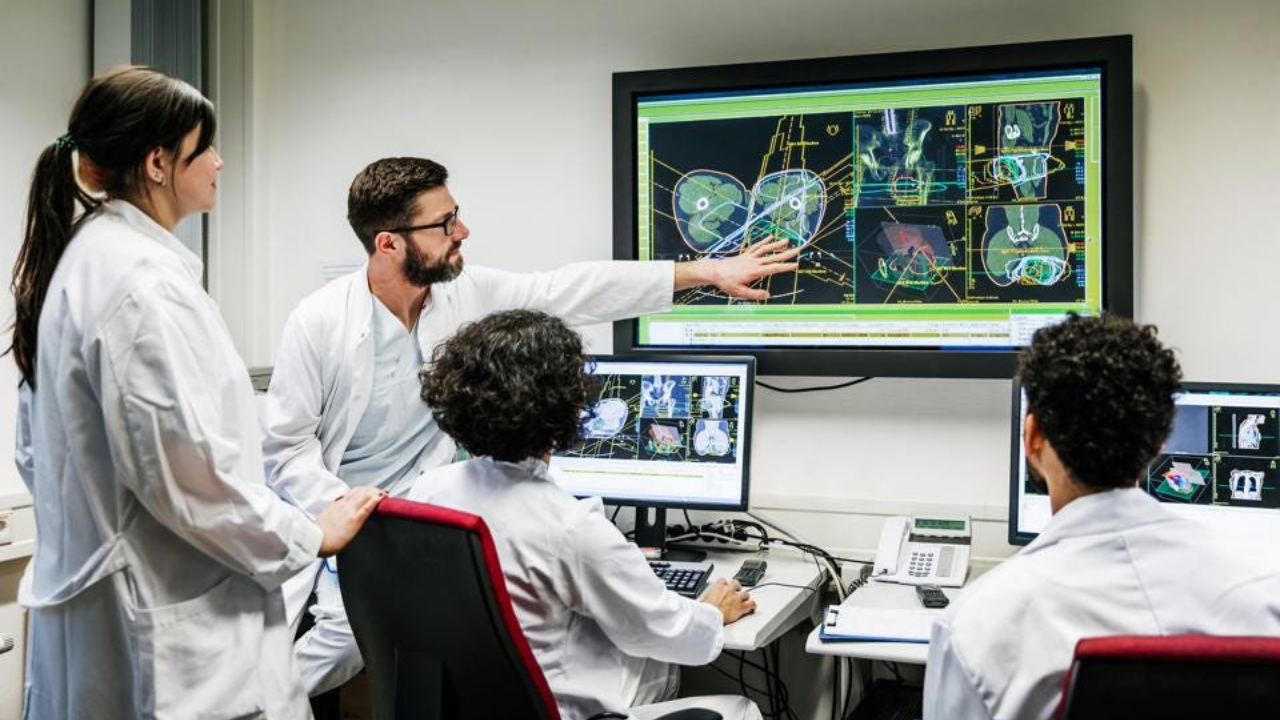
Second, AI can also function as a radiologist’s assistant, reducing workload by segmenting structures and automating routine tasks that take thousands of mouse clicks.
Third, AI is detecting lesions with an accuracy comparable to humans. AI’s work ethic prevails here as well, because it can analyse thousands of images better than a trained radiologist’s eyes.
Carrying out our quick analysis now into the pathology lab, we see similar benefits. After digitising biological samples, an AI/ML tool can spot patterns and provide that information to the pathologist, essentially screening for diseases at an astounding speed. So, instead of worrying for a week over the results of a biopsy or blood test, patients could have their results the next day.
It recognises patterns for patients at home
Digital health devices have changed the way doctors deliver care. A patient with Type 2 diabetes, for example, can monitor their blood sugar using a skin sensor and an app on a mobile device to send that data directly to their doctor’s office. The doctor can then make changes as needed and in a much more timely manner. This improves blood glucose control significantly, compared to waiting for a 3-month checkup.
AI-based tools can also help chronically ill patients live comfortably at home. For example, a doctor may send a heart failure patient home with a prescription and dietary instructions, but the doctor still has no insight into the patient’s daily health and whether the patient is about to deteriorate. By the time the patient’s 6-month follow-up arrives, they might have reverted to eating unhealthy foods, lapsing in their exercise program, and even forgetting to take their medication.
But if those patients were equipped with a smart stethoscope, a bodyweight scale, and a simple blood pressure cuff, the patient could check their vital signs daily. And by sending all of that information to an AI-based software, anomalies and bad trends could be identified in real time and alerts sent to the patient and the doctor.
While you now may be eager to get started with AI, there are some considerations. First, understand thoroughly the unmet clinical need and how an AI/ML tool can meet that need. Then, carefully search for potential suppliers and engage each one to understand their product’s impact: How does it work? Is it understandable? Explainable? Do you trust it? What’s its impact on the clinical workflow? Is there a sandbox for you to try before you buy? Who are the other stakeholders (finance, business development, IT)? Nowhere is the old adage truer: “An ounce of prevention is worth a pound of cure.”
In sum, because of its pattern recognition powers and its unflagging performance, AI/ML medical software will continue to have a profound effect on healthcare. It will almost certainly never replace physicians, but for the foreseeable future, it will serve as their valuable, indefatigable, intelligent assistant.

