


Courtesy: Element 14
Introduction



Accurate current measurement is a critical aspect of modern electrical engineering. Precision is essential everywhere – from battery management systems (BMS) to industrial automation. Traditional sensing methods are inadequate when temperatures fluctuate, leading to unreliable readings.
That’s where shunt resistors come to the rescue. These components produce a small, measurable voltage drop that reflects the amount of current flowing through them. However, their performance can be influenced by changes in temperature, which alter resistance and distort measurements. The temperature coefficient of resistance (TCR) quantifies this change, making low TCR shunt resistors essential for high precision applications.
Vishay’s WSBE8518 shunt resistor exemplifies such precision. Vishay offers the HV-IBSS-USB reference design – a sophisticated tool that simplifies testing and integration – to streamline its evaluation. This article explores the function of shunt resistors, the significance of low TCR, the impact of thermal drift, and how the HV-IBSS-USB reference design empowers engineers to achieve accurate current sensing in demanding environments.
Understanding Shunt Resistors in Current Sensing
A shunt resistor, also known as a current shunt resistor or an ammeter shunt, is a low resistance component placed in series with a load to measure voltage drop when current flows through it. This voltage drop, measured by an analogue-to-digital converter (ADC), is directly proportional to the current, enabling accurate current measurement using Ohm’s Law.
Shunt resistors are vital in precision current sensing across a wide range of high-reliability applications. These include monitoring charge and discharge cycles in BMS for electric vehicles (EV), energy storage systems, and portable devices, regulating output and detecting overcurrent in power supplies and motor control systems. Renewable energy setups like solar inverters and wind turbines ensure accurate power flow measurement, while industrial automation provides critical feedback for diagnostics and system reliability. They are also indispensable in network UPS systems, power meters, and high-precision environments such as aerospace and defence applications, where even minor deviations in current measurement can have critical consequences.
Selecting a shunt resistor involves balancing its resistance value, power rating, and TCR. For instance, the WSBE8518, with a 100 μΩ resistance and 36 W power rating at 70 °C, produces a 50 mV drop at 500 A – making it suitable for high current applications while maintaining accuracy. The WSBE series can support up to 1825 A with no noticeable resistance shift.
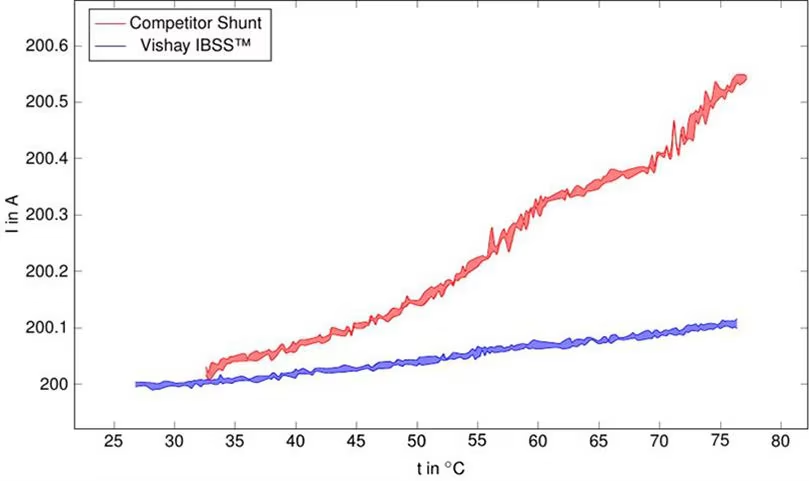
Figure 1 demonstrates that as the temperature rises from 25 °C to 80 °C, the standard shunt (in red) shows a current reading drift from 200 A to over 200.6 A, while Vishay’s (in blue) remains nearly flat at 200 A, highlighting its superior thermal stability. Vishay also delivers cleaner, less noisy measurements, unlike the standard shunt’s non-linear, noisier signal response.
Why Does TCR Matter in Precision Sensing?
Resistance isn’t constant—it changes with temperature. The TCR quantifies this change, expressed in parts per million per degree Celsius (ppm/°C). In simple terms, TCR tells us how much a resistor’s value will drift as the temperature fluctuates.
If a resistor has a positive TCR, its resistance increases with rising temperature. A negative TCR means resistance decreases as it gets warmer. In either case, too much variation can compromise measurement accuracy. A low TCR is critical in precision current sensing, especially in systems where even the slightest error can cascade into larger problems. Due to increased electron scattering, most metals naturally see resistance rise with temperature. However, specialized alloys — such as the manganese-copper used in Vishay’s WSBE8518 shunt resistor —can achieve remarkably stable performance, with TCRs as low as ± 10 ppm/°C. This makes them ideal for applications demanding high accuracy under wide temperature swings.
For instance, a 1 mΩ shunt with a TCR of ± 50 ppm/°C will experience a resistance change of ± 5 µΩ over a 100 °C temperature swing, which is equivalent to ± 0.5 % of its nominal resistance. That may seem insignificant, but in high precision environments such as battery charge balancing or power regulation, such deviations can skew current readings and disrupt system performance. The following equation calculates the maximum change in resistance value for a given TCR:
R = R0 X 1 [ 1 + α(T-T0)]
where,
R = final resistance
R0 = initial resistance
α = TCR
T = final temperature
T0 = initial temperature
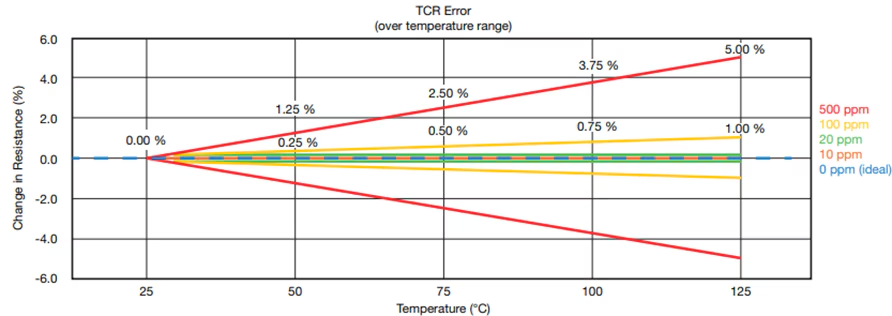
The benefits of low TCR are:
- Improved measurement accuracy: With resistance remaining stable across temperature variations, current sensing becomes more precise
- Better thermal stability: Minimal resistance drift, even under fluctuating ambient conditions or due to self-heating from applied power
- Ideal for high precision circuits: Supports applications that require consistent performance over wide temperature ranges
- Enhanced performance in harsh environments: Suitable for military and high-temperature electronics where reliability under thermal stress is critical
- Minimizes error in Kelvin configurations: Particularly advantageous in 4-terminal setups in which precise voltage sensing is critical
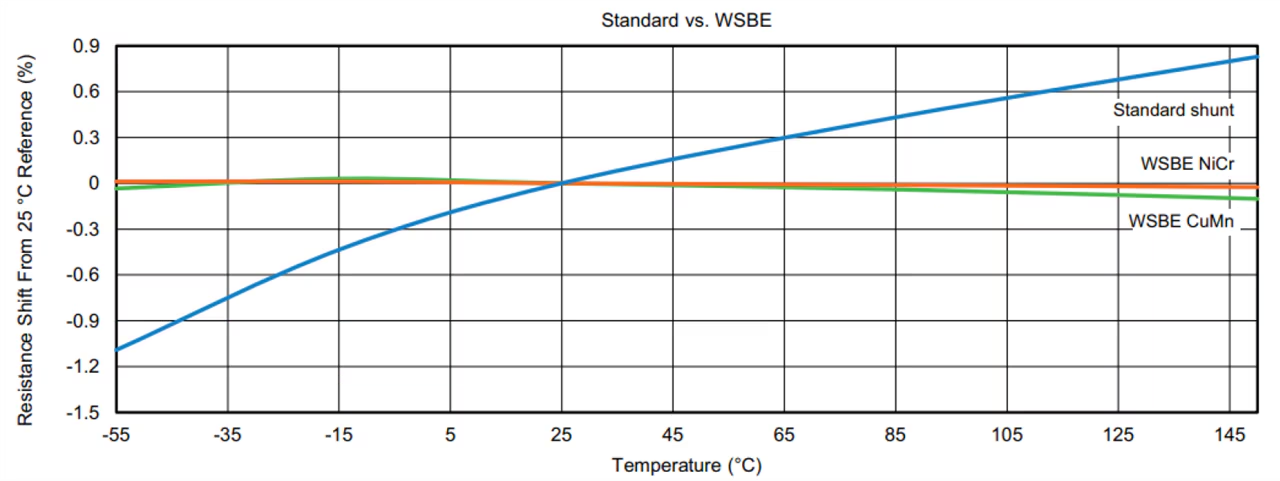
Figure 3 illustrates the superior thermal stability of WSBE series resistors (NiCr and CuMn) compared to standard shunt resistors. While the standard shunt exhibits a large resistance drift over temperature (indicative of poor TCR), the WSBE resistors maintain almost constant resistance across a broad thermal range.
Understanding Thermal Drift in Current Sensing
Thermal drift refers to changes in a component’s electrical characteristics caused by fluctuations in temperature. In shunt resistors, thermal drift alters resistance, directly affecting current measurement accuracy. For instance, copper, with a TCR of 3900 ppm/°C, can exhibit a 39 % resistance change over a 100 °C temperature range, severely compromising precision. Low TCR materials, such as the manganese-copper alloy in the WSBE8518, reduce this effect, maintaining high measurement accuracy.
Thermal drift can also arise from self-heating due to power dissipation during operation. Vishay’s HV-IBSS-USB mitigates this by combining a low TCR shunt with an efficient circuit design, minimizing temperature-induced errors. Kelvin (4-terminal) connections further enhance accuracy by reducing the impact of high TCR copper terminals, enabling consistent and repeatable measurements.
How the Reference Design Works
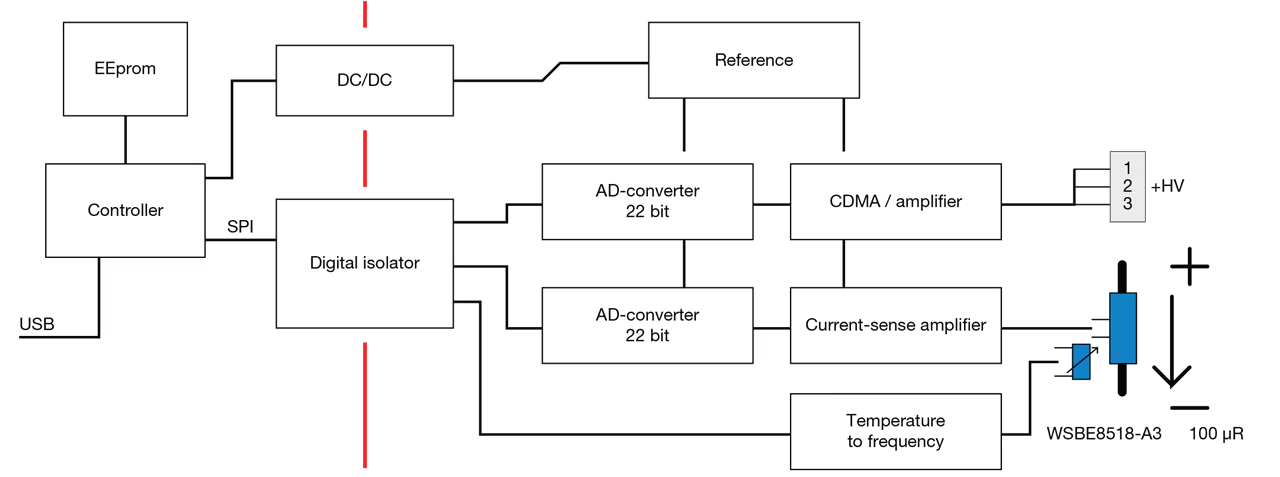
The HV-IBSS-USB reference design features two isolated domains: an HV analog front-end and an LV digital control section. Powered and interfaced via USB, the LV side hosts a microcontroller that manages data acquisition and communication. Power is transferred to the HV domain through a charge pump, where precision 22-bit sigma-delta ADCs and carefully selected analog components enable high-resolution current and voltage measurements.
The design compensates for thermal drift through automatic gain and offset calibration, ensuring accuracy across temperature variations. A dedicated voltage divider feeds the voltage signal directly to the ADC, eliminating amplifier drift. An NTC-based converter transmits a PWM signal across the isolation barrier for temperature monitoring. Data is available via a virtual COM port, auto-detected over USB, enabling seamless integration with PC-based tools.
- Current measurement: a third-order delta-sigma modulator converts the voltage drop across the WSBE8518 shunt into a digital signal, with automatic gain and offset calibration. The shunt’s TCR (10 ppm/°C) outperforms the analog circuitry’s drift (33.6 ppm/°C), ensuring high accuracy
- Voltage measurement: a 22-bit sigma-delta ADC measures voltage, divided by the CDMA2512 resistor to fit the ADC’s range
Temperature measurement: an NTC thermistor and multivibrator convert temperature to a frequency signal, transmitted as a PWM signal to the microcontroller
Application: EVs
In BMS for EVs and other compact mobility vehicles such as electric two-wheelers, precise current measurement is critical for monitoring charge and discharge cycles, balancing cells, and ensure safe, efficient operation. The HV-IBSS-USB facilitates the evaluation of the WSBE8518 shunt in these demanding environments. Installed in series with the high voltage battery pack, the shunt accurately measures currents up to 500 A, which is ideal for applications where currents routinely exceed 100 A.
The reference design’s USB-C interface enables real-time data logging, allowing engineers to analyze current flow, detect anomalies, and fine-tune battery management algorithms. The WSBE8518’s low TCR ensures accurate measurements even as operating temperatures rise during rapid charging or high load discharge. Voltage measurements spanning 10 V to 850 V and integrated temperature sensing provide additional data for detecting faults or optimizing power distribution.
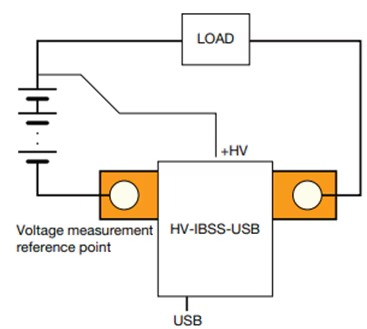
A typical application circuit places the shunt between the EV battery and the drive or charging system. The HV-IBSS-USB’s HV+ and HV + terminals connect to the shunt’s Kelvin terminals, and the USB-C port links to a computer for data acquisition and analysis.
Conclusion
As current sensing requirements continue to tighten across EVs, energy storage, and high-power industrial systems, accuracy can no longer be left vulnerable to temperature effects and component drift. Vishay’s HV-IBSS-USB reference design, built around the ultra-low-TCR WSBE8518 shunt resistor, addresses this challenge head-on by combining material stability, Kelvin sensing, high-resolution ADCs, and intelligent calibration in a ready-to-evaluate platform. By minimizing thermal drift and simplifying high-voltage, high-current measurements, the design enables engineers to validate performance quickly, reduce development risk, and deploy more reliable battery and power management systems. In applications where every milliamp matters, the HV-IBSS-USB offers a practical pathway from precision measurement theory to real-world, production-ready accuracy.

