
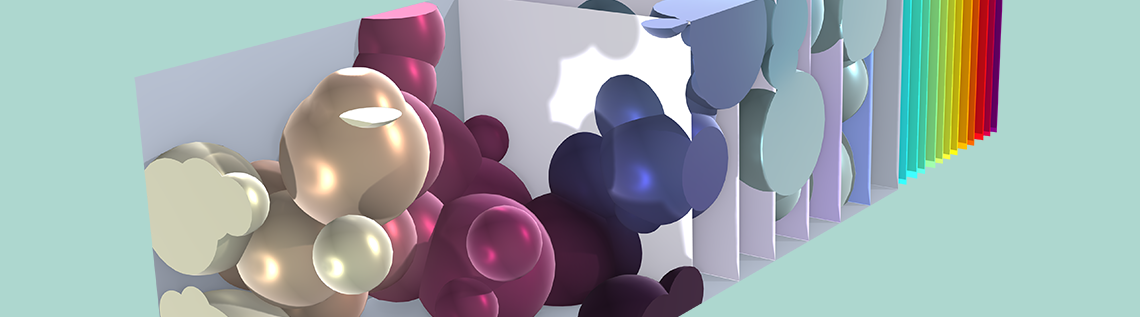
Courtesy: Comsol
Ever experience these common annoyances? You’re about to leave for the day and realize you forgot to charge your phone. Or, you’re on the road and remember your EV needs a charge. The integration of solid-state batteries into electric vehicles, electronics, and energy storage systems — once realized — will leave problems like these in the past. Solid-state batteries have the potential to charge faster and last longer, all while being a safer option. Simulation can help battery designers investigate solid-state batteries to better predict their performance for future uses.




The Solid-State Battery: A Fervently Anticipated Development
Solid-state batteries (SSBs) use a solid electrolyte to conduct ions between both electrodes, whereas conventional batteries use a liquid electrolyte or gel polymer. This difference gives SSBs many advantages over lithium-ion batteries, such as a longer lifecycle. Batteries in current EVs typically last 5–8 years, while EVs with solid-state batteries could increase this to 15–20 years. In addition, while the average Li-ion battery experiences degradation at 1000 lifecycles, an SSB could remain at 90% original capacity after 5000 cycles.

SSBs can complete a charge cycle much faster than other battery types, too. While the typical Li-ion battery takes about 45 minutes to reach 80% charge, an SSB could reach the same charge in 12 minutes, or in as little as 3 minutes. SSBs are also safer for consumer use. Without a liquid electrolyte, they are much less flammable and volatile than other options. Plus, by avoiding liquid electrolytes and carbon anodes, they offer more energy storage density (Ref. 1).
A Design Challenge Spanning Decades
The solid electrolyte was first discovered by physicist Michael Faraday in the early 1830s, and its mechanisms and potential uses have been a subject of research ever since. Fast-forward to the 2020s, when a wide variety of automakers, electronics companies, and research institutions are investing a large portion of their R&D in SSBs. However, battery research and design is an expensive and resource-intensive processes. Simulation can help battery developers investigate design challenges under different operating conditions and use cases.
SSBs are subject to a phenomenon called lithiation, in which the electrodes within the solid components of the battery grow and shrink, causing mechanical stress. In addition, the movement of ions in the battery during charge–discharge cycles causes stress and volume changes. These issues can lead to reduced lifespan and energy storage in the battery and even mechanical failure.
Multiphysics modeling can be used to analyze an SSB design. In the Heterogeneous Model of a Solid-State Battery Unit Cell tutorial model, we take you through the modeling process in the COMSOL Multiphysics software.
Modeling a Solid-State Battery in COMSOL Multiphysics
The Heterogeneous Model of a Solid-State Battery Unit Cell tutorial model simulates the charge–discharge cycle in an SSB, particularly how charge and mass transport interact with solid mechanics. The model geometry is made up of a composite positive electrode, a lithium metal negative electrode, and a solid electrolyte separator, located between both electrodes.
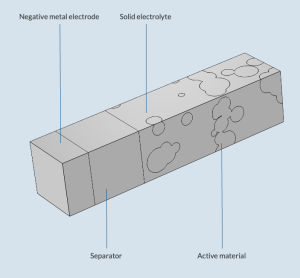
Specialized physics interfaces and features make the setup of the model straightforward. The conservation of charge, mass, and momentum can be modeled with the Lithium-Ion Battery, Transport in Solids, and Solid Mechanics interfaces, respectively. There are also specialized features for modeling:
- Plating at the negative electrode
- Growth and shrinkage of the positive electrode
- Redox reaction at the electrode–solid electrolyte interfaces
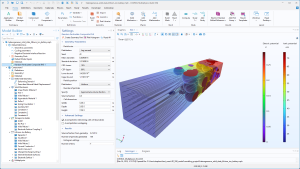
The simulation of the heterogeneous SSB evaluates certain quantities at the end of charge, including the electric and ionic potentials and von Mises stress in the solid electrolyte.
The results also include the evaluation of global quantities, including the cell voltage, state of charge, and stress in the z direction of the battery.
Paving the Way for SSBs
Looking into the mechanics of solid-state batteries with simulation can help researchers, automakers, and electronics companies incorporate SSBs into components and devices in the coming years — not decades.

