Courtesy: Anritsu Corporation
Due to the capacity constraints imposed by metropolitan areas, there is a growing trend to shift towards decentralized regional data centers. Along with the adoption of optical coherent transmission, such as 400G-ZR and OpenZR+, key to achieving this is the precise visualisation of fine quality. Anritsu, a long-established manufacturer of measurement instruments, supports this advancement of data centre networks with its high-precision measurement technology and support system completed in Japan.



The rapid growth in demand for AI has accelerated the global development of data centres, giving rise to an explosive growth in the amount of computational processing. In Japan, however, capacity limits are becoming apparent due to there being little physical space and an overextended electricity grid in metropolitan areas such as Tokyo, Chiba, and Osaka. This situation has led to a move towards the construction of decentralised data centres in rural areas.
Essential to supporting this decentralisation are high-speed, large-capacity, and low-latency data centre interconnections (DCIs). The communication speed of 400G is becoming mainstream, while the development of 800G-compatible products is progressing. At the same time, however, the increase in power consumption that accompanies higher transmission speeds is becoming an issue.
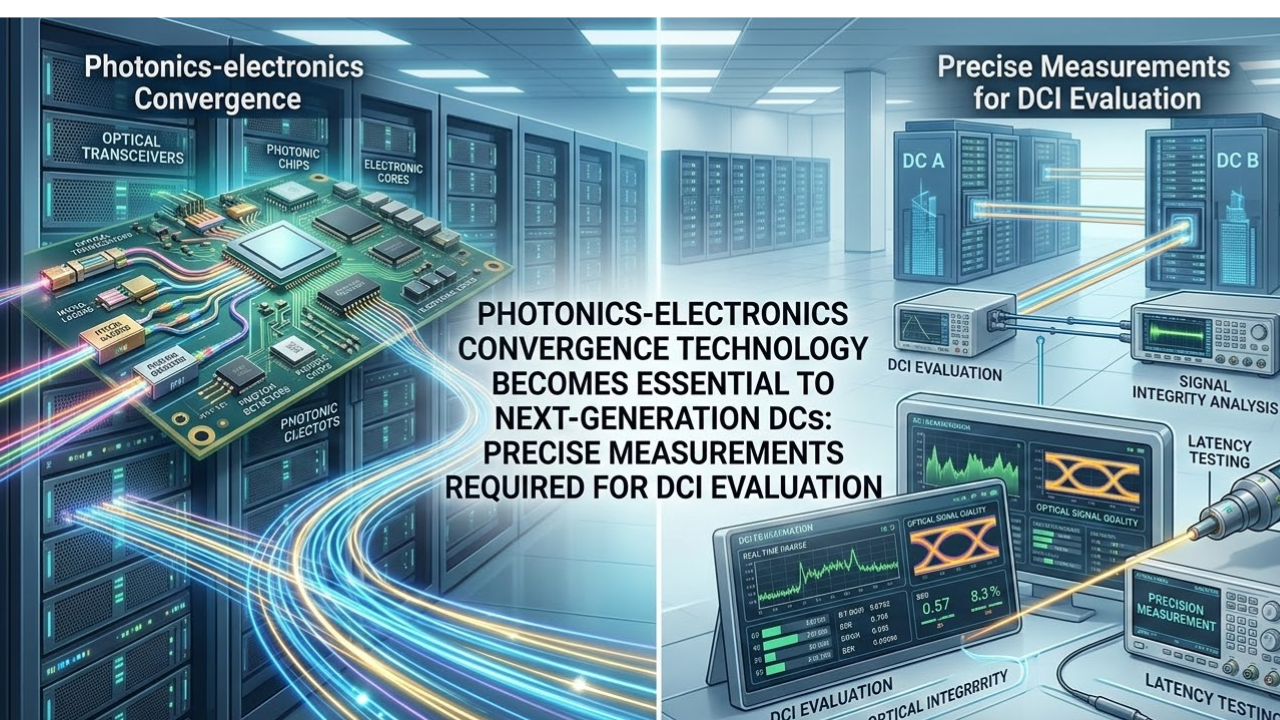
Co-Packaged Optics (CPO), an optical device technology that utilises photonics electronics convergence, is expected to be key to solving this problem.
Daiki Mochizuki, director of the Solutions Marketing Department at Anritsu’s Service Infrastructure Solutions Division, said, “Hyperscalers are also paying attention to CPO, with momentum building for its practical application.” CPO is an architecture that can significantly reduce transmission loss and power consumption by implementing optical transceivers in the same package as the switch ASIC, while shortening the length of the electrical wiring as much as possible. This also contributes to the IOWN initiative’s goal of “reducing electricity consumption to 1/100,” and is therefore attracting attention as a core technology for supporting next-generation infrastructure.

On the other hand, unlike pluggable optical transceivers, which are easy to replace, CPOs may require the replacement of the entire device in the event of its failure. Therefore, more precise measurements and evaluations that have been undertaken in the past are required to ensure reliability in the development and manufacturing stages.
Comprehensive Measurement Solutions for CPO Quality Enhancement
In CPO, the optical elements and ASICS are extremely close to each other, making it very difficult to guarantee performance after implementation and to identify the demarcation point of responsibility among vendors. Anritsu offers measurement solutions to overcome this issue.
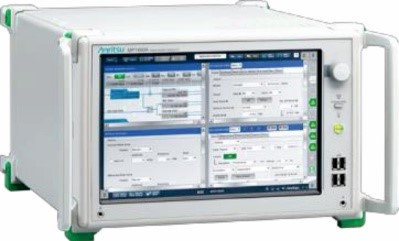
Mr Mochizuki first introduced the Bit Error Rate Tester (BERT), MP1900A. This is an instrument that visualises transmission errors by passing a test signal through a device, and which can accurately detect even minute bit errors.
The MP2110A is an optical sampling oscilloscope that analyses the waveforms and jitter of high-speed optical signals. As such, it is widely used on production lines for pluggable optical transceivers such as QSFP-DD. Due to its high repeatability and measurement accuracy, it will be increasingly applied to signal quality evaluation in new architectures such as CPO. These devices enable the quantitative understanding of signal quality and modulation integrity through “eye diagram measurement which visualises multiple signal waveforms by overlaying them.
In addition, the MS9740B is an optical spectrum analyser that analyses the wavelength characteristics of optical devices while measuring the Optical Signal-to-Noise Ratio (OSNR) and Side- Mode Suppression Ratio (SMSR). “There is a need to support measurement from a variety of perspectives to ensure the quality of optical devices,” said Mochizuki, further mentioning that these instruments are widely used not only by NTT’s research and development department but also by major device manufacturers.
MT 1040A: Essential for Distributed DCs – Focus on Virtual Tester Development
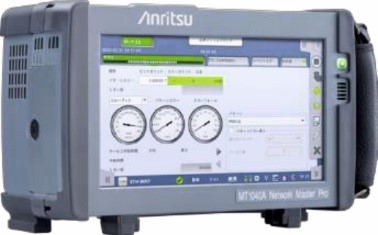
The practical operation of a distributed data centre requires that the network handle multiple geographically distant locations as if they were a single data centre. To this end, it is essential to be able to precisely measure and manage the latency and quality of communications. The Network Master Pro MT1040A addresses this need.
The MT1040A supports multiple communication standards, including 400G Ethernet. It is also equipped with a forward error correction (FEC) analysis function, enabling the comprehensive verification of the communication quality from the physical layer to the network layer.
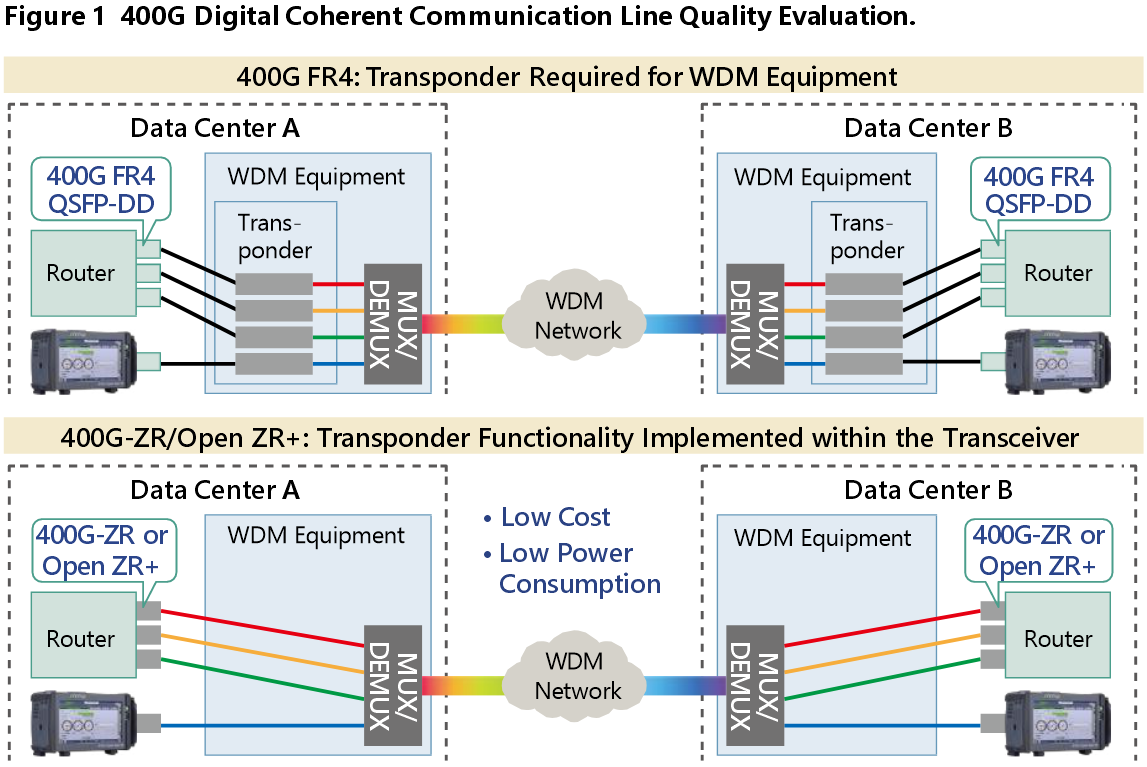
Notably, it supports digital coherent transmission technologies such as 400G- ZR and OpenZR+, with measurement possible at both the IP and optical layers. Until recently, transponder manufacturers were the main users of the device, but with the spread of 400G-ZR/OpenZR+ transceivers, which do not require transponders and which can be directly mounted on routers, their use is expanding to those equipment vendors that deal with coherent signals and users who are building ROADM networks.
While the use of 400G-ZR/OpenZR+ transceivers reduces both the number of devices and the power consumption, it also requires those users dealing with carrier networks to evaluate the network quality themselves, a task that was previously handled by telecommunications carriers.
The MT1040A, which supports QSFP-DD. plays an important role here because it can directly connect to 400G-ZR/OpenZR+ compatible transceivers and measure end-to-end communication quality.
Mitsuhiro Usuba, manager of the department, said: “More and more companies are considering introducing the 400G-ZR, which is becoming more multi- vendor compatible, but some are worried about its operation. To address this, we bring the MT1040A to the customer’s site to measure latency and throughput and support their operational launch.”
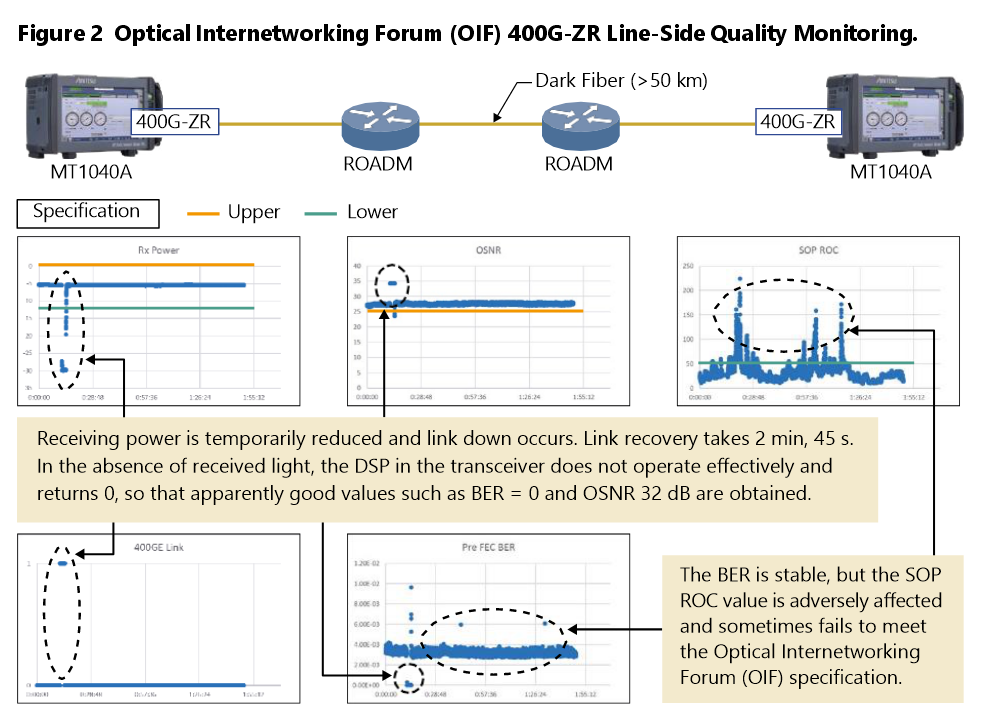
Figure 2 shows an example of measuring 400G-ZR network quality using the MT1040A. Two MT1040As are connected to the ends of an ROADM network using dark fibre. As a result, link downs due to temporary drops in receiving power, the time required to recover the link, and the detection conditions in the absence of received light were observed in detail. In addition, the MT1040A captures quality variations that cannot be detected by normal BER measurements, such as State- Of-Polarization Rate-Of-Change (SOP ROC).
Anritsu is further developing virtual testers for 5G MEC and cloud-native environments. The goal is to enable end-to-end latency and throughput measurements by deploying virtualized software testers on the server side, even in environments where it is physically difficult to install testers, such as in data centers or in automotive. “To take advantage of MEC’s low latency, it is important to have the technology to measure and guarantee its performance,” said Usuba.
Anritsu’s strength lies in its ability to complete all processes from planning to development, through production, to support in Japan. As such, Anritsu is an unparalleled partner in the construction and operation of increasingly sophisticated and complex next-generation networks.