
HomeNewsIndia NewsAdvancing Quantum Sensor for Bio applications with a collaborative work

    Advancing Quantum Sensor for Bio applications with a collaborative work

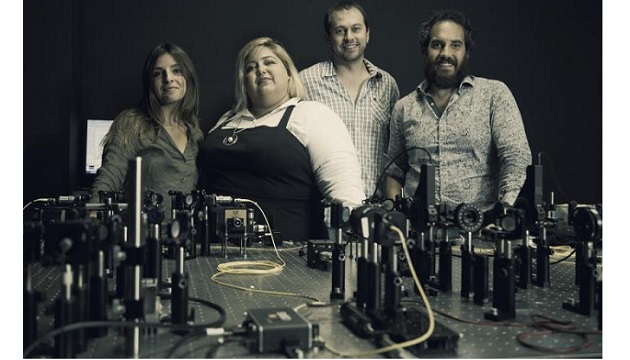
    A research team at Università degli Studi Roma Tre has shown that quantum light can be used to track enzyme reactions in real time. The researchers developed a setup that allowed them to control the light at the level of a single photon. This made it possible to use low illumination without disrupting the enzymes, with the potential to achieve improved sensitivity. The capability to address the sample directly allowed dynamic tracking with higher resolution.

    The researchers used their new technique to track changes in the chirality of a sucrose solution due to activity of an enzyme known as invertase. Tracking the chirality — the ability of a given molecule to rotate the polarization of light — provides information that can be used to determine how many molecules of sucrose have been processed by the enzymes. Control of the probe at the quantum level demonstrated the potential for reducing invasiveness while optimizing sensitivity at the same time.


    “This work is just one example of what quantum sensors could do,” research team leader Ilaria Gianani said. “Quantum sensors could be used to optimally use light for countless applications, including biological imaging, magnetic field sensing, and even detection of gravitational waves.”

    “Key to our success was a collaboration between quantum physicists, who know how to deal with photons, and biologists, who know how to deal with biological systems,” Gianani said. “This collaboration wouldn’t have been possible without the supervision of professor M. Barbieri, principal investigator of the Quantum Optics Group.”

    The researchers said there are some technological aspects to address before their approach could be applied to the tracking of enzymatic reactions. For example, light losses are a strong limiting factor, but the team hopes that its work will help spur technology development that could address this problem. This preliminary effort, bringing together methods of quantum physics and biology, could be a step toward the full development of quantum sensors for biological systems.

    ELE Times Research Desk
    ELE Times Research Deskhttps://www.eletimes.ai
    ELE Times provides a comprehensive global coverage of Electronics, Technology and the Market. In addition to providing in depth articles, ELE Times attracts the industry’s largest, qualified and highly engaged audiences, who appreciate our timely, relevant content and popular formats. ELE Times helps you build awareness, drive traffic, communicate your offerings to right audience, generate leads and sell your products better.

    Related News

    Must Read

    Global Semiconductor Revenue Grew 21% in 2025, reports Gartner

    Worldwide semiconductor revenue totalled $793 billion in 2025, an...

    India aims to be among the major semiconductor hubs by 2032, says Union Minister Ashwini Vaishnaw

    India has joined the global race to manufacture semiconductor...

    AI Glasses: Ushering in the Next Generation of Advanced Wearable Technology

    Courtesy: NXP Semiconductors   AI integration into wearable technology is...

    The semiconductor technology shaping the autonomous driving experience

    Courtesy: Texas Instruments Last summer in Italy, I held...

    The electronics Industry in 2026 and Beyond: A Strategic Crossroads

    As we stand on the threshold of 2026, the...

    Keysight & Samsung: Industry-First NR-NTN S-Band & Satellite Mobility Success

    Keysight Technologies announced a groundbreaking end-to-end live new radio non-terrestrial...

    Quantum Technology 2.0: Road to Transformation

    Courtesy: Rhode & Schwarz After more than 100 years of...

    Develop Highly Efficient X-in-1 Integrated Systems for EVs

    Courtesy: Renesas The recent tightening of CO2 emission regulations has...

    Cadence to deliver pre-validated chiplet solutions to Accelerate Chiplet Time to Market

    Cadence announced a Chiplet Spec-to-Packaged Parts ecosystem to reduce...

