

Author: STMicroelectronics
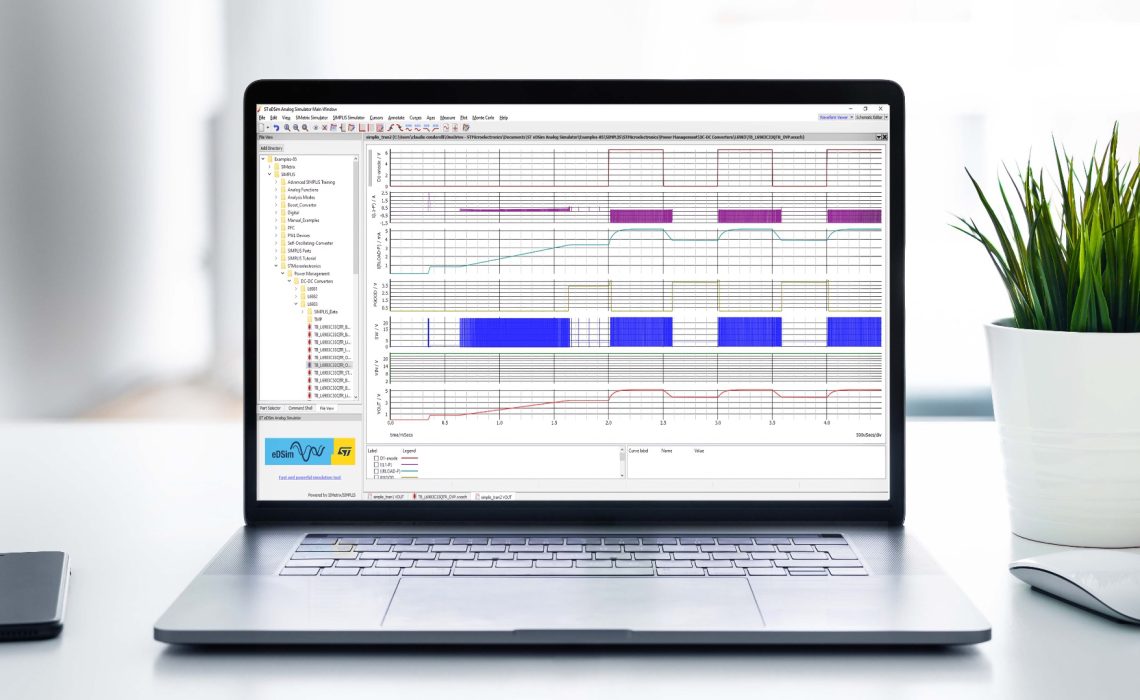
eDSim is our latest simulation tool for switched-mode power supplies (SMPS) and other power analog circuits. The tool runs on the SIMPLIS/SIMetrix engine, is available to download for free on our website, and is governed by a free-to-use commercial license. In a nutshell, our eDSim models are exempt from node limit count, thus enabling engineers to utilize them without restrictions on the number of nodes or circuit size. We even worked on a workflow that allows users to export a design out of eDesignSuite and into eDSim to help them run more detailed simulations faster. ST is also working on an online version of eDSim to optimize further the experience of designing and simulating a circuit.



Why did we decide to work on this?
The challenges behind designing power circuits
Power circuits are notoriously difficult to design because of their inherent complexity. Engineers must account for a specific load and how the overall circuit responds when there are sudden shifts in the line voltage or the load current due to spikes or low loads. In the case of an SMPS, teams must ensure that cycles are consistent, meaning that no significant fluctuations disrupt voltage regulations. It’s also critical to examine how the circuit performs under regular operations to determine the overall quality of the design. Is the ramp-up, when the input voltage is first applied, smooth, or is there a massive under- or over-shoot, among other issues?
The necessity of running simulations

Until simulations came along, the only way for engineers to test their power circuit was to design a PCB layout, manufacture it, and then physically try it in their lab. The obvious problem is that the process is slow and extremely expensive. Furthermore, because power calculations are often based on differential equations, complex models, and matrix computations1, teams may spot a problem but may not have an obvious solution to it, requiring even costlier trial-and-error operations. Hence, simulators are an essential tool when designing a power circuit. Unfortunately, licenses can be expensive, and knowing what software to use isn’t always obvious. Consequently, we tackled this problem so our partners wouldn’t have to.
Why did we invest so much time and money into eDSim?
10x to 50x faster
In essence, eDSim takes the SIMPLIS/SIMetrix engine and runs it on ST components and models. Why choose this engine? According to our benchmarks, simulating a synchronous step-down converter based on our L6983 would take between 10 minutes and 50 minutes on OrCAD PSpice, but only one minute or less on eDSim, thanks to its SIMPLIS/SIMetrix implementation. OrCAD PSpice takes a general-purpose approach to circuit simulation, which explains why it is very popular in many other instances. On the other hand, SIMPLIS/SIMetrix specializes in the types of calculations that are essential when simulating a power stage, which is why it can be 10 to 50 times faster at modeling a switching circuit.
A useful license for the ST community
ST worked with SIMPLIS Technologies to ensure we could provide professional engineers with one of the most flexible licenses. For instance, working with one of our models doesn’t contribute to the eDSim node count or circuit size limit, regardless of its complexity. A brief overview eDSim will reveal that we have tens of models for SMPS and analog ICs. We are also in the process of extending the coverage with power discrete and other smart power devices in future releases.
How to get started?
eDSim is a testament to our desire to create more accessible solutions and bridge digital divides. By working with SIMPLIS Technologies to offer our utility for free, any engineer can build a power circuit and learn from one of the most powerful simulators in the industry. All it takes is to download eDSim from ST.com. Additionally, to increase accessibility even further, we are happy to announce that we are working on an online version of eDSim and will update this blog post when it becomes available. In the meantime, we published the videos below to show how to get started, and we are also offering an example application built on the L6983.

