

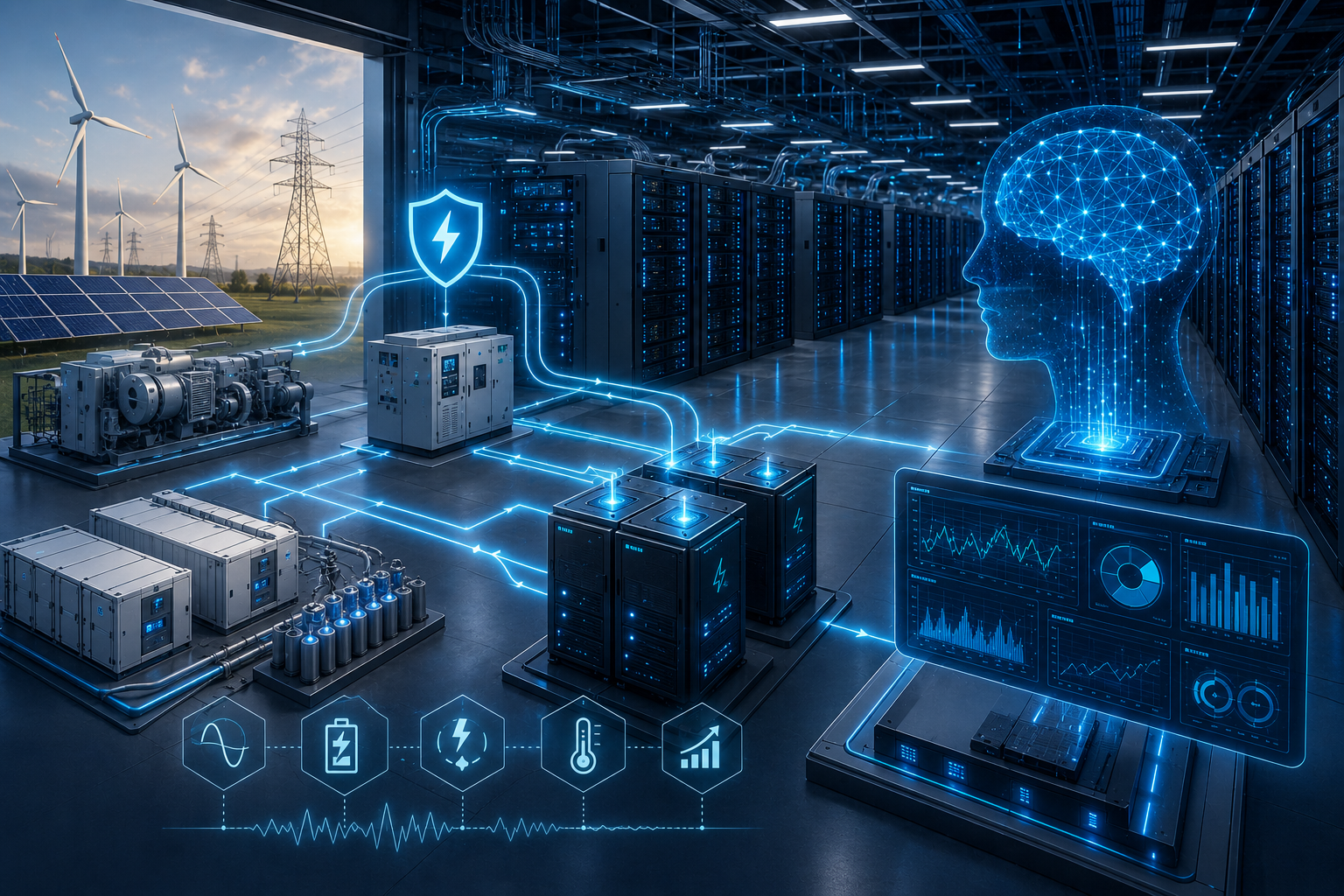
Introduction: When Power Defines the Limits of AI
As artificial intelligence expands across industries, the focus has shifted from just computing performance. Now, power systems under high-density AI infrastructure are the main constraint. Modern data centres with accelerator-rich clusters have intense and highly variable power demands.



When thousands of processing units ramp up at once, even millisecond-scale fluctuations in power delivery can ripple across racks, affecting performance and system stability. In such environments, power is not just a utility; it is a key determinant of operational reliability and scalability.
This shift is transforming data centre engineering. Jensen Huang says, “AI data centres are fundamentally different; they require new architectures for computing, networking, and power.” Power system transformation now drives the next generation of AI workloads.
The Evolving Power Profile of AI Workloads
AI workloads create distinct electrical behaviour compared to traditional enterprise applications. They rely on synchronised processing, with multiple accelerators running in parallel and quickly shifting between low and peak utilisation. These shifts cause sharp transient loads that immediately stress the power delivery network.
From an engineering standpoint, this poses two challenges. Infrastructure must deliver sustained power throughout training cycles and respond instantly to fluctuations while maintaining stable voltage. These demands set strict requirements for the entire power chain, from facility-level supply to board-level voltage regulators.
Power delivery now focuses on responsiveness, stability, and coordination, not just capacity.
Core Challenges in Maintaining Power Stability
A key challenge is managing transient load response. When multiple accelerators increase power draw simultaneously, the system must maintain stable voltage levels despite demand spikes. Any delay or inefficiency in response can cause voltage droop, affecting performance and stressing electrical components.
High-density deployment is also a major issue. AI-focused racks concentrate large power demand in tight physical spaces, making power distribution more complex. This concentration increases reliance on efficient conversion stages and highlights inefficiencies in traditional power architecture. Workload variability complicates the scenario. Training workloads, which involve running machine learning models to improve their performance, sustain high power consumption over long periods. Inference workloads, which use trained models to make predictions or classifications, create intermittent, bursty demand. At scale, these differences produce unpredictable aggregate loads that challenge conventional provisioning.
Overlaying these challenges is the tight coupling between power and thermal behaviour. As power increases, heat rises. This raises cooling requirements. This interdependency forms a feedback loop. Inefficiencies in one domain amplify stress in the other, so coordinated design is essential.
When Power Instability Becomes System Risk
In AI-driven environments, power instability does not remain localized; it propagates through the system, often with compounding effects. Even minor inconsistencies in power delivery can trigger a chain of operational issues, including:
- Accelerator throttling, reducing computational efficiency
- Node-level interruptions that disrupt distributed workloads
- Thermal stress escalation, impacting hardware reliability
- Increased overhead in workload redistribution and recovery
Such events may not always lead to immediate failure, but they degrade system performance and resilience over time. This makes it clear that power stability must be engineered proactively, rather than treated as an afterthought.
Engineering Approaches to Strengthen Power Stability
Addressing these challenges requires a shift to integrated, system-level engineering. The transformation begins with redesigning power-delivery architectures. Modern systems are optimised to improve transient response and maintain stable voltage levels under rapidly changing load conditions. Enhanced conversion efficiency and improved distribution reduce losses and maintain consistency.
Real-time monitoring and adaptive control are just as vital. By continuously tracking power use across nodes and racks, data centres can spot anomalies early and automatically adjust power allocation. This makes power management a dynamic, intelligent system rather than a static provisioning task.
Another critical advancement lies in workload-aware orchestration. Rather than treating compute demand as separate from infrastructure constraints, modern systems align workload scheduling with power availability. Distributing tasks more intelligently and avoiding synchronised demand peaks helps operators maintain a balanced, stable power profile.
To manage upstream variability, data centres are adding energy buffering solutions. Short-term storage helps absorb sudden spikes and smooth out power fluctuations. This decouples compute demand from instant grid changes, improving resilience and ensuring continuity during disturbances.
At a broader level, the integration of hardware and software design is becoming indispensable. Accelerators are being optimised for energy efficiency, while orchestration layers increasingly incorporate power-awareness into scheduling decisions. As Satya Nadella has emphasised, “Every layer of the computing stack must evolve to meet the demands of AI.” Power infrastructure is now a critical part of this evolution.
Power as a First-Class Resource
A defining shift in AI data centre design is recognising power as a first-class system resource, equal to compute and memory. This view requires coordinated management of compute clusters, networking, cooling systems, and energy delivery.
By treating power as a shared and dynamic resource, operators can optimise utilisation, reduce localised stress points, and improve overall system efficiency. This integrated approach represents a departure from traditional designs, in which power was often treated as a fixed constraint rather than an actively managed variable.
Industry Direction: Scaling Within Constraints
As organizations expand AI infrastructure, a clear divergence is emerging. Hyperscale operators are investing in purpose-built architectures designed to handle high-density, high-variability workloads. In contrast, many enterprise data centres are adapting existing infrastructure, often encountering limitations in power delivery and cooling capacity.
At the same time, sustainability considerations are becoming increasingly prominent. Energy efficiency is no longer optional—it is a critical factor influencing design decisions. This convergence of performance, reliability, and sustainability is shaping the next phase of data center evolution.
Future Outlook: Toward Autonomous Energy Management
Looking ahead, the future of AI-driven data centres lies in intelligent, self-regulating power systems. These systems will leverage predictive models to anticipate workload-driven demand, dynamically optimize energy distribution, and integrate seamlessly with evolving energy sources. In this emerging paradigm, AI will play a dual role-not only driving demand but also enabling smarter infrastructure management. As Sundar Pichai has noted, “AI will shape the infrastructure that powers it.” This feedback loop will define the trajectory of next-generation data centres.
Conclusion: Power Stability as the True Constraint of AI Growth
AI’s rapid progress brings huge computational power, but also exposes a major limit: delivering stable, efficient, and resilient power at scale. Power instability hurts performance, reliability, hardware life, and operational efficiency.
To meet these challenges, the industry must adopt a holistic approach. This should integrate advanced power delivery architectures, real-time adaptive control, and system-level optimisation. The evolution of AI infrastructure will depend on the effective combination of these elements.
Here, power stability is not just a support; it is the main constraint. The future of AI depends less on speed or scale and more on the reliability of the energy sustaining it.

