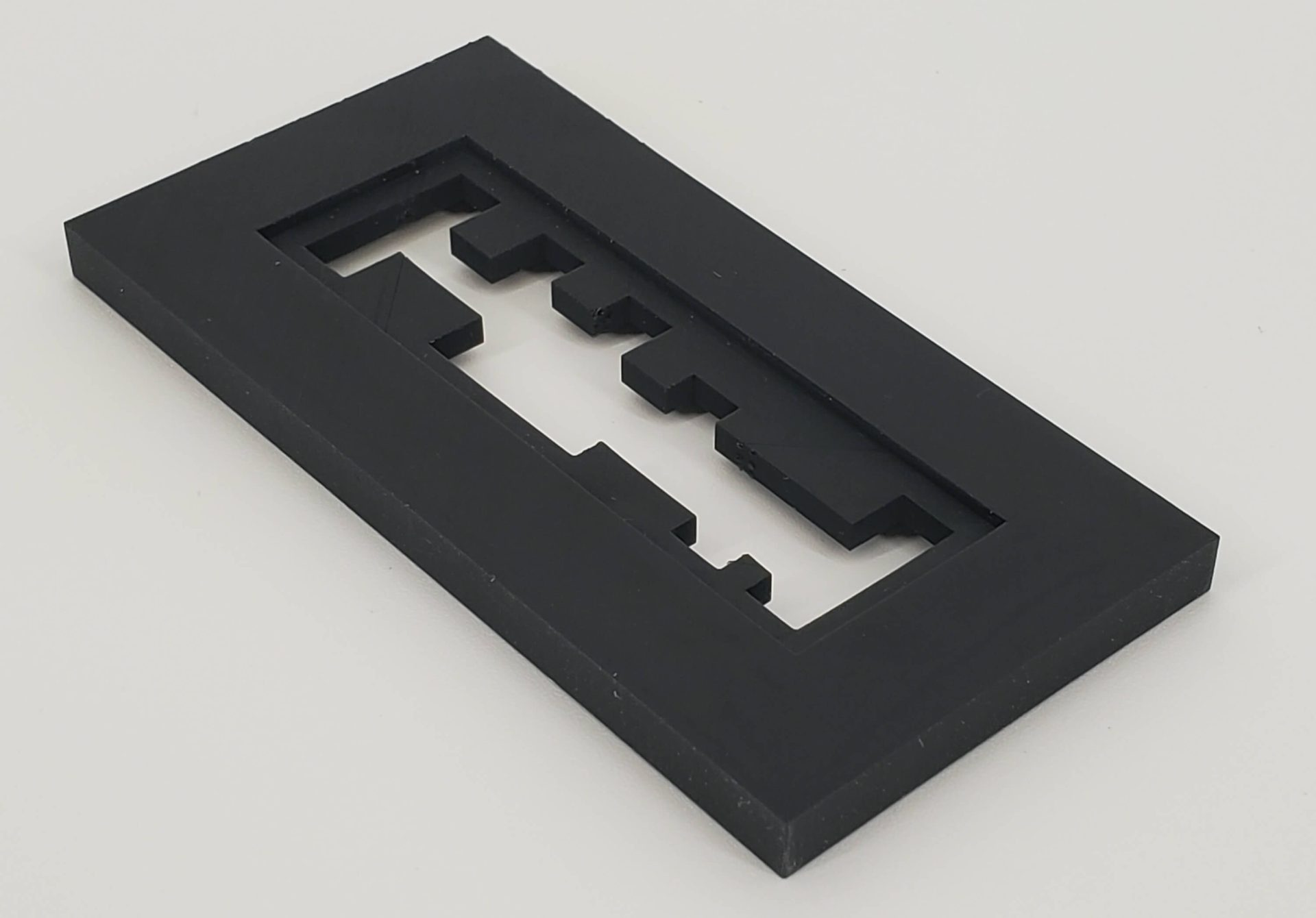
The electronics industry can be more agile when handling bespoke customer requests by using additive manufacturing (AM), commonly known as 3D printing, to fabricate ESD parts to support the reflow process. Mechnano uses AM to help electronic manufacturing service (EMS) providers reduce cycle time, increase throughput, and ensure Nano-Uniform ESD protection. Agility is essential for customer-specific applications that require a variety of non-standard components for low-volume production runs. Customers often request custom carriers/pallets to hold printed wiring assemblies during the reflow process. These carriers must protect today’s micro-electronic components from electrostatic discharge and withstand multiple cycles of a high-temperature wave soldering process (245°C). Using traditional manufacturing technologies for the fabrication of these components can slow down production and increase cost while using the traditional carbon fiber-filled materials in these components does not protect today’s electronics. The challenge is quickly fabricating custom Nano-Uniform ESD components that would withstand numerous thermal cycles.
In one recent case study, Mechnano, in partnership with Tethon3D, developed a new high-
temperature, rigid ESD material to meet this challenge. The resin can be processed on a variety of vat photopolymerization systems (SLA, DLP, LCD). The vat photopolymerization process allows for Quick-Turn part fabrication with ultra-high accuracy, Nano-Uniform ESD, and exceptional surface finish while taking advantage of custom 3D-printable design freedom.