HomeNewsIndia NewsGold Nanorods to become Portable Sensors in Detecting Mercury

    Gold Nanorods to become Portable Sensors in Detecting Mercury

    Mercury is harmful even in small amounts. Detecting it currently requires expensive equipment. Researchers are working on a faster and cheaper alternative: a portable sensor that can perform a rapid analysis in the field. The key is finding something small and accurate enough to do the job.

    For many years, scientists have studied tiny gold nanorods for making smaller mercury sensors. Recently, a team from the Tyndall National Institute based at University College Cork found that individual gold nanorods could be used to detect mercury with high sensitivity, making them a strong contender for portable analysers. The results were published in the journal Science and Technology of Advanced Materials.


    An individual gold nanorod was fixed to a glass slide that was placed under an electron microscope. Using an imaging method called dark-field microscopy, the team studied the composition of the sample by measuring how light scatters off the rod’s surface. A gold nanorod produces a red wavelength pattern, but when it was dipped in a salty solution containing trace levels of mercury, the shape and composition of the rod changed, producing an orange wavelength pattern. The more mercury in the solution, the more the wavelength changed. The nanorods were found to be far more sensitive to mercury than to other metals, including lead, nickel, copper and magnesium.

    “The reported linear correlation and high selectivity make this approach potentially suitable for on-site analysis using a miniaturized portable spectrometer,” the study concluded.

    However, major hurdles remain. The size and shape of gold nanorods vary from rod to rod, significantly throwing off measurements. Manufacturers must improve their fabrication so they are consistent. Also, pre-purification protocols of the rods will be required before real-world analysis can be reliably performed.
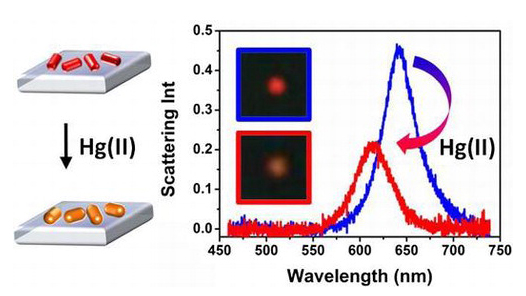
    [Left] Amalgam formation on gold nanorods and [Right] scattering color transition (inset) and associated blue shift of the surface plasmon resonance peak wavelengths (λmax) measured in individual nanorods by dark-field microscopy upon chemical reduction of Hg(II).
    ELE Times Bureau
    ELE Times Bureauhttps://www.eletimes.ai/
    ELE Times provides a comprehensive global coverage of Electronics, Technology and the Market. In addition to providing in depth articles, ELE Times attracts the industry’s largest, qualified and highly engaged audiences, who appreciate our timely, relevant content and popular formats. ELE Times helps you build awareness, drive traffic, communicate your offerings to right audience, generate leads and sell your products better.

    Related News

    Must Read

    From Power Grids to EV Motors: Industry Flags Key Budget 2026 Priorities for India’s Next Growth Phase

    As India approaches Union Budget 2026–27, multiple industrial sectors—from...

    India’s Next Big Concern in the AI Era: Cybersecurity for Budget 2026

    Artificial Intelligence (AI), like any other technology, comes with...

    Anritsu Unveils Visionary 6G Solutions at MWC 2026

    ANRITSU CORPORATION showcases next-generation wireless solutions at MWC 2026...

    CEA-Leti Advances Silicon-Integrated Quantum Cascade Lasers for Mid-Infrared Photonics

    CEA-Leti presented new research at SPIE Photonics West highlighting major...

    How A Real-World Problem Turned Into Research Impact at IIIT-H

    The idea for a low-cost UPS monitoring system at...

    Microchip Expands PolarFire FPGA Smart Embedded Video Ecosystem providing enhanced video connectivity

    Microchip Technology has expanded its PolarFire FPGA smart embedded video ecosystem...

    element14 and Fulham announce global distribution partnership

    element14 has formed a new global distribution partnership with...

    India’ PLI Scheme Brings a Surge of 146% in Electronics Production

    Despite geopolitical tensions, manufacturing in India has done exponentially...