
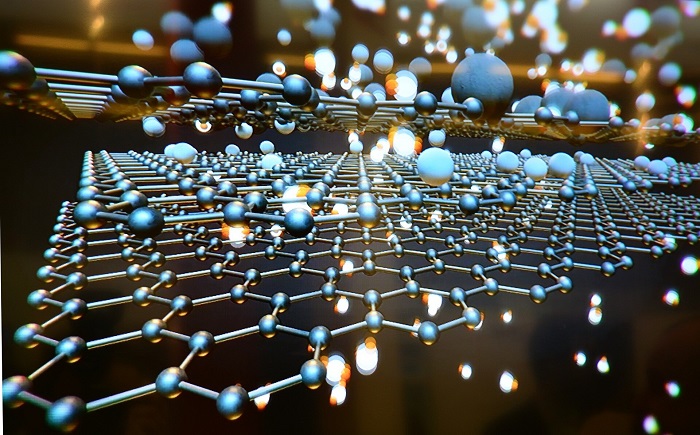
The University of South Florida researchers recently developed a novel approach to mitigating electromigration in nanoscale electronic interconnects that are ubiquitous in state-of-the-art integrated circuits. This was achieved by coating copper metal interconnects with hexagonal boron nitride (hBN), an atomically thin insulating two-dimensional (2-D) material that shares a similar structure as the “wonder material” graphene.
Electromigration is the phenomenon in which an electrical current passing through a conductor causes the atomic-scale erosion of the material, eventually resulting in device failure. Conventional semiconductor technology addresses this challenge by using a barrier or liner material, but this takes up precious space on the wafer that could otherwise be used to pack in more transistors. USF mechanical engineering Assistant Professor Michael Cai Wang’s approach accomplishes this same goal, but with the thinnest possible materials in the world, two-dimensional (2-D) materials.




“This work introduces new opportunities for research into the interfacial interactions between metals and ångström-scale 2-D materials. Improving electronic and semiconductor device performance is just one result of this research. The findings from this study open up new possibilities that can help advance future manufacturing of semiconductors and integrated circuits,” Wang said. “Our novel encapsulation strategy using single-layer hBN as the barrier material enables further scaling of device density and the progression of Moore’s Law.” For reference, a nanometer is 1/60,000 of the thickness of human hair, and an ångström is one-tenth of a nanometer. Manipulating 2-D materials of such thinness requires extreme precision and meticulous handling.
In their recent study published in the journal Advanced Electronic Materials, copper interconnects passivated with a monolayer hBN via a back-end-of-line (BEOL) compatible approach exhibited more than 2500% longer device lifetime and more than 20% higher current density than otherwise identical control devices. This improvement, coupled with the ångström-thinness of hBN compared to conventional barrier/liner materials, allows for further densification of integrated circuits. These findings will help advance device efficiency and decrease energy consumption.
“With the growing demand for electric vehicles and autonomous driving, the demand for more efficient computing has grown exponentially. The promise of higher integrated circuits density and efficiency will enable the development of better ASICs (application-specific integrated circuits) tailored to these emerging clean energy needs,” explained Yunjo Jeong, an alumnus from Wang’s group and first author of the study.
An average modern car has hundreds of microelectronic components, and the significance of these tiny but critical components has been especially highlighted through the recent global chip shortage. Making the design and manufacturing of these integrated circuits more efficient will be key to mitigating possible future disruptions to the supply chain. Wang and his students are now investigating ways to speed up their process to the fab scale.
“Our findings are not limited only to electrical interconnects in semiconductor research. The fact that we were able to achieve such a drastic interconnect device improvement implies that 2-D materials can also be applied to a variety of other scenarios.” Wang added.

