
Courtesy: Synopsys
The transition of PCIe over optical interfaces heralds a breakthrough for low-latency operations. As a key player in the PCI Special Interest Group (PCI-SIG), Synopsys is deeply involved in actively helping develop a new standard. The wheels of change are in motion for the Peripheral Component Interconnect Express (PCIe) standard, with transformative implications for the chip design process.




The PCI-SIG formation of a PCIe Optical Workgroup, announced last August, means that PCIe is set to transcend the practical limitations of copper signaling. The group sees optical, light-based interfaces as integral to the future of PCIe. This shift carries multiple prospective advantages, including expanded ranges and data rates and reduced power requirements.
The Transition to PCIe Over Fiber Optics
The goal is to standardize the implementation of PCIe over fiber optics while keeping the field open to a broad swathe of optical technologies. There is also talk of evolving the card electromechanical (CEM) connector toward an optical-based solution as a means to deliver PCIe.
However, while full ecosystem change will not be instantaneous, we can be sure that it is coming and prepare accordingly. With this in mind, Synopsys has been an active participant in the PCI-SIG Workgroup (as well as the only IP company on the board of directors) and is working with OpenLight Photonics, a leader in integrated silicon photonics technology, to develop tools that will enable a smooth transition.
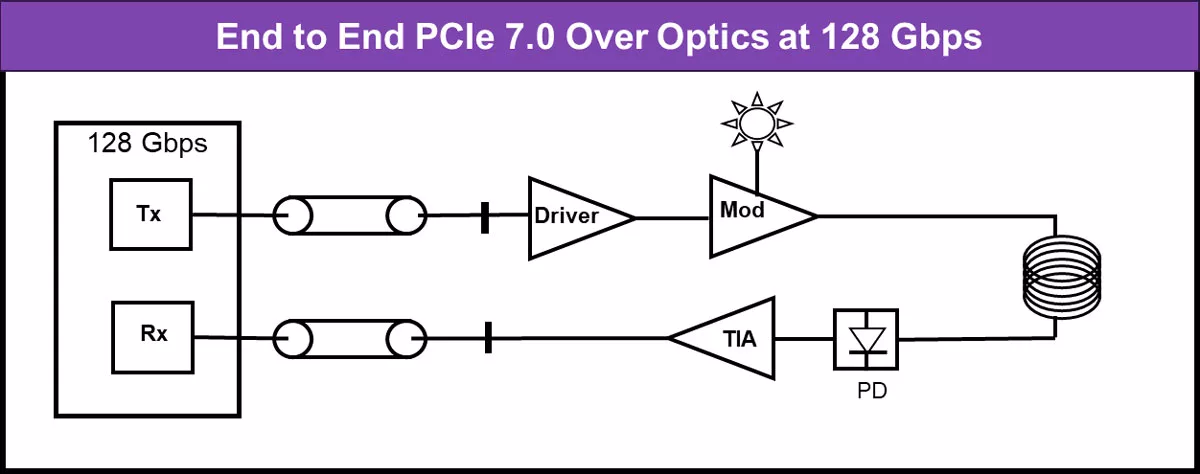
Figure 1: Synopsys PCIe PHY demonstrates non-retimed linear-drive PCIe 7.0 data-rate Electro-Optical-Electro Link
The Benefits and Challenges of PCIe Over Optics
It bears noting that this is not the PCI-SIG’s first foray into this new territory. Calls to draft a proposal for PCIe over optics surfaced almost a decade ago, driven by demand for low-power use cases. However, the case for development was not strong enough back then (even though increased efficiency does stand to reduce the total cost of ownership for data center operators).
Now, however, the promise of low latency that PCIe and Compute Express Link (CXL) offer together is compelling enough to warrant true progress. Reducing latency is a challenge that has dogged the industry for years, as excess latency threatens a system’s throughput.
PCIe over optics doesn’t just represent a low-power option; it can also provide a cache — a coherent way of splitting compute resources between processors and accelerators using an optical link. This breakthrough is likely to prove timely given the proliferation of large language models and requisite training systems, the growing need for unstructured data processing, and the corresponding exponential increase in demand for compute power.
A further advantage for data centers that the low-latency PCIe over optics solution offers is the disaggregation of resources such as central processing units (CPUs) and graphics processing units (GPUs), freeing up memory access that is currently highly localized and often untapped.
PCIe over optics is crucial in enabling connectivity between rack units and enabling them to function as a cluster. PCIe itself serves as a controller — the digital logic that interfaces with a piece of software. One challenge is ensuring the shift to PCIe over optics does not upend the software stack control process.
A bigger challenge lies in managing the physical layer and the interoperability of the electro-optical interface. This is where Synopsys, together with OpenLight, plays a pivotal role by providing an electrical IP solution that can work in conjunction with a photonic one. Once a common standard is set, any photonic die vendor will be in a position to assimilate PCIe.
In an age defined by the activities of supercomputers and hyperscalers as well as data centers, it is clear that PCIe over optics represents the future of signaling. Its development and adoption depend on the enablement of a supportive ecosystem.

