
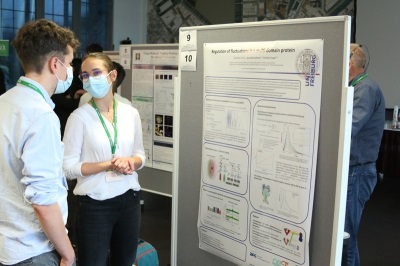
From September 29 to October 1, 2021, PicoQuant organized the 26th International Workshop on “Single Molecule Spectroscopy and Super-resolution Microscopy”; the first on-site meeting in the single-molecule community since the beginning of the COVID-19 pandemic. The workshop gave scientists from 13 different countries the opportunity to finally meet in person for sharing their most recent results in the field of ultrasensitive optical detection down to the single-molecule level and beyond the classical diffraction limit.
It was really exciting to once again see so many members of the single-molecule community and to interact with them in person. Judging from the feedback I got, the participants also greatly enjoyed networking and talking science while being in the same real-world location”, says Rainer Erdmann, Managing Director of PicoQuant.




The scientific program encompassed 70 talks and posters by students and renowned scientists alike. A wide range of topics and techniques were covered, such as MIET, PAINT, or machine learning approaches for image analysis. Among the highlights was a presentation by Viktoria Glembockyte (Ludwig-Maximilians-Universität München, Germany) on using a smartphone camera for detecting single molecules by using nanopillars for amplifying fluorescence or the invited talk by prof. Jennifer Lippincott-Schwarz (Janelia Research Institute, USA) on emerging imaging technologies for studying the architecture, function, and dynamics of cells.
To encourage young researchers to present their work in an international setting, PicoQuant offers a 750 Euro prize for the best talk by a student at the workshop. This year’s prize was split between three winners: Jonas Zähringer (LMU München, Germany) for his presentation on “Exploiting Fluorescence Lifetime in Pulsed Interleaved MINFLUX”, Prithu Roy (Aix Marseille University, France) for his talk about “Label-Free study of Single-Proteins using Deep-UV Plasmonic Horn Antennas”, and Mark Nüesch (University Zurich, Switzerland) for his work on “Enhancing the single-molecule detection of ultrafast biomolecular dynamics with nanophotonics”.

