

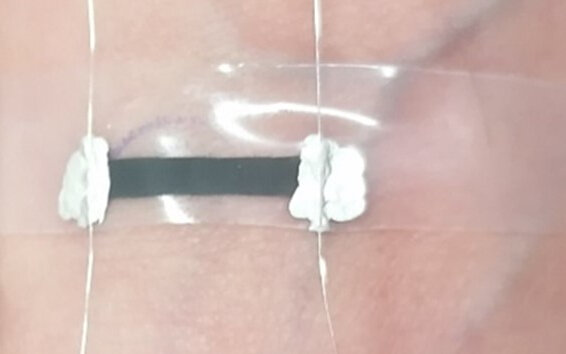
Researchers at Trinity’s School of Physics have developed next-generation, graphene-based sensing technology using their innovative G-Putty material.
The team’s printed sensors are 50 times more sensitive than the industry standard and outperform other comparable nano-enabled sensors in an important metric seen as a game-changer in the industry: flexibility.



Maximizing sensitivity and flexibility without reducing performance makes the teams’ technology an ideal candidate for the emerging areas of wearable electronics and medical diagnostic devices.
The team demonstrated that they can produce a low-cost, printed, graphene nanocomposite strain sensor.
Creating and testing inks of different viscosities (runniness) the team found that they could tailor G-Putty inks according to printing technology and application.
In medical settings, strain sensors are a highly valuable diagnostic tool used to measure changes in mechanical strain such as pulse rate, or the changes in a stroke victim’s ability to swallow. A strain sensor works by detecting this mechanical change and converting it into a proportional electrical signal, thereby acting as a mechanical-electrical converter.
While strain sensors are currently available on the market they are mostly made from metal foil that poses limitations in terms of wearability, versatility, and sensitivity.
The team have previously created nanocomposites of graphene with polymers like those found in rubberbands and silly putty. They have now turned G-putty, our highly malleable graphene blended silly putty, into an ink blend that has excellent mechanical and electrical properties. Their inks have the advantage that they can be turned into a working device using industrial printing methods, from screen printing to aerosol and mechanical deposition.
An additional benefit of the very low-cost system is that it can control a variety of different parameters during the manufacturing process, which gives the ability to tune the sensitivity of the material for specific applications calling for detection of really minute strains.
Current market trends in the global medical device market indicate that this research is well placed within the move to personalized, tuneable, wearable sensors that can easily be incorporated into clothing or worn on the skin.
In 2020 the wearable medical device market was valued at USD $16 billion with expectations for significant growth particularly in remote patient monitoring devices and an increasing focus on fitness and lifestyle monitoring.
The development of these sensors represents a considerable step forward for the area of wearable diagnostic devices—devices that can be printed in custom patterns and comfortably mounted to a patient’s skin to monitor a range of different biological processes.
The team is currently exploring applications to monitor real-time breathing and pulse, joint motion and gait, and early labor in pregnancy. Because their sensors combine high sensitivity, stability, and a large sensing range with the ability to print bespoke patterns onto flexible, wearable substrates, they can tailor the sensor to the application. The methods used to produce these devices are low cost and easily scalable—essential criteria for producing a diagnostic device for wide-scale use.

