
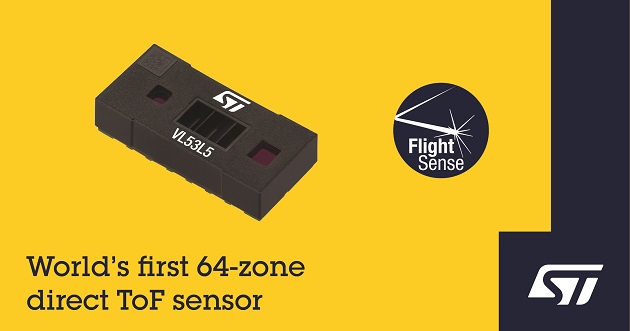
STMicroelectronics (NYSE: STM), a global semiconductor leader serving customers across the spectrum of electronics applications, has extended its portfolio of FlightSense™ Time-of-Flight (ToF) sensors with the world’s first 64-zone device that breaks a scene into separate areas to help an imaging system build the most detailed spatial understanding of a scene.
This first-of-its-kind product comprises a 940nm Vertical Cavity Surface Emission Laser (VCSEL) light source, a System-on-Chip sensor integrating a VCSEL driver, the receiving array of Single Photon Avalanche Diodes(SPADs), and a low-power 32-bit MCU core and accelerator running sophisticated firmware. TheVL53L5 retains the Class 1 certification of all ST’sFlightSensesensors and is fully eye-safe for consumer products.




Housed in a miniature module, the VL53L5 ToFsensor contains optical elements in the receive aperture that creates 64 ranging zones, unlocking a host of new features and use cases.
“The multi-zone VL53L5 FlightSense direct Time-of-Flight sensor uses our most advanced 40nm SPAD production process to offer outstanding 4m ranging performance and up to 64 ranging zones that help an imaging system build a detailed spatial understanding of the scene,” said Eric Aussedat, General Manager of ST’s Imaging Division. “Delivering 64x more ranging zones than previously available, the VL53L5 offers radical performance improvement in laser autofocus, touch-to-focus, presence detection, and gesture interfaces while helping developers create even more innovative imaging applications.”
With a vertically integrated manufacturing model for its FlightSense sensors, ST builds its SPAD wafers on a 40nm proprietary silicon process in the Company’s state-of-the-art 12” wafer plant at Crolles, France before assembling all of the module components in ST’s back-end plants in Asia. This approach delivers exceptional quality and reliability to customers.
Customer development with the VL53L5 can build on ST’s strong relationships with key smartphone and PC platform suppliers as ST has pre-integrated the sensor onto these platforms. Android and Windows device drivers are also widely available for the FlightSense products. The VL53L5 is in mass production with millions of units already shipped to leading wireless and computer manufacturers.
Technical Notes to Editors:
With each new generation, ST’s Time-of-Flight technology has continued to build significant high-value performance improvements across a wide range of use cases including human-presence detection to control the wakeup and hibernation of laptops or monitors and laser autofocus in hybrid focusing algorithms for smartphone cameras. The autofocus feature of ST’s FlightSense sensorsis embedded in most of the highest-ranking smartphone cameras according to DXOMARK, an independent benchmark that assesses image quality.
The camera subsystem is a major factor in differentiating smartphone performance, and, within the camera, the laser autofocus assures quick, accurate focusing in low-light scenes or when capturing low-contrast targets. These scenarios present tough challenges for conventional autofocus systems but are no problem for ST’s sensors. Widely adopted by leading smartphone OEMs, laser autofocus embedding ST’s FlightSense is now shipping in more than 150 phone models.
Packaged in a 6.4 x 3.0 x 1.5 mm module, the VL53L5 integrates both transmit and receive lenses into the module design and expands the Field of View (FoV) of the module to 61-degrees diagonal. This wide FoV is especially suited to detect off-center objects and ensure perfect autofocus in the corners of the image. In the ‘Laser Autofocus’ use case, the VL53L5 gathers ranging data from up-to 64 zones across the full FoV to support “Touch to Focus” and many other features. This flexibility significantly enhances smartphone/camera performance, convenience, and versatility.
Further flexibility is available via the SPAD array, which can be set to favor spatial resolution, where it outputs all 64 zones at up to 15fps, or to favor maximum ranging distance, where the sensor outputs 4×4/16 zones at a frame rate of 60fps.
ST’s architecture can automatically calibrate each ranging zone and direct Time-of-Flight technology allows each zone to detect multiple targets and reject reflection from the cover-glass. In addition, the FlightSense approach gathers the raw data collected by the SPAD array and performs post processing, via a proprietary, embedded MCU and accelerator before transferring the ranging data to the system host over an I2C or a SPI bus. This removes the need for a specific camera interface and powerful receiver MCU and assures high-quality, high-performance operation.
For further, go to www.st.com

