
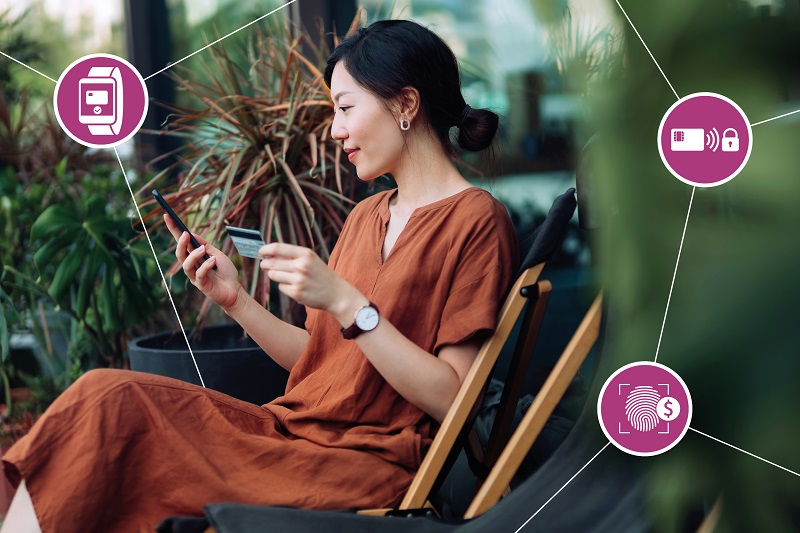
Mobile and contactless payments, digital wallets and biometrics: future topics from a few years ago have now become part of our everyday lives. But how will we pay in the future? Will cash and banking cards disappear from our lives? And how will this change our daily lives?
On the occasion of the consumer electronics show IFA 2022 in Berlin, Germany, Infineon Technologies AG presents the most important trends for the future of payments: digital wallets and payments through connected devices in the Internet of Things, as well as biometrics. As the long-standing market leader in digital security and payments, Infineon offers the industry’s broadest portfolio of security chips available in innovative, easy-to-integrate and highly scalable delivery forms. With the SECORA Pay and SECORA Connect product families, Infineon expanded the reach of its core technology to application-specific full system solutions based on hardware and software enabling trusted, convenient and secured payments.




“Users expect reliable and convenient payment methods that fit their everyday life,” says Ioannis Kabitoglou, head of Infineon’s Digital Security & Identity product segment. One in two bank cards uses a microchip from Infineon. Looking to the future, Kabitoglou adds: “We want to make digital payments via connected devices accessible to as many people and businesses as possible worldwide. Ease of use and security go hand in hand.”
Biometrics for simple, convenient and fast payments
Today, around 82 per cent of retail payments worldwide are contactless – either traditionally by bank card, via smartphone or by wearable electronics such as watches and rings. They make payment faster, easier and – especially in times of pandemic – also more hygienic.
Contactless payments have already become standard today, and cards with integrated fingerprint sensors for authorization are emerging. As early as 2024, 60 million such bank cards with biometric authorization including a built-in biometric sensor are expected to be in circulation.
Yet new biometric authentication methods enable far more possibilities. Just as the Internet has revolutionized our shopping behavior, the Internet of Things (IoT) will bring a whole range of new connected devices that we will use for payment transactions in the future. Biometric authentication will play an important role in securing payments and making them as user-friendly as possible. Today, purchases in cars can already be approved by fingerprint. In future, facial recognition could play a more significant role. And when orders are placed via the smart speaker, the device can also identify the owner’s voice and initiate both order and payment. This allows a seamless user experience.
Digital wallets and connected devices
More than half of retail transactions were conducted online in 2021. Around 48 percent were processed by digital wallets. This opens up simple, convenient payment options for users with their device of choice. Merchants benefit from fast and secured payment processing and low transaction fees.
Not only people, but connected devices will also initiate and process payments in the Internet of Things (IoT) as well. By 2025, there are expected to be around 2.7 billion pay-enabled and connected smart home devices on the market (Juniper Research). Tomorrow’s refrigerator, for example, will be able to order milk or pizza, if the smart speaker hasn’t already done so by voice control – all paid for thanks to an integrated security chip.
IoT payments are also simplifying our everyday lives outside our own homes. For example, more and more charging stations are recognizing the electric car and processing payments automatically (“Plug & Charge”). Moreover, market researchers expect the revenue potential of in-car payments expected to grow to USD 86 billion worldwide by 2025.
Better user experience – new security requirements
While this enables new, convenient shopping experiences, it also increases the requirements for the payment processes. Connected remote payments and the integration of networked devices require not only general device security but also the reliable safeguarding of biometric and private information of the user, the storage and provision of proof of transfer, and the fulfilment of specific legal requirements for two-factor authentication. Data protection, data security and, last but not least, user-friendliness are not mutually exclusive.
Semiconductors from Infineon are at the heart of digital and connected payment solutions
Infineon offers contactless security chips with EMV certification for bank cards, embedded security solutions for connected devices and sensor solutions for recognizing biometric features. They open up new and consumer-friendly possibilities in payment transactions for banks, fintech and card or device manufacturers.
For more information, visit www.infineon.com

