
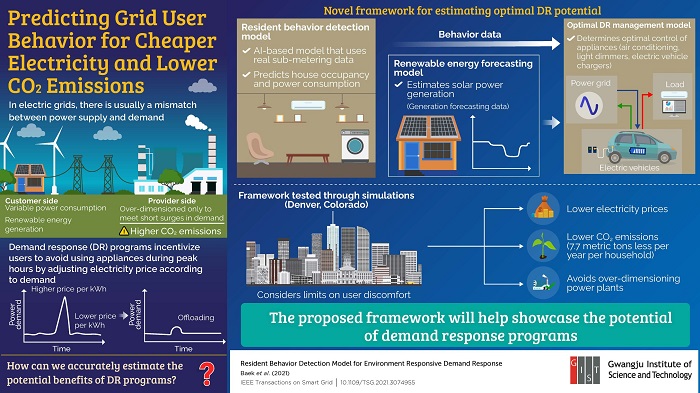
Electrical grids are almost always over-dimensioned to meet short surges in energy demand. Put simply, power stations need to have an excess number of generators only to be able to provide electricity during peak hours. This mismatch between power supply and demand and the inefficient operation of power stations lead to higher carbon dioxide (CO2) emissions. Moreover, distributed energy resources such as rooftop solar panels, which are becoming popular, only increase the supply-demand mismatch.
Fortunately, communication technologies have unlocked a clever strategy to address this problem: Demand response (DR) programs. In this scheme, users are incentivized to use less electricity during peak hours by reducing the electricity price outside of projected peak hours and informing consumers about the prices in advance. Furthermore, they can be integrated with the management of distributed energy resources to take load off the grid whenever necessary.




However, few studies have focused on estimating the potential benefits of DR programs using real-world user behavior data. To this end, a team of scientists from the Gwangju Institute of Science and Technology (GIST) in Korea have developed a novel artificial intelligence (AI)-based approach that analyzes and extracts the behavior of grid users in terms of energy consumption per household. In their paper, describe a data-driven framework that estimates the optimal DR management for each household, taking into account user appliances and behavior patterns as well as the predicted generation of energy from distributed sources.
The researchers tested their model through simulations using data from the real world. “In our simulations, we considered and quantified the level of user discomfort related to the dynamics of home appliances in each household and then used it to estimate the optimal DR potential,” explains Prof. Jinho Kim, who headed the study. The team also calculated the potential contributions of DR programs in terms of reduction in CO2 emissions and the cost of managing coal-powered generators.
Overall, this study showcases how AI can be leveraged to improve our electricity consumption, realizing both lower prices and a smaller carbon footprint. “Our results show that big data-based analysis can be used to convert information about household energy demand into large-scale integrated resources,” highlights Prof. Kim. “We believe this technology can be further expanded to improve the efficiency and coupling of other sectors, including water, heat, gas, and electric vehicles sectors.”

