
HomeNewsIndia NewsX-Men’s Wolverine Inspired Self-Healing Electronics is here

    X-Men’s Wolverine Inspired Self-Healing Electronics is here

    Scientists have developed a new type of material that could be used in the future to create self-healing electronics, such as smartphones, batteries, speakers, robotics, and others.

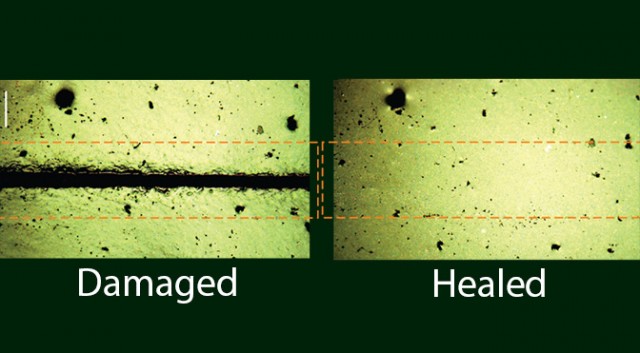
    The new material, which doesn’t have a name as of yet, is transparent, stretches up to 50 times its size, conducts ions to generate current, and stitches itself together in about a day, at room temperature, after being completely torn apart.


    The new material is the work of Ph.D. Chao Wang, from the University of California, Riverside, who’s been working on it for the past two years.

    The material has been called an artifical muscle, albeit is not intended for medical applications. The reason it’s been called this is because it responds and moves to electrical signals, just like a real muscle.

    At the chemical level, this material is a combination between an ionic salt and a stretchable polymer (vinylidene fluoride-co-hexafluoropropylene), which stays together thanks to fluid-like type of bond called an ion-dipole interaction.

    Wang says he started working on this material being inspired by X-Men character Wolverine, wanting to create a self-healing lithium ion battery that could repair itself when dropped and damaged.

    His research advanced as he realized the material is highly transparent and could be used for other purposes, such as a smartphone’s screen.

    In the real world, LG G Flex smartphones come with a self-healing cover that repairs itself from knife attacks, but unlike Wang’s material, it doesn’t conduct electric signals.

    Wang’s research will take this type of material to the next level, allowing manufacturers to employ it for more than covers. Currently, Wang’s team is testing the material in high-humidity environments, wanting to see how water affects the self-repair operations.

    The scientist showed his most recent studies this past week at a meeting of the American Chemical Society.

    ELE Times Bureau
    ELE Times Bureauhttps://www.eletimes.ai/
    ELE Times provides a comprehensive global coverage of Electronics, Technology and the Market. In addition to providing in depth articles, ELE Times attracts the industry’s largest, qualified and highly engaged audiences, who appreciate our timely, relevant content and popular formats. ELE Times helps you build awareness, drive traffic, communicate your offerings to right audience, generate leads and sell your products better.

    Related News

    Must Read

    Top Seven Tech Trends in the semiconductor sector for 2026

    In 2026, a new class of intelligent machines will...

    Keysight launches next-gen Infiniium XR8 Oscilloscopes for faster analysis, clearer insights, and a compact design

     Keysight Technologies introduced its next-generation Infiniium XR8 Real-Time oscilloscopes,...

    R&S showcases its comprehensive embedded systems test solutions at embedded world 2026

    Rohde & Schwarz will present its advanced test and...

    Toxics Link study Finds a Long Road to Circularity in India’s E-waste EPR Model

    A new report by an environmental group, Toxics Link,...

    ESGDS’ AI platform slashes data processing time by 98% with MongoDB Atlas

    ESG Data & Solutions (ESGDS) is a fast-growing Indian...

    Keysight Unveils 3D Interconnect Designer for Chiplet and 3DIC Advanced Package Designs

     Keysight Technologies introduced 3D Interconnect Designer, a new addition to...

    Jodi Shelton, CEO of GSA – Launches A Bit Personal, a New Podcast Offering Rare, Candid Conversations with the Most Powerful Tech Leaders

    Jodi Shelton, Co-Founder and CEO of the Global Semiconductor Alliance and Shelton...

    Is SDV Really an Automotive or Just A Software-based machine That Moves?

    Speaking at the Auto EV Tech Vision Summit 2025,...

    ROHM’s New Compact, Highly Reliable Package Added to Automotive 40V/60V MOSFET Lineup

    ROHM has expanded its lineup of low-voltage (40V/60V) MOSFETs...

