
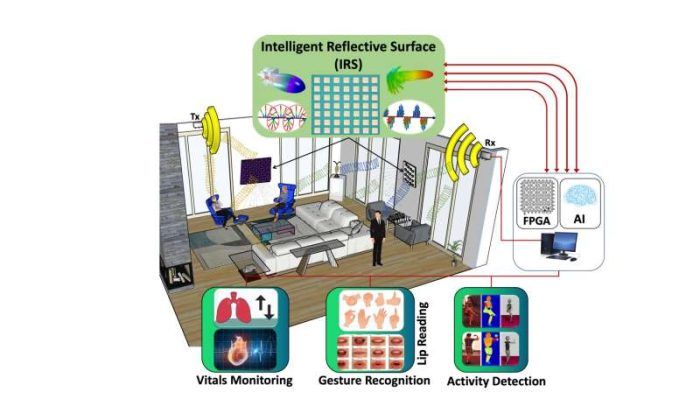
Patient health care strongly relies on in-hospital situations and remote monitoring at home is very challenging. Various human activity recognition systems have been proposed exploiting sensors, cameras, and wearables. However, these techniques raise either privacy concerns or involve the discomfort of carrying wearables all the time. These concerns can be addressed by exploiting a contact-less human activity monitoring system.
One proposed method for remote patient monitoring is wireless channel sensing utilizing radio frequency (RF) devices. This means one must deploy additional active RF devices for patient health care and monitoring at home, which would be a costly solution. An unusual but common solution is to explore the ambient-stray signals which are already present in the environment, e.g., Mobile and/or WiFi signals. Furthermore, the patient or end-user acceptance is an issue if we install additional devices for health monitoring in homes, motivating the need to recycle ambient signals for monitoring.





A team of scientists, led by Dr. Qammer H. Abbasi from the James Watt School of Engineering, University of Glasgow, UK has developed a reconfigurable intelligent surface (RIS) aka—”Intelligent Walls” for controlling the electromagnetic (EM) waves on the physical level and manipulating the propagation path to harness human activity data in a contactless manner.
RIS is typically composed of two layers, the first layer being a metasurface structure composed of tunable, subwavelength unit cell elements with subwavelength spacing, with a second layer accommodating a control and biasing network. Compared to technologies such as phased arrays and relays, a major advantage of employing RIS for EM transformations is their low complexity and passive nature, thereby making the technology easily scalable to cover large surface areas at low manufacturing cost and with minimal power consumption.
Empowered by artificial intelligence (AI), the work aims to offer a paradigm shift in contactless in-home activity monitoring by introducing the RIS to extend the coverage region of an activity monitoring system which can help in tracking and improving resolution by focusing the beam. The sensing capabilities of the RIS-aided activity monitoring system are demonstrated in complex wireless propagation environments where conventional microwave sensing cannot perform well. Namely, sensing around a corner in a corridor junction and sensing across multiple floors.
The developed intelligent wall can be manipulated to steer the beams in various directions. Due to the broader scan angle, activity detection and monitoring can be performed in wide open spaces. The advantage provided by the experimental setup is that activities can be performed in real-time and the beam could be switched to multiple locations allowing patient monitoring in different spaces. The scientists summarize the operational principle of their Intelligent Wall as follows:

