
HomeIndustryPower ElectricalsPowering the Future: How High-Voltage MLCCs Drive Efficiency in Modern Electronics

Powering the Future: How High-Voltage MLCCs Drive Efficiency in Modern Electronics

Courtesy: Murata Electronics

Power electronics is undergoing a profound transformation. Devices are now expected to operate faster, become smaller, and achieve unprecedented levels of efficiency.


To meet these demands, wide-bandgap (WBG) semiconductors, such as silicon carbide (SiC) and gallium nitride (GaN), are increasingly adopted over silicon-based devices. These advanced materials enable significantly higher switching frequencies and increased voltage levels. This reduces system size and boosts power density.
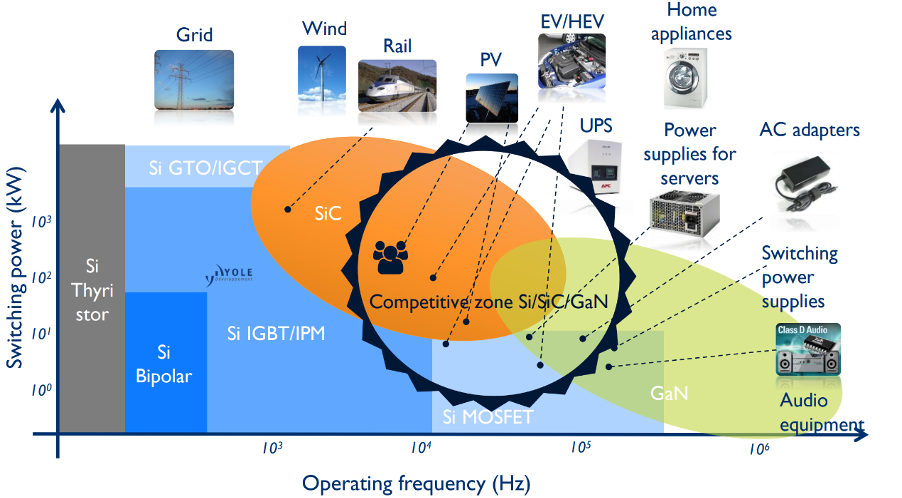
Figure 1: The typical operating frequency and switching power of various semiconductor materials (Source: Yole Group) [see MURA200 for original images]
At the same time, the rapid electrification of transport, industry, and energy infrastructure is driving an unprecedented expansion in power conversion applications. This evolution exposes designers to a far wider spectrum of operating conditions.

Critical Challenges in High-Voltage Systems

These evolving expectations place significant stress not only on active devices but also on the passive components integral to these systems. Higher switching speeds, for instance, lead to sharp voltage transients and electromagnetic interference (EMI). Increased voltages impose strict demands on insulation and overall reliability.

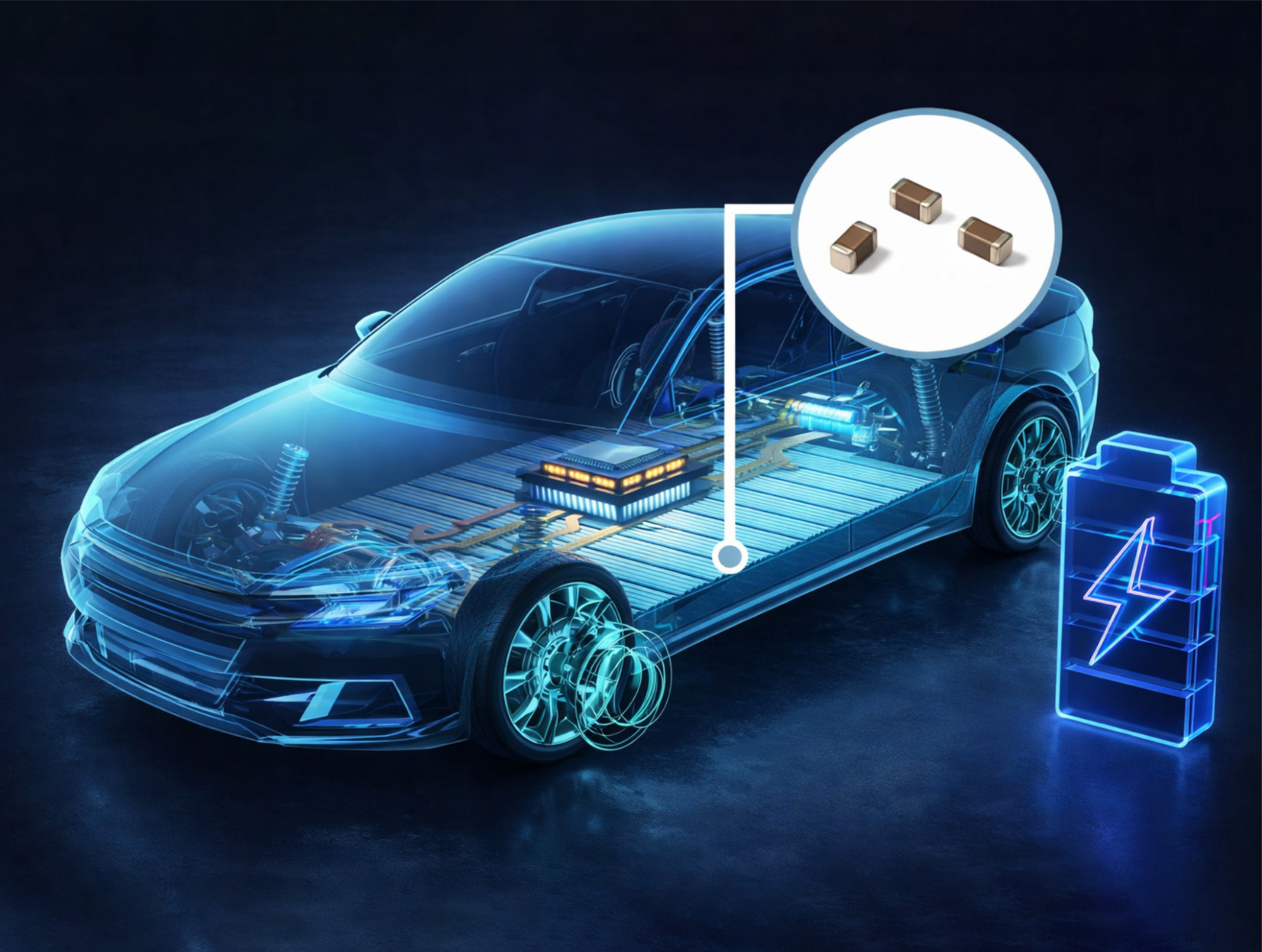
Multilayer ceramic capacitors (MLCCs) play a vital role in suppressing high-frequency noise, absorbing transient spikes, and protecting semiconductor devices from overvoltage stress. Therefore, the advancement of MLCCs must align with the increased performance standards required by WBG devices, necessitating enhancements in dielectric compositions and creative packaging approaches.

Taming Transient Spikes

Snubber capacitors are essential in power electronics, especially where high-speed switching induces voltage overshoot and ringing. This is particularly critical during the turn-off transitions of MOSFETs or IGBTs. This issue is heightened in SiC and GaN power semiconductors, which exhibit greater surge voltages compared to traditional silicon IGBTs.
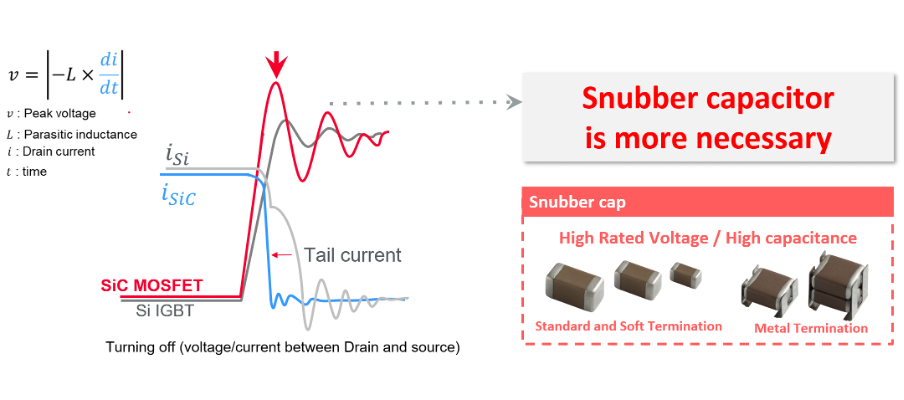
Figure 2: SiC MOSFETs exhibit a higher surge voltage than traditional Si IGBTs (Source: Murata) [see MURA200 for original images]
A well-matched snubber capacitor effectively absorbs transient energy, suppresses peak voltages, and damps oscillations. Murata’s metal-termination MLCCs, such as the KC3 and KC9 series, are optimised for use in SiC-based circuits.

ELE Times Research Desk
ELE Times Research Deskhttps://www.eletimes.ai
ELE Times provides extensive global coverage of Electronics, Technology and the Market. In addition to providing in-depth articles, ELE Times attracts the industry’s largest, qualified and highly engaged audiences, who appreciate our timely, relevant content and popular formats. ELE Times helps you build experience, drive traffic, communicate your contributions to the right audience, generate leads and market your products favourably.

Related News

Must Read

Why Every EV & 5G Phone Could Soon Be Powered by Gujarat

In a move that cements India’s transition from a...

WSCAD ELECTRIX AI Cuts 50% Engineering Effort For Alligator Automations

Alligator Automations India Pvt. Ltd., a manufacturer of end-of-line...

Govt Infuses ₹258 Crore Into 128 Startups to Drive DeepTech and IP Creation

In a major move to solidify India's standing as...

Nuvoton Launches Upgraded Driving Smart Device, NuMicro M3331 Series MCU

As the global transition toward industrial automation and smart...

India’s Electronics Powerplay: Why 2026 Will Lead the Way for the Industry

India's electronics and semiconductor sector is currently experiencing a...

