

Batteries have quietly become the limiting factor of modern technology. They define how far an electric vehicle can go, how safely energy can be stored in a city, how fast systems can charge, and how reliably power can be delivered over years of use. In transport, grids, and electronics alike, progress is no longer constrained by motors or software—it is constrained by electrochemical trade-offs embedded deep inside the cell.
At the heart of those trade-offs sits a deceptively simple question: what are you optimising for? Every battery design balances five variables—energy density, safety, lifetime, cost, and scalability—and no chemistry can maximise all five at once. Push harder on one axis, and something else gives way. This is not a materials problem waiting for a perfect solution; it is an engineering problem that demands choice.



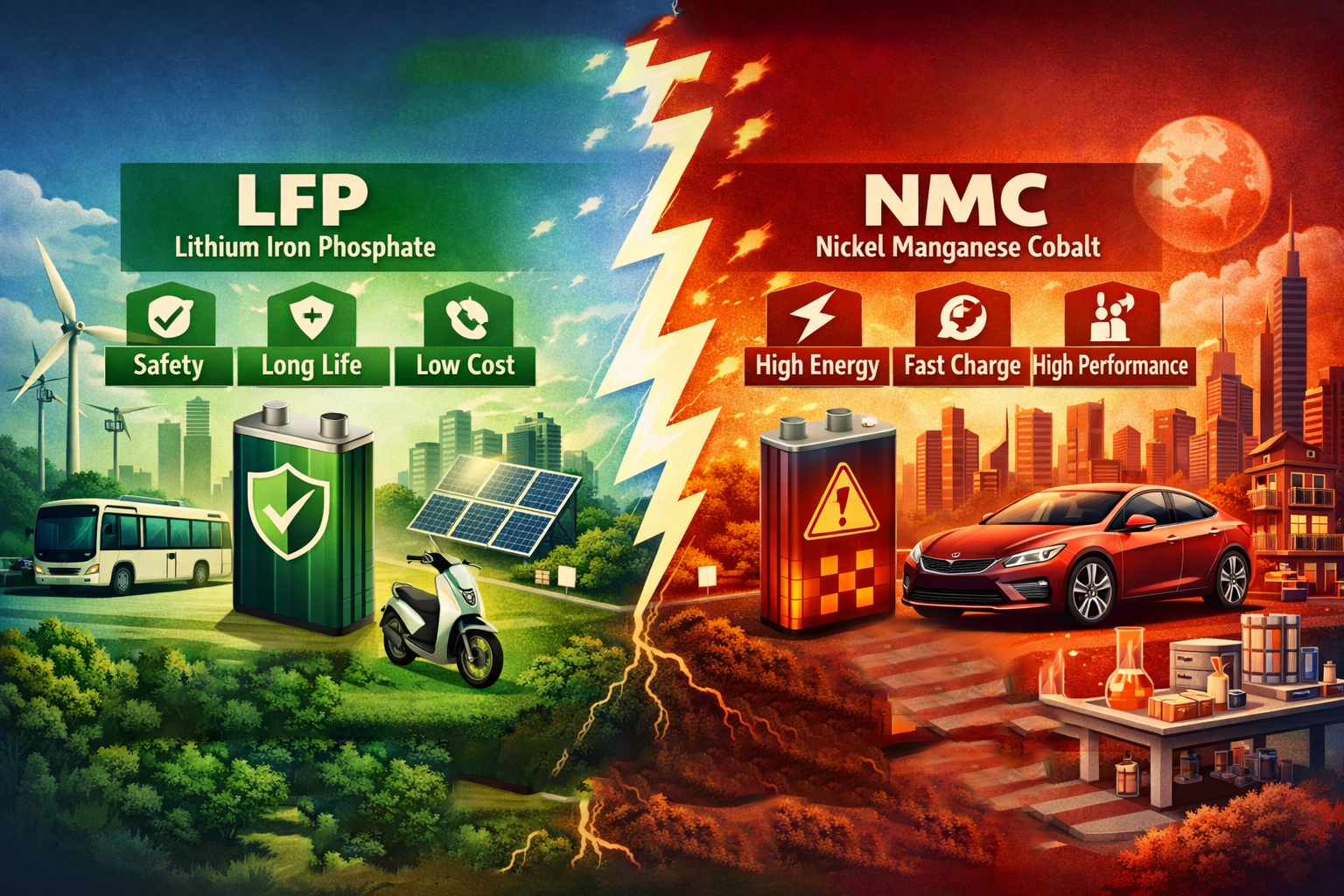
That choice, today, largely resolves into two dominant lithium-ion chemistries: LFP and NMC. They are not incremental variations of the same idea. They represent two fundamentally different engineering philosophies. LFP embeds stability, durability, and cost control into the chemistry itself. NMC extracts higher performance by operating closer to material limits, shifting risk and complexity to system-level design.
For companies such as Amara Raja Advanced Cell Technologies, this divergence is not theoretical. It directly shapes manufacturing strategy, product architecture, and long-term capacity planning. The future is not converging toward one universal battery. It is segmenting.
Engineering First, Chemistry Second
Every battery discussion eventually sounds like a chemistry debate—but the real argument is architectural.
Engineers do not choose LFP or NMC because of crystal diagrams; they choose them based on how each chemistry behaves across five non-negotiable constraints:
- Energy density
- Safety under abuse or fault
- Cycle life and ageing behaviour
- Cost stability and manufacturability
- Scalability across millions of cells
From a manufacturer’s standpoint, these trade-offs extend beyond lab performance. When thermal management, battery management system (BMS) complexity, and warranty risk are considered, the hidden advantages of LFP become system-level advantages.
According to Yi Seop Ahn, Associate Vice President – Centre of Excellence at Amara Raja Advanced Cell Technologies, customers today largely understand LFP’s strengths over NMC:
- Less heat generation, reducing thermal management burden
- Lower degradation at high temperatures
- Reduced BMS complexity due to smaller variation in cell ageing
- Lower warranty risk because of longer intrinsic cycle life
One often underestimated advantage, however, lies in cell sizing. Because LFP carries a lower risk of rupture or explosion compared to NMC, manufacturers can scale cell capacity significantly higher. Larger-format LFP cells reduce the proportion of inactive components within a pack, partially offsetting LFP’s lower gravimetric energy density. In other words, system-level design can compensate for chemistry-level limitations.
Structural Philosophy: Conservative vs Aggressive
At the material level, LFP and NMC reflect opposing design philosophies.
LFP: Structurally Conservative
Its iron–phosphate framework is chemically and mechanically stable. The lattice resists deformation during cycling, tolerates elevated temperatures, and does not readily release oxygen under stress. Stability is intrinsic, not engineered on top.
NMC: Structurally Aggressive
Its layered oxide structure enables higher voltage and energy density, but expands and contracts during cycling. At high states of charge or temperature, structural instability increases. The chemistry delivers more—but demands tighter control.
This difference cascades into real-world outcomes: thermal behaviour, ageing, fast-charging margins, and pack architecture.
India’s Conditions and LFP’s Rise
In India, the expansion of LFP is not accidental—it is contextual.
Yi Seop Ahn notes that most Indian vehicle usage consists of daily commuting and urban mobility rather than sustained high acceleration or long-distance highway driving. In a price-sensitive market, these usage patterns favour a chemistry optimised for durability, cost stability, and safety rather than peak energy density.
Temperature is an even stronger driver. Intrinsically, LFP performs weaker at low temperatures compared to NMC. However, India’s predominantly hot climate turns this limitation into an advantage. LFP cells exhibit lower degradation at high temperatures and require less aggressive cooling strategies. In such environments, LFP becomes a natural fit.
The result is not merely economic preference — but climatic alignment.
Energy Density, Heat, and Ageing
Energy density, thermal behaviour, and lifetime are not separate attributes. They stem from how aggressively a material system is pushed.
NMC achieves higher energy density through higher operating voltage and electrochemically active nickel content. But that gain comes with tighter stability margins and increased reliance on cooling, sensing, and control algorithms.
LFP sacrifices some voltage and gravimetric energy density but maintains wider thermal margins. Ageing remains slower and more predictable due to minimal structural strain during cycling.
From a system-design perspective, LFP reduces the engineering burden outside the cell. NMC shifts complexity upward—into pack design, software controls, and thermal infrastructure.
Innovation Pathways: Chemistry, Cell, and System
While LFP is often described as “mature,” its evolution continues across three parallel layers: chemistry, cell design, and system integration.
Chemistry
Over the past decade, LFP active materials have undergone incremental but meaningful improvements. Manufacturing costs have declined significantly, enabling price competitiveness over NMC. Compaction density has steadily increased through sintering process refinements, with further improvements expected. New chemistries such as LMFP are entering the market, targeting improved cycle life alongside electrolyte advancements.
Cell Architecture
Capacity per cell has expanded dramatically. LFP cells have moved into the 300 Ah range and are advancing toward 400–500 Ah formats. Larger cells reduce inactive material proportion and improve effective pack-level energy density.
System Integration
Innovation is accelerating at the integration layer—moving from module-based packs to cell-to-pack and cell-to-chassis architectures. As integration tightens, chemistry choice increasingly influences vehicle platform design.
All three vectors—chemistry, cell scaling, and system integration—are advancing in parallel rather than sequentially.
The NMC Equation: Performance at a Price
NMC’s performance advantages remain real and strategically important.
Despite requiring more robust and complex pack management, NMC offers:
- Better low-temperature performance
- Higher power output
- Longer-range capability
- Stronger suitability in weight- and space-constrained applications
These characteristics ensure NMC’s continued relevance in premium and performance-oriented platforms.
Moreover, innovation in electrolyte systems—including semi-solid and solid-state approaches—aims to mitigate thermal risks. Pairing high-nickel cathodes and silicon-dominant anodes with safer electrolyte systems and improved thermal insulation could extend high-energy-density solutions into domains currently dominated by LFP.
In that sense, NMC is not static. It is evolving along a different axis.
Platform Standardisation: The Inevitable Split
Looking five to seven years ahead, battery chemistries are unlikely to remain interchangeable components.
Different nominal voltages and operating profiles between LFP and NMC inherently drive platform divergence. NMC’s need for more robust management systems further reinforces chemistry-specific architectures.
While experimental “dual-pack” or “two-heart” systems exist—combining different chemistries in one vehicle—they require discrete BMS systems and add architectural complexity. The broader trend points toward OEMs standardising around chemistry-specific platforms rather than designing neutral battery bays.
This is not convergence. It is structural segmentation.
Two Futures, Not One
LFP and NMC are not competitors in a zero-sum contest. They are solutions optimised for different definitions of performance. LFP embeds safety, longevity, and cost predictability into the chemistry itself—reducing system-level burden and aligning naturally with India’s climate and usage patterns. NMC maximises energy density and performance, accepting tighter operating margins and higher management complexity.
For manufacturers such as Amara Raja Advanced Cell Technologies.

