
By- Shreya Bansal, Sub-Editor
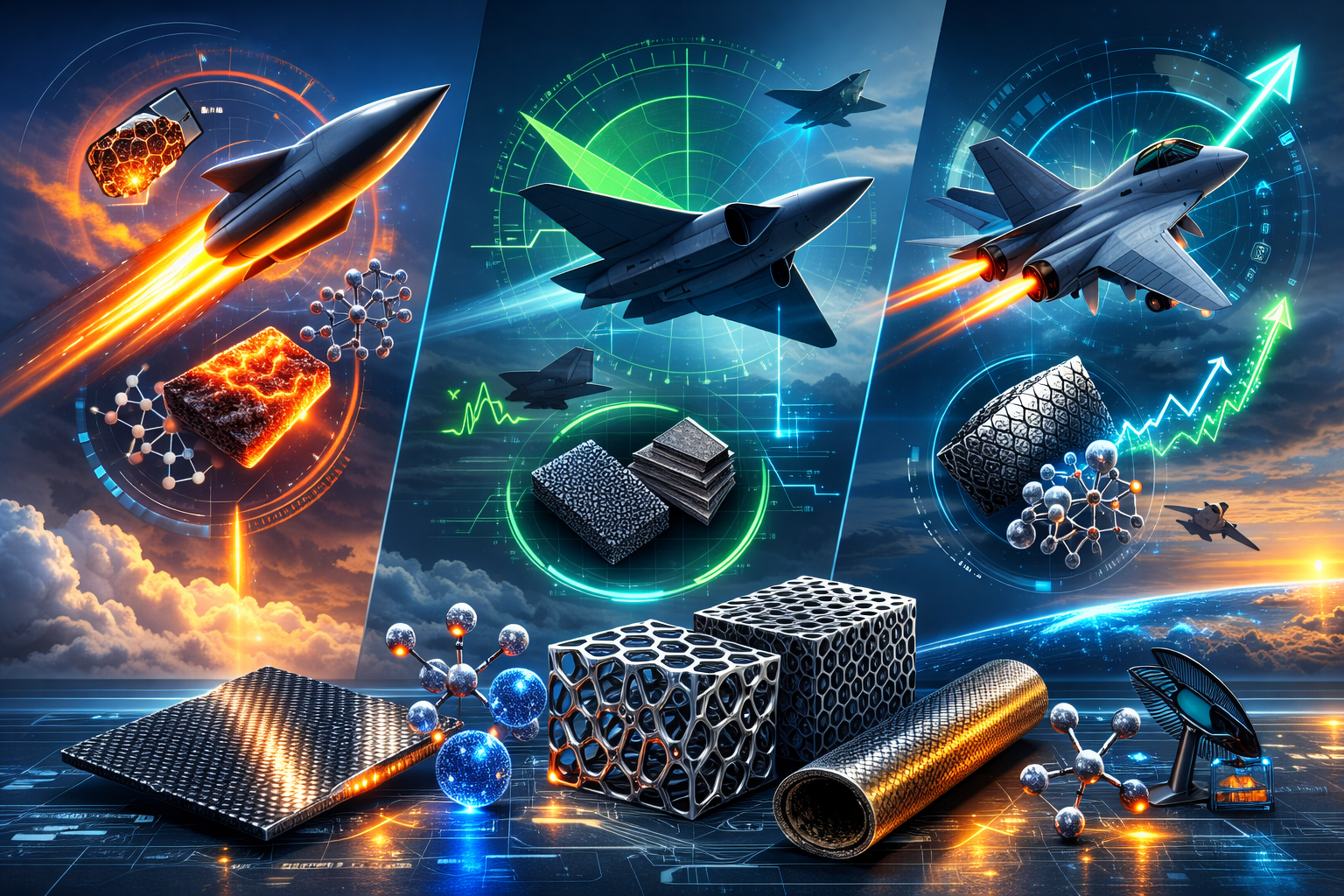
The aerospace and defence sector is undergoing a materials revolution driven by escalating performance demands that conventional alloys and composites can no longer meet. As military and commercial aircraft push toward hypersonic speeds, extended operational ranges, and stealth capabilities, traditional materials face fundamental limitations in thermal tolerance, weight-to-strength ratios, and electromagnetic properties. This article examines the current landscape of advanced materials, including ceramic matrix composites, high-entropy alloys, graphene-enhanced structures, and metamaterials that are displacing legacy materials in critical applications.




The transition isn’t merely about incremental improvement; it represents a paradigm shift in how aerospace components are designed and manufactured. Engineers are abandoning materials that have dominated the industry for decades in favour of solutions that enable previously impossible capabilities: jet engines operating at temperatures that would melt nickel super alloys, airframe structures that self-repair micro-damage, and radar-absorbing surfaces engineered at the molecular level. Through expert interviews with materials scientists and aerospace engineers, this article explores why this transition is happening now, what technical and economic factors are driving adoption, and which materials are positioned to define the next generation of aerospace and defence systems.
The Materials Revolution Redefining Aerospace and Defence
The aerospace and defence sector is undergoing a profound materials transformation. As aircraft and defence systems push toward hypersonic velocities, extended mission endurance, lower radar signatures, and improved fuel efficiency, conventional materials such as aluminium alloys, titanium, and nickel-based superalloys are reaching their performance ceilings.
The next generation of aerospace capability is no longer driven solely by aerodynamics or propulsion; it is increasingly defined by materials science. From ceramic matrix composites (CMCs) that withstand temperatures exceeding traditional alloy limits to high-entropy alloys (HEAs) engineered at the atomic scale, advanced materials are enabling systems once considered technologically unattainable.
Vern Benson, Northrop Grumman Technical Fellow (2026):
“Previous generations of aircraft were mostly made of metal, while newer versions are approximately 50% composite materials, with an even higher percentage for military aircraft… In order to compete with metals, we have to be highly automated in our manufacturing process.”
The Performance Ceiling – Why Traditional Materials Are No Longer Sufficient
For decades, aerospace engineering relied on aluminium alloys, titanium, and nickel-based superalloys as the backbone of structural and propulsion systems. These materials delivered an optimal balance of strength, weight, corrosion resistance, and manufacturability for subsonic and supersonic flight regimes. However, modern mission profiles, ranging from hypersonic vehicles and advanced fighter aircraft to long-endurance unmanned systems, have exposed the inherent limitations of these conventional materials. Aluminium alloys lose strength rapidly at elevated temperatures, titanium becomes cost-prohibitive at scale, and nickel superalloys are approaching their thermal operating thresholds in next-generation turbine engines. As propulsion systems push for higher combustion temperatures to improve efficiency, and as airframes demand lighter structures to extend range and payload capacity, traditional materials no longer provide sufficient performance margins. These realities have shifted material selection from being a secondary design consideration to a primary performance enabler in aerospace and defence programs. Conventional materials, while proven and reliable, were engineered for a different era of performance requirements. Aluminium alloys struggle under extreme thermal loads. Titanium offers strength but at a weight and cost penalty. Nickel superalloys approach thermal limits in advanced jet engines.
Baba Kalyani, Chairman & MD, Bharat Forge (2025):
“At a time of heightened geopolitical and supply-chain uncertainty… the emphasis is firmly on upgrading platforms, systems and technologies… we must emerge as an ‘Innovation driven Economy’ that manufactures and exports best-in-class products.”
Hypersonic systems and next-generation combat aircraft demand materials that can endure sustained extreme heat while maintaining structural integrity. The tipping point for abandoning traditional materials often occurs during thermal modelling or fatigue simulations, where safety margins erode under mission stress scenarios.
Engineers are increasingly identifying material limitations during early-stage digital twin simulations, triggering a search for advanced alternatives before physical prototyping even begins.
Ceramic Matrix Composites and High-Entropy Alloys: From Research to Reality
Advanced materials such as ceramic matrix composites (CMCs) and high-entropy alloys (HEAs) are redefining what aerospace components can endure. CMCs, for example, can withstand temperatures hundreds of degrees higher than conventional superalloys while weighing significantly less. Their integration into turbine shrouds and combustor liners has enabled engines developed by companies such as GE Aerospace to operate at higher efficiencies while reducing cooling requirements. Similarly, HEAs, engineered with multiple principal elements rather than one dominant base metal, exhibit exceptional strength, oxidation resistance, and thermal stability. These materials are transitioning from laboratory experimentation to production-grade deployment, driven by advances in additive manufacturing and precision powder metallurgy. What was once considered experimental is now becoming operational, marking a fundamental shift in aerospace material qualification and deployment timelines.
Five years ago, advanced materials comprised a niche percentage of aerospace structural systems. Today, in next-generation engines and airframes, they are becoming integral rather than experimental.
Lifecycle Economics: Justifying Advanced Material Investment
While advanced materials often command higher upfront costs, their value becomes evident when evaluated over the full lifecycle of an aerospace platform. Lighter airframes reduce fuel consumption, directly lowering operational expenditures and emissions. Higher-temperature engine materials increase thermodynamic efficiency and reduce maintenance frequency. Extended component durability minimises downtime and replacement cycles, factors critical for both commercial airlines and military operators. Leaders at organisations such as RTX Corporation have emphasised that procurement decisions are increasingly based on total ownership cost rather than acquisition price alone. Moreover, as production volumes scale and supply chains mature, the cost gap between conventional and advanced materials continues to narrow. When assessed across decades of operational service, advanced materials frequently offer compelling economic advantages despite their initial premium.
Fuel savings, extended maintenance intervals, and enhanced durability can offset initial procurement premiums.
Yet supply chain maturity remains a gating factor. Dependency on rare earth elements, specialised ceramic fibres, or advanced powder metallurgy inputs introduces geopolitical and availability risks.
Government R&D partnerships, particularly in the U.S., Europe, and Asia, have played a critical role in de-risking early-stage adoption by subsidising demonstration programs and pilot manufacturing lines.
Manufacturing Evolution: Scaling Advanced Materials Safely
The adoption of advanced materials requires a parallel transformation in manufacturing methodologies and quality assurance frameworks. Unlike traditional metal alloys that rely on well-established forging and casting processes, materials such as CMCs and ultra-high-temperature ceramics demand specialised fabrication techniques, including fibre weaving, matrix infiltration, and controlled sintering. Additive manufacturing has further expanded possibilities, enabling complex geometries that were previously impossible to machine. However, these innovations introduce new challenges in inspection, certification, and scalability. Companies like Boeing are investing heavily in digital twins, advanced non-destructive evaluation methods, and automated production systems to ensure reliability and repeatability. Successfully integrating advanced materials into flight-ready systems requires not only material innovation but also synchronised advances in manufacturing science, workforce training, and regulatory certification standards.
Dr. G. Satheesh Reddy, Former Chairman, DRDO (2025):
“While precision manufacturing of the stealth airframe is critical, the speciality materials, including RAM (Radar Absorbent Material), have already been developed… Manufacturing the aircraft itself won’t be a challenge if we work entirely from the provided designs and material lists with disciplined scaling.”
CMC production, for instance, requires precision fibre weaving and matrix infiltration processes not used in conventional metallurgy. Quality assurance shifts from visual inspection and ultrasonic testing to advanced microstructural evaluation.
Organisations must also retrain engineers and technicians in new fabrication techniques, creating workforce transition challenges alongside technological ones.
Strategic and Geopolitical Implications of Materials Leadership
In aerospace and defence, materials innovation is no longer purely a technical matter; it is a strategic asset. Advanced composites enable stealth characteristics through radar absorption and electromagnetic manipulation. Ultra-high-temperature ceramics support hypersonic weapon systems capable of withstanding extreme aerodynamic heating. Lightweight structures extend operational reach and payload flexibility, enhancing mission effectiveness. As global competition intensifies, control over critical materials, precursor chemicals, and advanced manufacturing capabilities has become a national security priority. Organisations such as Airbus and major U.S. defence contractors increasingly view materials science as a pillar of competitive differentiation. Nations investing heavily in advanced material research are positioning themselves to define the performance boundaries of next-generation aircraft, spacecraft, and defence platforms.
From a defence perspective, material science leadership is increasingly viewed as a domain of geopolitical competition similar to semiconductors and AI. Control over precursor materials, advanced manufacturing capabilities, and a proprietary composite formulation carries strategic weight.
Dependence on foreign-sourced rare materials or advanced fibres presents vulnerabilities that governments are actively addressing through domestic production incentives.
Looking Ahead – The Next Frontier in Aerospace Materials
Looking ahead, the next frontier in aerospace materials will be shaped by computational design, artificial intelligence, and sustainability imperatives. AI-driven materials discovery platforms can simulate atomic interactions and predict performance characteristics before physical prototypes are fabricated, dramatically accelerating development cycles. At the same time, environmental considerations are becoming central to material selection. Recyclable composites, bio-derived resins, and low-emission manufacturing processes are gaining traction as aerospace companies commit to long-term decarbonization goals. Future “smart materials” may combine self-healing properties, adaptive electromagnetic behaviour, and extreme thermal resistance within a single multifunctional structure. As aerospace systems grow more complex and mission demands intensify, the integration of digital engineering and advanced materials science will define the trajectory of innovation for decades to come. AI-driven materials discovery platforms now simulate atomic structures and predict performance before physical synthesis, dramatically reducing time-to-certification.
Future “dream materials” would combine:
- Extreme thermal resistance
- Structural strength
- Lightweight properties
- Electromagnetic tunability
- Sustainability
Such materials would enable sustained hypersonic travel, near-zero-emission propulsion systems, and adaptive stealth platforms.

