

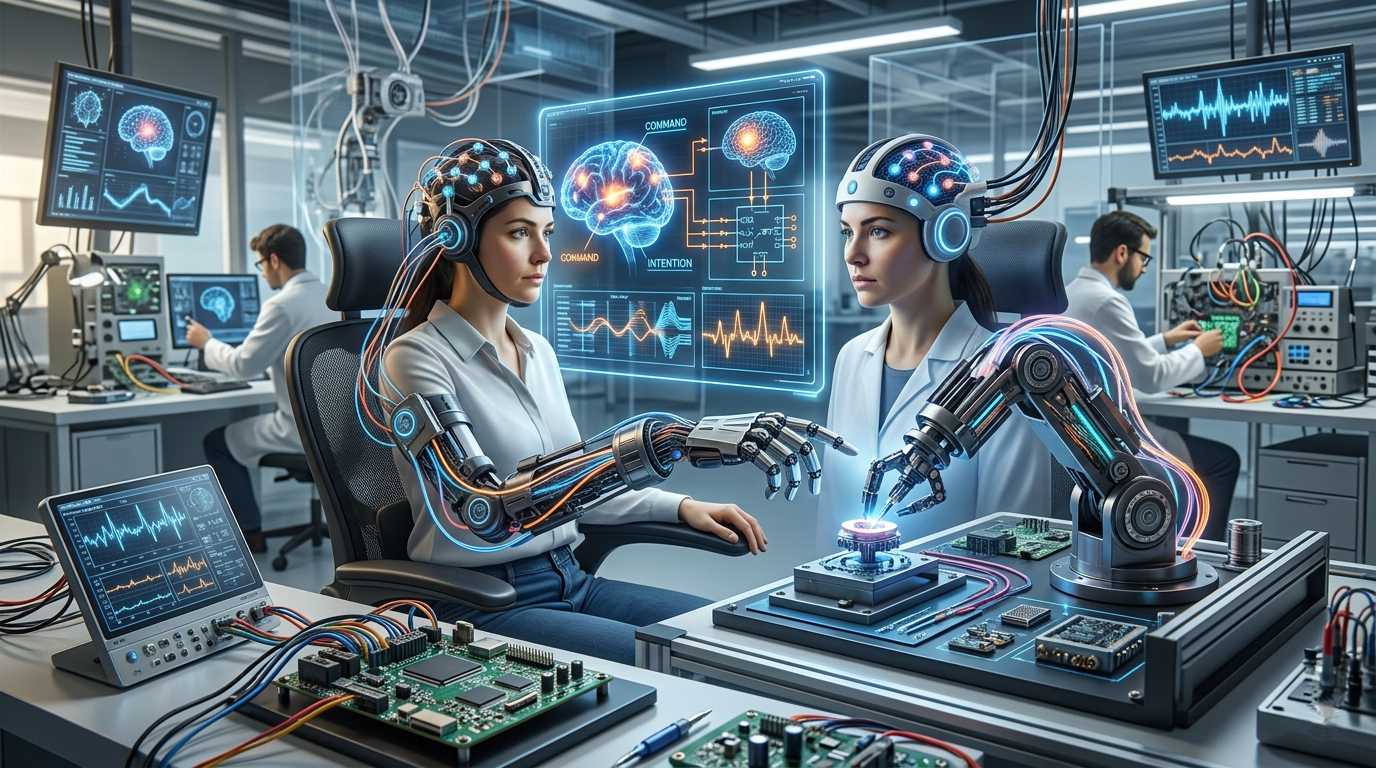
The convergence of neuroscience, electronics, and artificial intelligence is driving one of the most transformative technological revolutions of the 21st century: Brain-Computer Interfaces (BCIs) and neurotechnology. Once confined to science fiction, BCIs are now rapidly evolving into practical systems capable of enabling direct communication between the human brain and external electronic devices. For electronics engineers, this emerging domain offers exciting opportunities in embedded systems, signal processing, flexible electronics, biomedical instrumentation, and AI-driven hardware development.
The Rise of Brain-Computer Interfaces



A Brain-Computer Interface is a system that acquires neural signals, processes them, and translates them into commands for computers, prosthetics, or other electronic systems. Traditional BCIs relied on electroencephalography (EEG), where electrodes placed on the scalp measure brainwave activity. While non-invasive EEG systems remain important for research and healthcare applications, recent advances in high-density electrode arrays and implantable bioelectronics are dramatically improving signal quality and functionality.
Modern BCIs can now interpret neural activity with remarkable precision, enabling paralyzed individuals to control robotic limbs, type text using thought alone, and even regain limited speech capabilities. The integration of machine learning algorithms with neural signal acquisition hardware has accelerated these developments significantly.
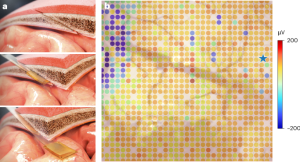
High-resolution brain–computer interface with electrode scalability and minimally invasive surgery
Flexible Bioelectronics: A Game Changer
One of the biggest engineering challenges in neurotechnology has been the mechanical mismatch between rigid electronic devices and soft biological tissues. Conventional silicon-based implants often trigger inflammation or degrade over time due to tissue damage. Flexible bioelectronics are solving this issue.
Flexible neural interfaces are built using biocompatible materials such as polyimide, graphene, conductive polymers, and ultra-thin gold traces. These devices can bend and stretch with brain tissue, reducing long-term damage and improving signal stability. Engineers are also exploring bioresorbable electronics that safely dissolve in the body after completing their function.
For electronics engineers, flexible electronics require innovation in several areas:
- Low-power integrated circuit design
- Stretchable conductive materials
- Miniaturized sensor architectures
- Wireless power transfer systems
- High-speed neural signal amplification
These systems must operate reliably while consuming extremely low power to minimize heat generation near sensitive neural tissue.
High-Density Electrode Arrays and Neural Mapping
High-density electrode arrays are enabling researchers to record thousands of neurons simultaneously. Companies and research institutions are developing microelectrode arrays with unprecedented spatial resolution, allowing detailed mapping of neural activity patterns.
Advanced semiconductor fabrication techniques are making it possible to integrate thousands of microscopic electrodes onto a single chip. These arrays are combined with custom ASICs (Application-Specific Integrated Circuits) for signal amplification, filtering, analog-to-digital conversion, and wireless communication.
The data bandwidth generated by these systems is enormous. A next-generation BCI may process gigabits of neural data every second, creating major opportunities for engineers specializing in:
- Edge AI processing
- FPGA-based neural computing
- Real-time DSP systems
- Wireless telemetry
- Neuromorphic processors
Neuromorphic engineering, inspired by the architecture of the human brain, is becoming particularly important for efficient neural data processing. Unlike conventional processors, neuromorphic chips mimic biological neural networks and consume significantly less power.
Applications Transforming Healthcare
Healthcare remains the most promising application area for BCIs and neurotechnology. Neuroprosthetics are helping amputees control robotic limbs using brain signals with increasing accuracy and natural movement. Cochlear implants and retinal prostheses are restoring sensory functions to patients with hearing and vision impairments.
In neurological diagnostics, implantable neural sensors can monitor epilepsy, Parkinson’s disease, and other disorders in real time. Closed-loop neurostimulation systems can detect abnormal brain activity and automatically deliver corrective electrical stimulation.
Researchers are also investigating memory enhancement, depression treatment, and cognitive rehabilitation through targeted neural stimulation. These advancements depend heavily on reliable biomedical electronics and ultra-low-noise analog front-end design.
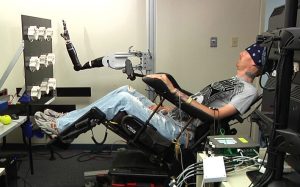
Patient controlling robotic prosthetic arm using BCI technology
Challenges and Ethical Considerations
Despite rapid progress, significant challenges remain. Neural signals are extremely weak and susceptible to noise, requiring sophisticated filtering and signal conditioning techniques. Long-term implant reliability, cybersecurity, and wireless communication safety are also major concerns.
Ethical issues surrounding cognitive enhancement, neural privacy, and brain data ownership are becoming increasingly important. As BCIs evolve from medical devices to consumer technologies, electronics engineers will play a critical role in designing secure and responsible systems.
Power management is another key challenge. Implantable devices require efficient energy harvesting or wireless charging technologies to avoid repeated surgical battery replacement. Advances in ultra-low-power electronics and energy-efficient communication protocols will be essential.
The Future of Neurotechnology
The future of BCIs lies in seamless human-machine integration. Emerging systems may eventually enable direct brain-to-brain communication, immersive virtual reality control, and advanced cognitive augmentation. Artificial intelligence combined with adaptive neural interfaces could create highly personalized neuroprosthetic systems capable of learning and evolving with users.
For electronics engineers, neurotechnology represents a multidisciplinary field where expertise in electronics, embedded systems, materials science, AI, and biomedical engineering converge. As the boundaries between biology and electronics continue to blur, BCIs are poised to become one of the defining technologies of the coming decades.
The era of intelligent bioelectronic systems has begun — and electronics engineers are at the center of this technological transformation.

