

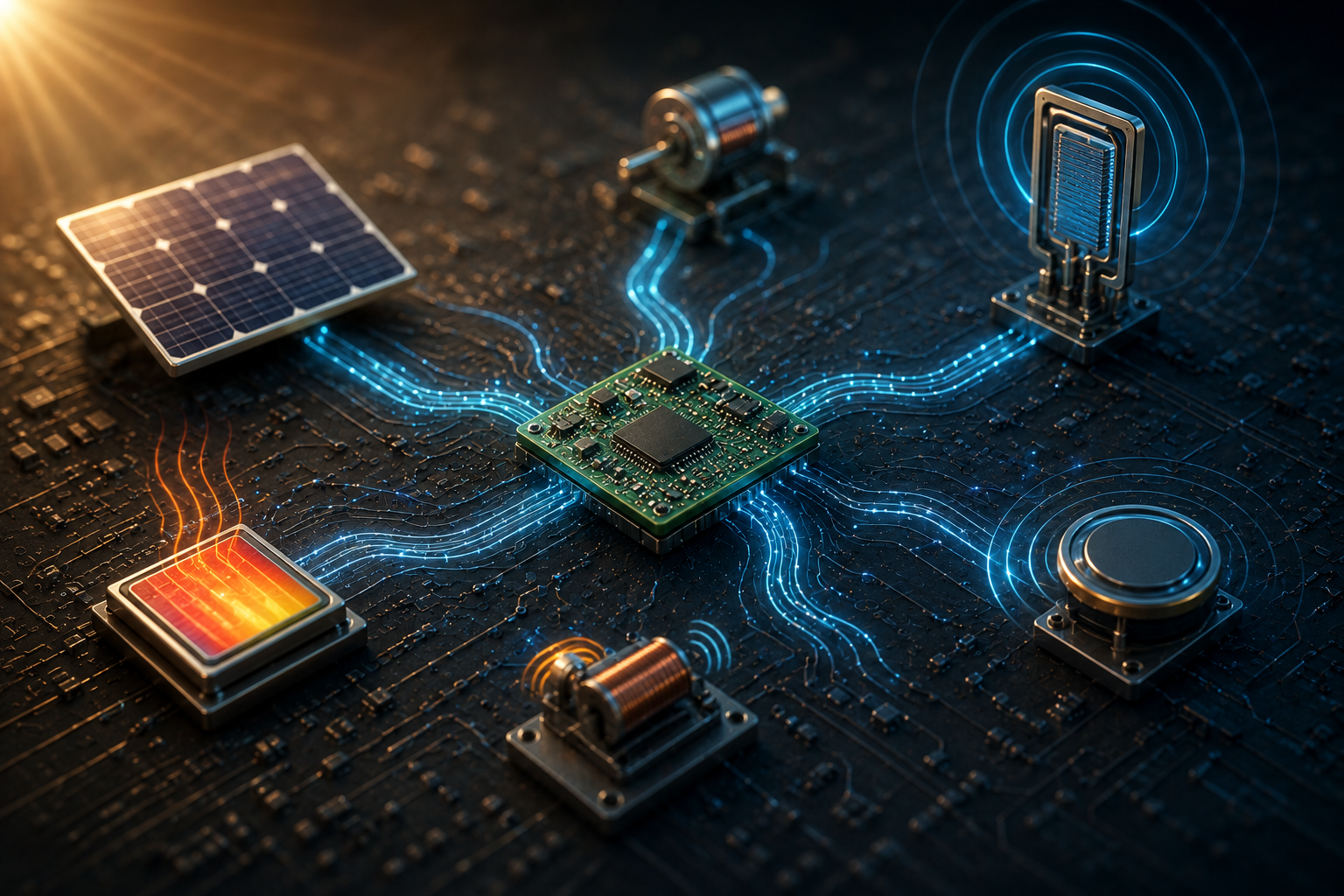
The Internet of Things (IoT) is expected to connect tens of billions of devices over the coming decade. One of the most significant challenges facing this expansion is the power supply. Conventional batteries increase maintenance costs, create environmental waste, limit device lifetimes, and become impractical in large-scale deployments. Energy-harvesting micro-power technologies are emerging as a transformative solution, enabling autonomous devices that derive energy from their surrounding environment. By harvesting radio-frequency signals, thermal gradients, mechanical vibrations, and ambient light, next-generation IoT nodes can operate for years—or potentially indefinitely—without battery replacement.
For electronics engineers, energy harvesting represents a convergence of ultra-low-power electronics, advanced materials, power management ICs, and wireless communication technologies.
A new generation of Energy-Harvesting Micro-Power Systems is poised to overcome this limitation. Instead of relying solely on batteries, these devices extract energy from their environment—capturing radio frequency (RF) signals, body heat, ambient light, and mechanical vibrations—to power sensors, processors, and wireless communication modules.
For electronics engineers, energy harvesting represents more than an incremental improvement. It is enabling the development of self-powered, maintenance-free IoT networks capable of operating for years without human intervention. As ultra-low-power electronics continue to mature, battery-free devices are expected to become a cornerstone of Industry 4.0, smart cities, healthcare wearables, and environmental monitoring systems.



Energy harvesting is moving IoT design away from the “battery-first” model toward ultra-low-power, maintenance-light nodes that capture energy from their surroundings. In practice, that means converting ambient light, RF energy, thermal gradients, vibration, or motion into usable electrical power, then storing and regulating it for a sensor, MCU, and radio burst. The result is a class of devices that can run where wiring is expensive or battery replacement is impractical.
For working electronics engineers, the key shift is not just the harvester itself; it is the full power chain. A successful design needs a harvester, an energy-storage element, cold-start circuitry, and a PMIC that can regulate tiny input power levels while protecting the load. Vendors also emphasize maximum power point tracking and ultra-low quiescent current because harvested power is often measured in microwatts or low milliwatts, not watts.
The most promising ambient sources map well to real deployment environments. RF harvesting is attractive for low-power tags and short-duty-cycle nodes because it can turn broadcast energy into a regulated supply, though received power is usually small and distance-dependent. Thermal harvesting uses temperature differences, including body heat or industrial heat gradients, and is a strong fit for wearables and machinery-adjacent sensors. Vibration and piezoelectric harvesting are natural choices for motors, pumps, rotating equipment, and transport assets.
Several companies are actively building this ecosystem. Silicon Labs positions its EFR32xG22E energy-harvesting family around battery-less operation and reference designs for solar-powered and RF-powered batteryless tags, aimed at asset tracking and similar use cases. EnOcean’s wireless sensors and switches harvest energy from motion, light, and temperature differences for maintenance-free building and industrial applications. Powercast focuses on RF energy harvesting for low microwatt and low milliwatt applications, including RFID and wearables.
Thermal and multi-source harvesting are also well covered by major component vendors. STMicroelectronics offers energy-harvesting and solar-charging ICs for ambient light or thermal differences, and its SPV1050 supports thermoelectric and PV harvesting with MPPT. e-peas describes product families for photovoltaic, thermal, RF, and vibration harvesting, with thermal and vibration sources explicitly sized for the microwatt-to-millwatt range. Texas Instruments has also published low-power harvesters for light, heat, and vibration sources, highlighting battery-free operation for sensor networks and wearables.
For engineers, the design challenge is usually energy budgeting, not RF protocol selection. The load profile must fit the harvested envelope: deep sleep for most of the time, brief wake-ups for sensing and transmitting, and enough storage to survive startup and energy gaps. In many cases, the “batteryless” node still includes a supercapacitor or thin-film storage element, but the maintenance burden drops sharply because the system no longer depends on periodic battery replacement.
Where this is headed is clear: battery-free or battery-minimal IoT nodes will first win in asset tracking, smart buildings, wearables, industrial condition monitoring, shelf labels, and distributed sensing, where installation and service costs dominate. The best near-term opportunities are not power-hungry always-on devices, but ultra-low-duty-cycle systems that can tolerate intermittent energy while still delivering useful telemetry. That is exactly the niche energy harvesting is becoming ready to fill.
Companies Leading Energy-Harvesting Micro-Power Innovation
e-peas: A pioneer in energy-harvesting PMICs. Key focus areas include: Solar harvesting, Thermal harvesting, Vibration harvesting, Battery-free IoT platforms. Their AEM-series PMICs are widely used in autonomous sensor nodes.
STMicroelectronics: Develops ultra-low-power microcontrollers and energy-management solutions for industrial IoT. Contributions include: STM32 ultra-low-power MCUs, Energy harvesting reference designs, and smart industrial sensing platforms.
Texas Instruments: Offers energy-harvesting power-management ICs and ultra-low-power processors. Applications include: Wireless sensing, Building automation, and smart metering.
Analog Devices: A leader in vibration energy harvesting. Products support: Predictive maintenance, Condition monitoring, Industrial automation
Wiliot: Known for battery-free Bluetooth tags powered by ambient radio-frequency energy. Applications include: Supply chain visibility, Retail tracking, Smart packaging. Their technology demonstrates practical, large-scale RF-powered IoT deployments.
Powercast: Specializes in wireless power transfer and RF energy harvesting. Solutions include: RF transmitters, Power receivers, Battery-free sensors. Used extensively in industrial and logistics applications.
EnOcean: A pioneer in self-powered wireless switches and building automation systems. Its products harvest energy from: Button presses, Indoor light, Temperature differences.
Schneider Electric: Integrates energy-harvesting sensors into smart-building and industrial-management systems. Focus areas include: Energy efficiency, Building automation, and Sustainable infrastructure.
The Road Ahead
The convergence of Energy harvesting, Ultra-low-power electronics, AI-enabled edge processing, and advanced semiconductor materials is creating a new class of autonomous devices.
Research laboratories are already developing systems capable of operating continuously on harvested microwatts while performing local machine learning inference. As semiconductor power consumption continues to decline, the vision of truly maintenance-free IoT networks becomes increasingly realistic.
For electronics engineers, the next decade will not simply be about designing lower-power products—it will be about designing products that generate their own power.
Conclusion
Energy-harvesting micro-power technology is rapidly becoming a foundational enabler of the next generation of IoT systems. As ultra-low-power electronics, advanced materials, and intelligent power-management architectures continue to mature, the vision of maintenance-free, battery-independent sensor networks is moving from research laboratories into commercial reality. For electronics engineers, mastery of energy harvesting, power optimization, and autonomous sensing architectures will be essential skills in the coming decade. The future IoT ecosystem will not merely communicate wirelessly—it will increasingly power itself from the energy already present in its environment.

