


The trends toward higher power density and cost optimization dominate the development goals of efficient high-power applications that create substantial value for segments such as electromobility. To push these boundaries, Infineon Technologies AG announced it has successfully registered its QDPAK and DDPAK top-side cooling (TSC) packages, which are ideal for high-voltage MOSFETs as a JEDEC standard.
This registration further solidifies Infineon’s goal to help establish a broad adoption of TSC in new designs with one standard package design and footprint. Additionally, this provides flexibility and comfort to OEM manufacturers to differentiate their products in the market and take power density to the next level to support various applications.



“As a solutions provider, Infineon continues to influence the semiconductor industry through innovative packaging technologies and manufacturing processes,” said Ralf Otremba, Lead Principal Engineer for High Voltage Packaging, Infineon. “Our advanced top-side cooled packages bring significant advantages to the device and system levels to fulfill the challenging demands of cutting-edge high-power designs. Package outline standardization will help ease one of the main design concerns of OEMs for high-voltage applications by securing pin-to-pin compatibility across vendors.”
For more than 50 years, the JEDEC organization has been the global leader in developing open standards and publications for the microelectronics industry for a broad range of technologies, including package outlines. JEDEC has been widely accepting semiconductor packages such as the TO220 and TO247 through-hole devices (THD) devices that have been prominently used over the past decades and are still an option in new onboard charger (OBC) designs, high voltage (HV) and low voltage (LV) DC-DC converters.
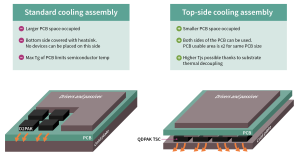
To facilitate design transition for customers from the TO220 and TO247 THD devices, Infineon has designed QDPAK and DDPAK SMD devices to deliver equivalent thermal capabilities with improved electrical performance. Based on a standard height of 2.3 mm for QDPAK and DDPAK SMD TSC package for HV and LV devices, developers are now able to design complete applications such as OBC and DC-DC conversion with all SMD TSC devices measuring the same height. Compared to existing solutions that require a 3D cooling system, this facilitates designs and reduces system cost for cooling.
Additionally, TSC packaging offers up to 35 percent lower thermal resistance than standard bottom-side cooling (BSC). By enabling the use of both PCB sides, TSC packages offer better board space utilization and at least two times more power density. The thermal management of the packages is also improved by thermal decoupling from the substrate since the thermal resistance of the leads is much higher compared to the exposed package top side. Because of the improved thermal performance, stacking different boards is not necessary. Rather than combining both FR4 and IMS, a single FR4 is enough for all components and also requires fewer connectors. These features deliver an overall bill of materials (BOM), which ultimately reduces overall system cost.
In addition to improved thermal and power capabilities, TSC technology also offers an optimized power loop design for increased reliability. This is possible by the placement of the drivers, which can be placed very close to the power switch. The low stray inductance of the driver switch loop reduces the loop parasitics and leads to less ringing on the gate, higher performance, and a smaller risk of failures.
Additional information is available at www.infineon.com/ddpak and www.infineon.com/obc

