
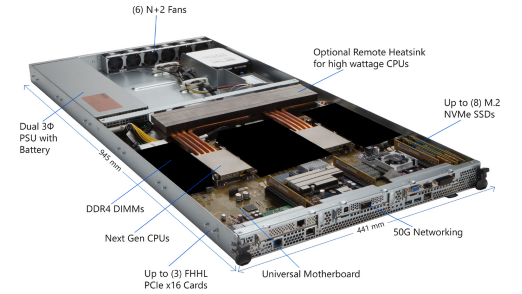
Microsoft’s has posted early specifications for a next generation data center server called Project Olympus. It also called for an open hardware process that more closely mirrors the speed and flexibility of open source software.
The current process of contributing data center hardware designs to the Open Compute Project (OCP) when they are production-ready is too slow, Microsoft argued in a blog posted Monday. It “delays the development of derivative designs, limits interactive community engagement and adoption, and slows down overall delivery,” wrote Kushagra Vaid, general manager of hardware for Microsoft’s Azure service.




So the company released specs on Git Hub for its next-generation server design although they are only half done. It also called for designers to fork designs in different directions as they see fit to heighten innovation.
The Project Olympus design specifies a new motherboard, server and rack. It defines a 945 x 441-mm server with room for two CPUs, 32 DDR4 DIMMs, 50G networking, eight M.2 NVMe SSD slots, three PCI Express x16 cards and a 12V power supply.
Interestingly, the design did not follow a call from rival Google earlier this year to shift to 48V servers to save energy by reducing power conversions.
Project Olympus development began prior to Google’s 48V open hardware contribution, said a Microsoft representative. “We will evaluate potential benefits of 48V power for future motherboards, but with the three-phase power distributed to the individual servers via the Universal PDU, a 48V bus bar distribution wouldn’t bring any additional efficiency to Project Olympus,” he added.
The specs also detail the layout of the motherboard and how to distribute power in a rack that includes a hard-disk storage array. Microsoft claims 90% of the servers it buys are now based on OCP contributions.
Facebook started the OCP effort. China’s largest data centers have a similar effort called Scorpio.
Amazon, one of the largest data center operators in the world, is highly secretive about its hardware. However, it has disclosed details about its efforts to build wind farms that support their power needs.
Amazon Web Services (AWS) announced Monday a new 189 megawatt wind farm in Hardin County, Ohio will generate 530,000 megawatt hours of wind energy annually starting in December 2017. It is the company’s fifth renewable energy project in the United States. The five will generate a total 2.2 million MWh of energy a year.
AWS said it is on track to exceed its 2016 goal of 40 percent renewable energy use and set a 50 percent goal for the end of 2017. Long term it aims to run all its data centers from renewable energy.

