
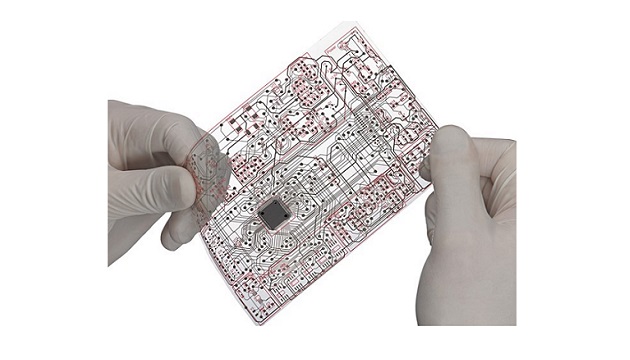
Several markets such as automotive (dashboards, lighting, sensors), smart buildings (lighting facades, air quality, solar panels), medical (health patches, X-ray, analysis), and smart clothing (position tracking, sports) are requesting the seamless integration of electronics into flexible, curved, and even stretchable surfaces.
There would be an improved user interface, if the requirement for the products are light, conformable and easily integrated into an existing design. The product should also be robust from a cost-effective process consuming less material, and the technology should be consistent with the Internet of Things roadmap.




The Printed Electronics Concept
Printed electronics deliver smart surfaces for applications by creating printed circuits on polymer films and utilizing traditional graphical printing techniques, such as screen printing and inkjet printing, to create the circuitry on foils in sheet or roll form.
Crossovers and vias can be printed by alternating conducting and dielectric layers, which can maintain a PCB-like structure, only now on a roll. All polymer foil materials are suitable substrates for printed electronics. Polyesters such as polyethylene terephthalate (PET) and polyethylene naphthenate (PEN), rubberlike material (thermoplastic polyurethane or TPU), and even paper are known substrates for printed electronics. The low costs of these materials immediately show the second advantage of printed electronics.
One more benefit of printed electronics is the ability to change the form factor of the PCB. Foils are easy to shape into the desired form by bending, rolling, cutting, and laminating. In this way, the electronics can be integrated easily into examples like clothing, building, and on-body applications.
The prints can also be seamless, effectively with no beginning and no end, so that the size of the PCB is limited only by the length and width of the roll. LED foils are printed at the Holst Centre with a length of 300 m and a width of 30 cm. The LED foils have a pitch of 5 cm and are used as a wallpaper lighting source for indoor applications.

