HomeNewsIndia NewsThermal microscope equipped with FLIR camera

Thermal microscope equipped with FLIR camera

Researchers at the Tyndall National Institute (Cork, Ireland) are developing a next-generation passive optical network (PON) demonstration module for high-speed fiber-to-home internet connectivity as part of the European FP7-Project “FABULOUS.” At the heart of the PON is a silicon photonic integrated circuit (Si-PIC) that receives information on an incoming optical-signal (downloading), before reflecting the optical signal back, after encoding extra information (uploading).

In this device, an electronic integrated circuit (EIC) is bonded to the top of the Si-PIC to distribute the electronic timing signals that are needed to drive the optical modulator in the photonic chip. Joule-heating from these high-frequency timing-signals causes an increase in the temperature of the EIC and Si-PIC, which can have a significant impact on the performance and reliability of the photonic chip.


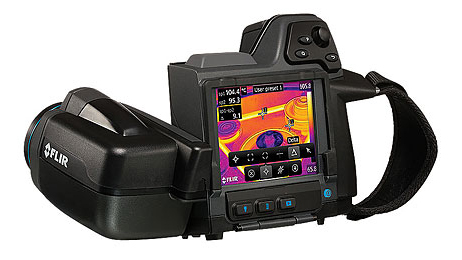
To image the silicon-photonic optical network unit (ONU) and to visualize and measure its heat output, the Tyndall researchers are using a thermal microscope system that includes a FLIR Systems (Meer, Belgium) X6540sc thermal imaging camera, allowing the researchers to simultaneously measure the EIC and Si-PIC temperatures in different operating modes so that they can chose the most efficient way to thermally stabilize the photonic chip.

“The last decade has seen the emergence of silicon photonics as a vehicle for next-generation information communication technology applications,” says Lee Carroll, research manager at the Photonics Packaging Group at Tyndall. “The need for high-performance optoelectronic devices is driven by an ever-increasing demand for higher bandwidth in data and telecom networks. One practical solution for the efficient distribution of high-speed electrical modulation onto the photonic platform is the face-to-face stacking (3D-integration) of a driver electronic integrated circuit on top of a silicon photonic integrated circuit (Si-PIC).”

“The thermal behavior of a packaged Si-PIC can impact the performance, stability, and lifetime of the device,” adds Kamil Gradkowski, another researcher at the Packaging Group. “We use a combination of thermal modelling and temperature measurements to characterize the thermal behaviour of a packaged PIC. Being able to conduct high-resolution (640 x 512 pixel) thermal measurements at high frame rates (100 Hz) using the FLIR X6540sc camera has shown that thermal management of the photonic module accounts for approximately 30% of the overall power budget, and so is a significant factor in the overall operational cost. We aim to use the camera to evaluate future packaging designs that are better optimized for cooling.”

The X6540sc thermal imaging camera has a 640 × 512 pixel digital indium antimonide (InSb) detector with spectral sensitivity from 1.5 to 5.5 µm and an f/3 aperture. It provides images up to 125 Hz in full frame and up to 4011 Hz in a 64 × 8 sub windowing mode. The camera has snapshot imagery, a motorized spectral filter wheel, and a detachable touchscreen LCD and connects to the company’s ResearchIR Max R&D software for thermal imaging data acquisition, analysis, and reporting.  The X6540sc can be temperature-calibrated up to 300 °C, or up to 3000 °C with spectral and/or neutral density filters and has a measurement accuracy of ±1 °C for standard configurations.
ELE Times Bureau
ELE Times Bureauhttps://www.eletimes.ai/
ELE Times provides a comprehensive global coverage of Electronics, Technology and the Market. In addition to providing in depth articles, ELE Times attracts the industry’s largest, qualified and highly engaged audiences, who appreciate our timely, relevant content and popular formats. ELE Times helps you build awareness, drive traffic, communicate your offerings to right audience, generate leads and sell your products better.

Related News

Must Read

Microchip Advances Neural Network Implementation with VectorBlox 3.0 Accelerator SDK

Deploying AI inference in powerconstrained and missioncritical environments such as...

Indian Deep-Tech Startup Meine Electric’s Fast-Charging Iron-Air Battery Clears Independent Validation, Paving the Way for 24/7 Renewable Energy Storage

Indian deep-tech startup Meine Electric has developed the world's first fast-charging iron-air battery system, marking a significant technical advancement for long-duration energy storage (LDES). The technology, which features a proprietary Fast Charge Long Discharge (FCLD) capability allowing the battery to charge in 6 hours and discharge over 18 hours, has been independently validated by Customized Energy Solutions (CES), a US-headquartered global energy services and technology company and the parent organization of the India Energy Storage Alliance (IESA). The independent testing was conducted by the CES Battery Laboratory through a structured testing...

Indian Army Seeks Indigenous AI-enabled Attack Drones with 1,000-km Strike Range

The Indian Army has initiated the process to acquire...

Bharat Electronics Wins ₹572 Crore Defense Order

Continuing its aggressive order book expansion, Bharat Electronics Limited...

Adani Defence Announces India’s Largest Private Missile Manufacturing Hub, Invests Rs 2,500 Crore

In a bid to create India’s first backward-integrated private-sector...

Keysight Delivers New High-Performance 4x100GE Network Cybersecurity Test Platform

Keysight Technologies, Inc. (NYSE: KEYS) today announced the APS-ONE-400, a...