
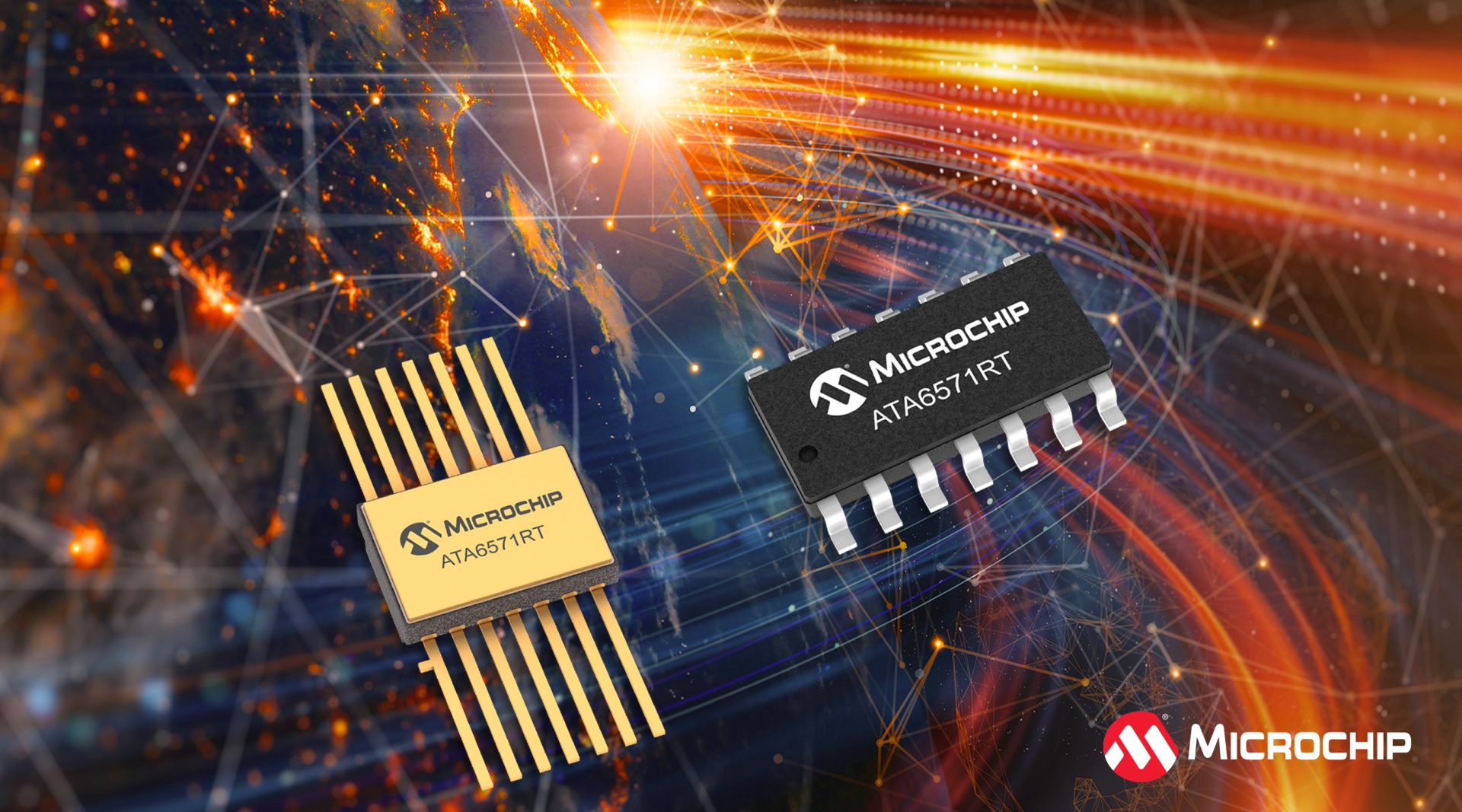
Microchip Technology announced the release of its Radiation-Tolerant (RT) ATA6571RT CAN FD Transceiver, a high-reliability communication solution designed specifically for space applications. This advanced transceiver supports flexible data rates up to 5 Mbps, making it well-suited for space systems such as satellites and spacecraft that require robust and efficient data transmission.
The ATA6571RT transceiver offers significant advantages over traditional CAN solutions, which are typically limited to a 1 Mbps communication bandwidth. With the ability to handle bit rates up to 5 Mbps and support for larger payloads of up to 64 bytes per frame, the ATA6571RT enhances efficiency and reduces bus load. Backward compatible with classic CAN, the ATA6571RT offers a smooth transition for existing systems.
Additionally, its Cyclic Redundancy Check (CRC) mechanism provides enhanced error detection, increasing reliability for safety-critical applications. The ATA6571RT is designed for space applications including platform data handling, propulsion system control, sensor bus control, robotics, on-board computers for nanosatellites and more. For easy integration at the PCB level, this RT device remains pin-distribution compatible with the original Commercial-Off-The-Shelf (COTS) plastic or ceramic versions.
“The ATA6571RT transceiver offers a cost-effective, size-optimized and power-efficient device designed to meet the stringent demands of space environments,” said Leon Gross, corporate vice president of Microchip’s aerospace and defense business.
The ATA6571RT transceiver is designed to withstand harsh space conditions with its resistance to Single-Event Effects (SEE) and Total Ionizing Dose (TID). It also features low power management with local and remote wake-up support, as well as short-circuit and overtemperature protection.





