HomeIndustryPower ElectricalsSlim DIN Rail Power Supplies For Industrial Applications

    Slim DIN Rail Power Supplies For Industrial Applications

    Advertorial by RECOM

    DIN rail mounting has revolutionized electrical cabinets since the idea was first conceived in the 1920s to standardize the mounting of switchgear and enable interchangeability between manufacturers. DIN stands for “Deutsche Industrie Norm” or the “German Industrial Standard” and the success of the DIN rail system rapidly spread outside of Germany, eventually becoming the European standard DIN EN 60715.


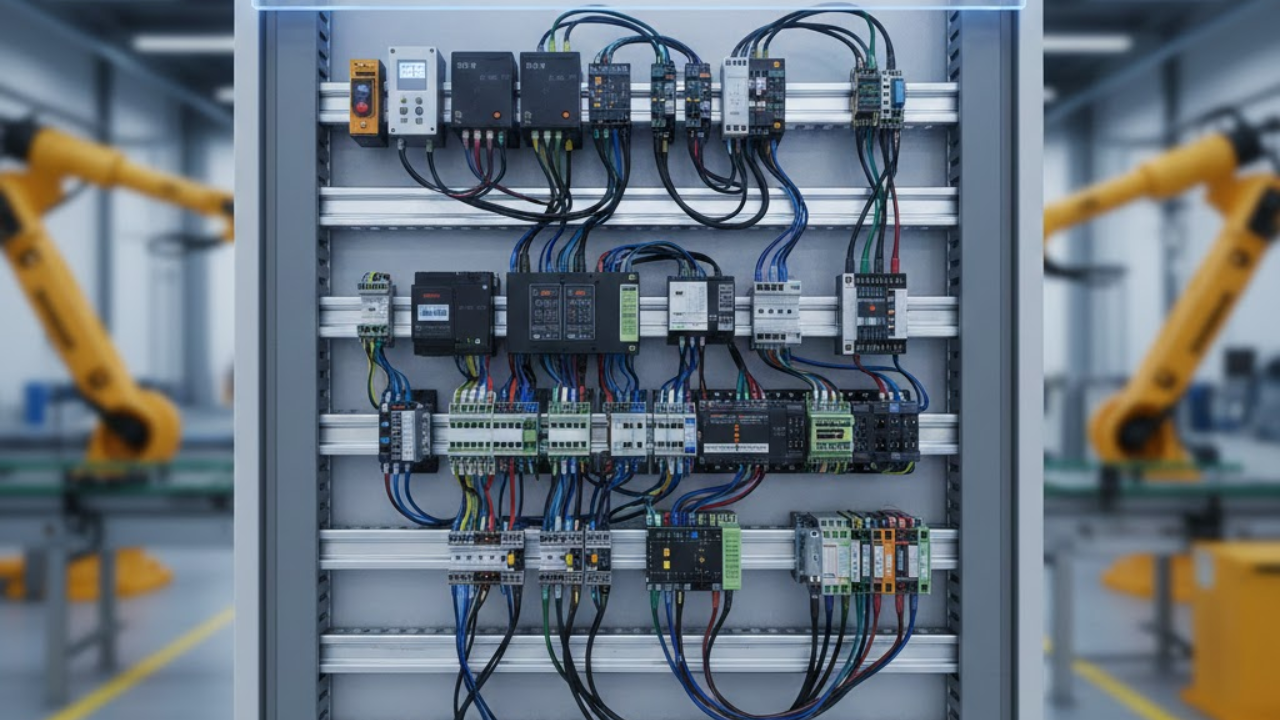
    The DIN rail system’s simplicity and versatility—allowing components to be easily clicked into place or removed for maintenance—has made it the preferred standard for electrical cabinet design. As a result, manufacturers offer a wide range of DIN rail-compatible components, including circuit breakers, relays, contactors, terminal blocks, data interfaces (KNX, DALI, Ethernet), PLCs, and slim DIN rail power supplies (Figure 1).
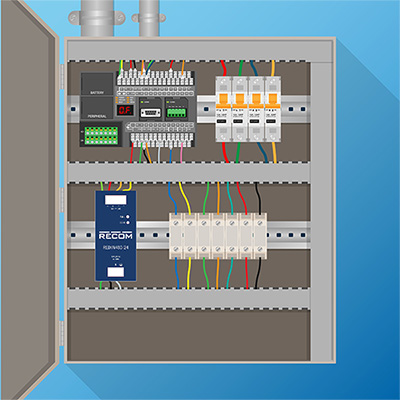
    Fig. 1: Typical DIN rail installation

    Advantages of the DIN Rail System

    Firstly, the modular approach allows electrical cabinets and panels to be quickly assembled, moved, or rearranged for optimum use of the available space with only a standard electrician’s screwdriver as a tool. There is no drilling, cutting, or threading needed. Electrical cabinets and panels are often available with pre-installed rails so installation can begin immediately.

    Secondly, the DIN rail system allows easy upgrading or repair without disrupting other components – a defective part can be simply unclipped and replaced without affecting the other components. If the new part happens to be slightly larger than the older module, then the existing components can be shifted along the rail to make space.

    Thirdly, as the mounting rail dimensions are all standardized, parts from different manufacturers are interchangeable and mounting compatible. On a single rail, different electrical components can be freely mixed, so, for example, connector blocks can be placed next to power supplies to simplify the distribution of power and reduce the amount of cabling required, or actuator relays placed next to PLCs.

    Fourthly, as you might expect from a German standard, the ease of mounting allows an organized, neat, and logical layout within the cabinet. This not only speeds up assembly by streamlining the whole construction process but simplifies maintenance and troubleshooting. All electrical contacts are accessible from the front without disconnecting any wiring and many electrical components have status or alarm indicators so that complex installations can be quickly inspected to find the fault.
    In some ways, the DIN rail system has become a victim of its own success. As the DIN rail mounting system is now ubiquitous for almost all electrical, networking, and telecommunication equipment, there is a tendency to pack as much as possible onto each rail. This puts pressure on making each component as slim as possible to minimize the amount of rail space required. However, heat-generating components—such as power supplies, contactor coils, and relays—can disrupt natural convection airflow when placed too closely together. As every 10°C increase in ambient temperature halves the operational lifetime, this is a consequence that must be avoided.
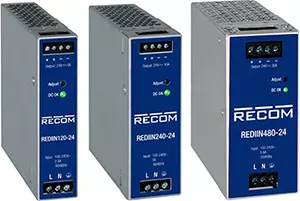
    Fig. 2: REDIIN120, REDIIN240, and REDIIN480 DIN rail Power Supplies

    Solutions include adding spacers between equipment to allow free air convection to cool the components, repositioning heat-generating components so that they are not in close proximity to one another, or, in extreme cases, adding fans to force-air cool the parts. The vertical separation between rails also needs to be considered so that warm air rising from one component does not adversely affect the component placed immediately above it. Fortunately, software packages are readily available that can be used to both plan the layout of the panel or cabinet in advance and to calculate the expected thermal loading. This software is often offered free by the cabinet manufacturers. More advanced software can also automatically check for compliance with electrical safety, construction, and technical standards, such as EN 61439.

    RECOM is an established power supply manufacturer that is well-known for board-mounting or chassis-mounting embedded power, but also offers competitively priced AC/DC DIN rail mount power supplies (Figure 2).

    Key Features of DIN Rail Power Supplies

    Always-On

    Power supplies in panels and electrical cabinets typically operate in “always on” mode. Even if a production line is shut down overnight, the low-voltage power supply for the relays and controllers remains active. Operating 24/7 means that DIN rail power supplies need to have a very long operational lifetime, which is achieved both by careful design and by robust input filtering stages that can withstand severe input voltage fluctuations, supply interruptions, mains transients, and power surges.

    High Efficiency

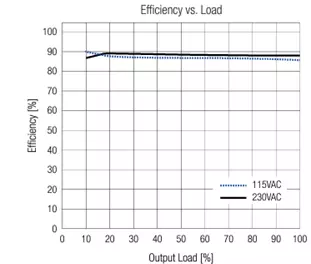
    Both when fully loaded and at no-load, high efficiency is needed to minimize internal heat dissipation and to save energy during standby. The REDIIN series features a flat efficiency curve which remains at around 90-94% for all loads from 20% or less up to 100% full load (Figure 3) independently from supply voltage. Under no-load conditions, the 480W version consumes less than 750mW, while the 120W and 240W versions both consume less than 300mW.
    Fig. 3: Flat efficiency curve of the REDIIN120-24. No load power consumption is only 150mW

    Design

    DIN rail mounted power supplies are designed with all electrical connections at the front, while major heat-dissipating components—such as switching transistors and power diodes—are in good thermal contact with the back of the device (often referred to as the “book shape”). By using this thermally efficient layout, the metal DIN rail can function as an additional heatsink, allowing the REDIIN series to operate at full output power in ambient temperatures up to +50°C with only natural convection cooling. In some cases, the environment may be very cold rather than hot—for example, in an outdoor solar farm PV string controller or an unheated warehouse—so low-temperature operation is also essential. The REDIIN series supports full load operation down to -30°C, with cold start capability down to -40°C.

    Protection

    All REDIIN power supplies operate from a universal single-phase AC input (90 to 264 VAC), making them suitable for all global mains power supplies including under voltage and overvoltage conditions. Power factor correction is included as standard. The short-circuit, over-voltage, and overload protected outputs are the typical industrial supply voltages of 12V (REDIIN 120), 24V, or 48V DC, all trimmable over the range of ±10% to adjust for cable losses. They also have automatic CV/CC operational modes, making them suitable for either highly inductive or highly capacitive loads. An output over-current limit of up to 150% allows high start-up current loads to be driven without needing to oversize the power supply. If the power supply is continuously overloaded, the built-in over-temperature protection will safely turn off the output before the unit becomes damaged. A two-colour indicator LED shows if the output voltage is within range or if it is in short-circuit, over-temperature, or overload protection mode.

    Summary

    The cost-effective REDIIN power supply series is designed to meet the demanding technical requirements needed for many industrial-grade electrical cabinet applications without compromising on quality and reliability. The series are all housed in an extremely slim ‘book-shape’ case of only 123.6mm high and 116.8mm deep. The REDIIN120 delivers 120W output power with only 30mm width, the REDIIN240 delivers 240W with only 40mm width, while the REDIIN480 delivers an impressive 480W with only 56mm width. The exceptionally slim design frees up valuable space while the low weight avoids overloading the DIN rail in congested installations.

    The products are fully certified according to international safety standards IEC/EN/UL 62368-1, IEC/EN/UL61010-1, and IEC/EN/UL/CSA61010-2-201. Electromagnetic radiated and conducted emissions are compliant with heavy industrial EN 61000-6-4 Class B Emission standard and EN 61000-6-2 Immunity standard.

    The REDIIN series are designed for industrial, automation, power distribution, and test and measurement environments. These slim power supplies are ideal for applications in heavy engineering, production, home automation, data and telecom, traffic control, and water management—anywhere a compact, reliable, and cost-effective DC power supply is required within cabinets or electronic enclosures.

    ELE Times Research Desk
    ELE Times Research Deskhttps://www.eletimes.ai
    ELE Times provides extensive global coverage of Electronics, Technology and the Market. In addition to providing in-depth articles, ELE Times attracts the industry’s largest, qualified and highly engaged audiences, who appreciate our timely, relevant content and popular formats. ELE Times helps you build experience, drive traffic, communicate your contributions to the right audience, generate leads and market your products favourably.

    Related News

    Must Read

    ASMPT Wins New Orders for Nineteen Chip-to-Substrate TCB Tools to Serve AI Chip Market

    ASMPT announced it had won new orders for 19...

    Microchip Halves the Power Required to Measure How Much Power Portable Devices Consume

    Battery-operated devices and energy-restricted applications must track and monitor...

    India needs up to 15,000 crore more investment for PCB manufacturing: JS Gujral, MD, Syrma SGS

    In the budget for 2021, the Indian government sanctioned...

    The Software-Defined Vehicle Revolution: The Engineering Call to Action

    The global automotive industry is undergoing its most profound...

    Outages Won’t Wait: Why Grid Modernization Must Move Faster

    Courtesy: Keysight Technologies A routine click on a recommended...

    The Unsung Hero: How Power Electronics is Fueling the EV Charging Revolution

    The electrifying shift towards Electric Vehicles (EVs) often dominates...

    Emerging Technology Trends in EV Motors

    Electric Vehicles (EVs), central to the global climate transition,...

    Terahertz Electronics for 6G & Imaging: A Technical Chronicle

    As the demand for more spectrum increased with the...

    When Tiny Devices Get Big Brains: The Era of Edge and Neuromorphic AI

    From data-center dreams to intelligence at the metal Five years...