
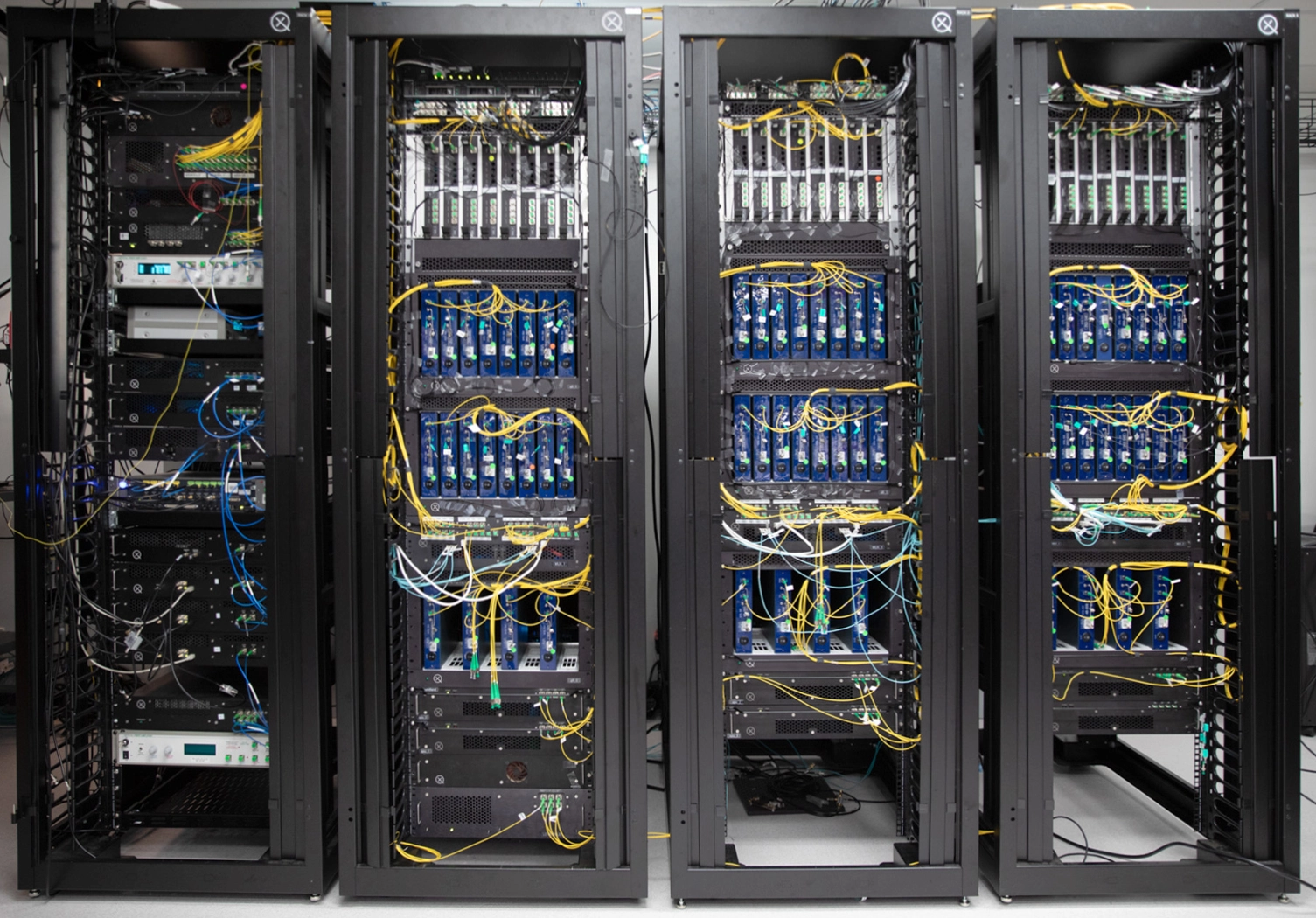
Courtesy: Xanadu
Xanadu has announced a major milestone in photonic quantum computing with the completion of Aurora, its most advanced quantum system to date. Detailed in a newly published paper in Nature, Aurora represents a significant step toward practical, fault-tolerant quantum computation and builds upon the company’s earlier systems, including X8—the first commercially cloud-deployed photonic quantum computer—and Borealis, one of the few machines globally to demonstrate quantum computational advantage.




Aurora stands apart from its predecessors as a complete prototype of a universal photonic quantum computer. For the first time, all the subsystems required for universal and fault-tolerant quantum computation have been integrated into a single photonic architecture. The system combines 35 photonic chips, interconnected through 13 kilometers of optical fiber, and implements every essential function outlined in Xanadu’s blueprint for fault-tolerant quantum computing. These include qubit generation and multiplexing, creation of large-scale cluster states with temporal and spatial entanglement, logic gate operations, and real-time error correction and decoding—executed within a single quantum clock cycle.
Remarkably, the entire system operates within four standard, room-temperature server racks, is fully automated, and can run continuously for hours without human intervention. This level of integration and stability marks a major advance in quantum hardware engineering.
The development of Aurora was the result of a year-long, cross-team effort within Xanadu, bringing together expertise in photonic chip design, electronics, packaging, and large-scale systems integration. To validate the platform, the team subjected Aurora to a series of demanding benchmarks. In one demonstration, the system ran continuously for two hours while maintaining entanglement across 86 billion modes, the largest such scale reported to date. Additional tests verified real-time error detection and correction using classical controllers, a capability considered essential for fault-tolerant quantum computers and previously unachieved in a photonic system.
The Nature paper, titled “Scaling and networking a modular photonic quantum computer,” highlights three core strengths of Aurora’s architecture: scalability, modularity, and networkability. Large-scale quantum computing will inevitably require distributing qubits across multiple modules rather than a single monolithic system. Aurora demonstrates how independently manufactured photonic modules can be networked together while preserving entanglement, addressing one of the key challenges in scaling quantum hardware.
Beyond architectural design, the work also addresses a critical performance requirement for fault-tolerant quantum computing: optical loss reduction. In photonic systems, losses caused by material imperfections and interface roughness directly impact error rates. Xanadu’s study establishes detailed optical loss budgets and identifies clear performance targets needed to cross the fault-tolerance threshold—where adding more qubits improves, rather than degrades, computational reliability.
While Aurora itself uses commercially available fabrication platforms, Xanadu is now collaborating with foundry partners to develop customized, low-loss photonic processes tailored for fault-tolerant operation. According to the company, improving component performance to meet these thresholds is now the primary focus of its hardware and architecture teams.
With Aurora, Xanadu has demonstrated a viable path toward large-scale, fault-tolerant photonic quantum computers—bringing the industry one step closer to quantum systems capable of delivering real-world value.

