

Introduction
For more than half a century, digital electronics has relied on binary systems in which information is represented by bits existing as either 0 or 1. From microcontrollers to supercomputers, this binary architecture has powered modern civilization. However, the increasing demand for ultra-fast computation, secure communication, and advanced artificial intelligence is pushing conventional semiconductor technology toward its physical limitations. Quantum computing and quantum cryptography are emerging as revolutionary technologies capable of transforming the future of electronics engineering.



Unlike classical systems, quantum electronics operate using qubits (quantum bits), which exploit the principles of quantum mechanics such as superposition and entanglement. These properties allow quantum computers to solve highly complex problems in seconds that would require traditional supercomputers thousands of years to complete.
Understanding Qubits
A classical bit can exist only in one state at a time: either 0 or 1. In contrast, a qubit can exist simultaneously in multiple states due to the phenomenon known as superposition.
|\psi\rangle = \alpha|0\rangle + \beta|1\rangle
This quantum state representation enables parallel computation on a massive scale. Furthermore, qubits can become entangled, meaning the state of one qubit instantly affects another regardless of distance. Entanglement dramatically increases processing power and computational efficiency.
Quantum computers leverage these effects to perform operations on enormous datasets simultaneously. As a result, applications such as molecular simulation, optimization algorithms, cryptographic analysis, and machine learning become significantly faster and more efficient.
Quantum Computing Hardware Challenges
Building practical quantum computers is one of the greatest engineering challenges of the 21st century. Qubits are extremely sensitive to environmental disturbances such as heat, electromagnetic noise, and vibration. Even minimal interference can collapse the fragile quantum state, a problem known as decoherence.
To overcome this issue, engineers are developing highly specialized hardware systems, including:
- Superconducting circuits
- Trapped ion processors
- Photonic quantum systems
- Topological qubits
- Cryogenic cooling systems
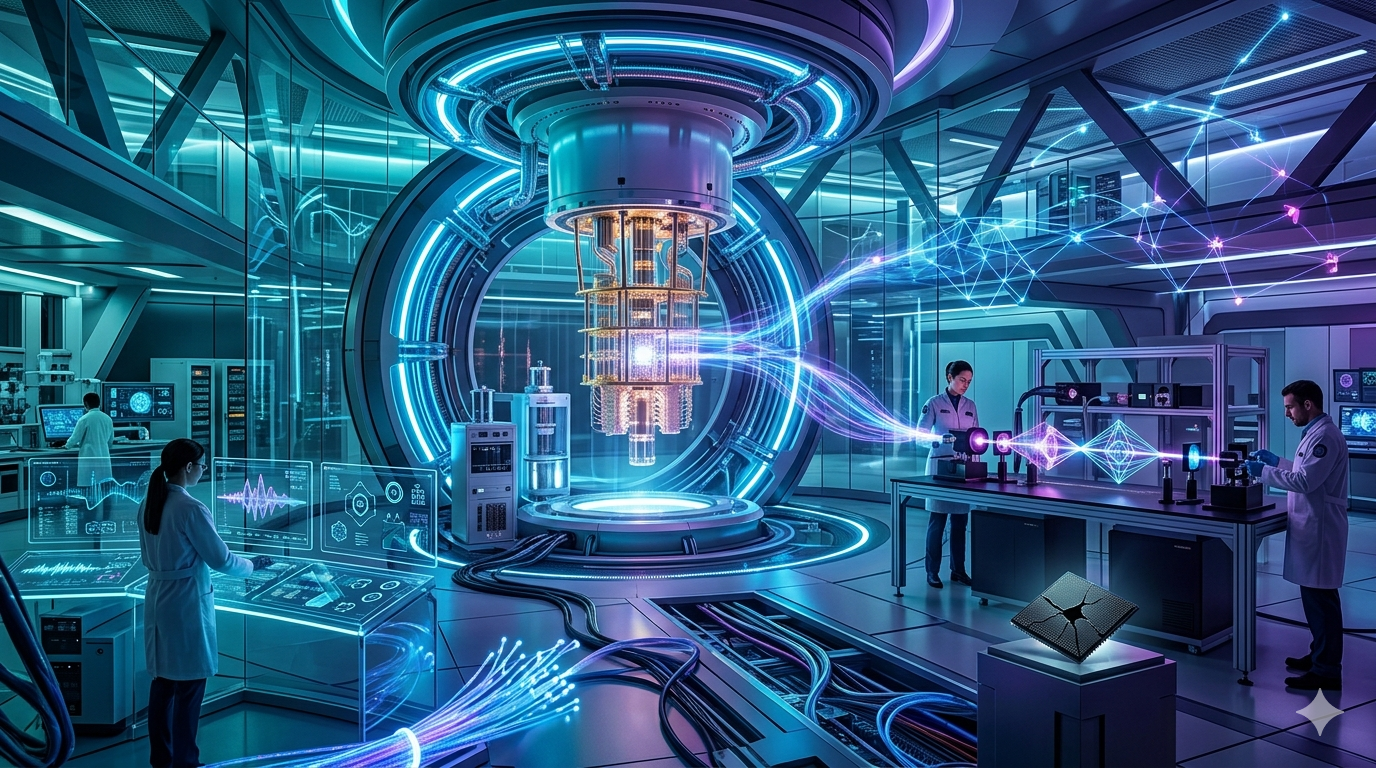
Most quantum processors operate at temperatures near absolute zero using dilution refrigerators. These ultra-cold environments reduce thermal noise and help maintain quantum coherence.
Schematics of superconducting quantum computers. A). The conventional approach to manipulating and reading out of a superconducting quantum processor. Room temperature electronics are used as control units to generate analog microwave pulses with a well-defined frequency, amplitude, and phase, which are sent to the cryogenic quantum processing unit (QPU) through coaxial cables with careful attenuation and filtering. The significant hardware overhead limits the scaling of the quantum computer. B). A conceptual superconducting quantum computer that integrates the QPU with its control units at cryogenic temperatures. The control units may compose cryogenic microwave pulse generators and their control electronics. Such a monolithic integrated architecture enables large-scale superconducting quantum computers
Comparison chart between classical bits and quantum qubits
Another major challenge is achieving fault-tolerant quantum computing. Quantum systems naturally produce errors because qubits are unstable. Engineers, therefore, implement quantum error correction techniques to maintain computational accuracy. The race among technology companies and research laboratories is focused on creating scalable, stable, and fault-tolerant quantum processors.
Major organizations, including IBM, Google, Intel, and Microsoft, are investing billions of dollars into quantum hardware development.
Quantum Cryptography and Cybersecurity
While quantum computing offers immense computational power, it also threatens existing cybersecurity systems. Modern encryption methods such as RSA and ECC rely on mathematical problems that classical computers cannot solve efficiently. However, quantum algorithms such as Shor’s Algorithm could potentially break these cryptographic systems within minutes.
Quantum cryptography addresses this challenge by using the laws of quantum mechanics to secure communications. The most important application is Quantum Key Distribution (QKD), where encryption keys are transmitted using quantum particles such as photons.
The security advantage of QKD lies in the Heisenberg Uncertainty Principle. Any attempt to intercept or measure the quantum transmission changes its state, immediately alerting the communicating parties to potential eavesdropping.
Schematic of a two-node implementation of Quantum Key Distribution.
Photons are distributed using a quantum channel, usually an optical link, and detected using single-photon detectors. Parties follow a protocol allowing them to simultaneously generate identical keys at two distant locations by communicating measurement details over a data channel. Security is guaranteed by quantum physics, which predicts that an eavesdropper inadvertently produces detectable errors through her activities.
Quantum cryptography provides several advantages:
- Extremely high security
- Real-time intrusion detection
- Resistance against quantum attacks
- Secure military and financial communications
Countries and corporations worldwide are now investing heavily in quantum-secure communication networks to prepare for the post-quantum era.
Applications of Quantum Technology
Quantum technologies are expected to revolutionize multiple industries, including:
- Healthcare and Drug Discovery
Quantum simulations can model molecular interactions accurately, accelerating pharmaceutical research and personalized medicine.
- Artificial Intelligence
Quantum machine learning may process vast datasets faster than conventional AI systems.
- Financial Modeling
Banks can optimize trading strategies, risk analysis, and portfolio management using quantum algorithms.
- Logistics and Optimization
Complex optimization problems in transportation and supply chains can be solved more efficiently.
- Defense and Space Research
Quantum sensors and secure communication systems are becoming critical for national security and satellite networks.
Future Outlook
Quantum computing remains in its early developmental stage, but progress is accelerating rapidly. Electronics engineers will play a central role in designing quantum processors, cryogenic electronics, photonic systems, RF control circuits, and quantum communication networks.
As Moore’s Law approaches its practical limit, quantum electronics may become the next major technological revolution. The transition from binary systems to quantum architectures represents not merely an upgrade in computing power, but a complete transformation in how information is processed, transmitted, and secured.
The coming decades will likely witness the integration of classical and quantum systems, creating hybrid computing platforms capable of solving problems previously considered impossible. For electronics engineers, mastering quantum technologies today could define the future of next-generation innovation.

