
HomeNewsIndia NewsHelping Engineers Succeed in Millimeter-wave Design Simulation and Measurement

    Helping Engineers Succeed in Millimeter-wave Design Simulation and Measurement

    As developers venture into the millimeter-wave frequency band, it’s easy to underestimate the challenges that arise in design, simulation, measurement, and analysis. Compared to signals at baseband, RF or microwave, those at 30 GHz, 300 GHz or 1 THz behave quite differently. For example, signals at the respective wavelengths of 10 mm, 1 mm or 0.3 mm experience substantial propagation losses, especially at the resonant frequencies of oxygen, water and carbon dioxide molecules. The inherent challenges also make it difficult to generate power, and it also becomes increasingly challenging to make calibrated measurements and get useful results.
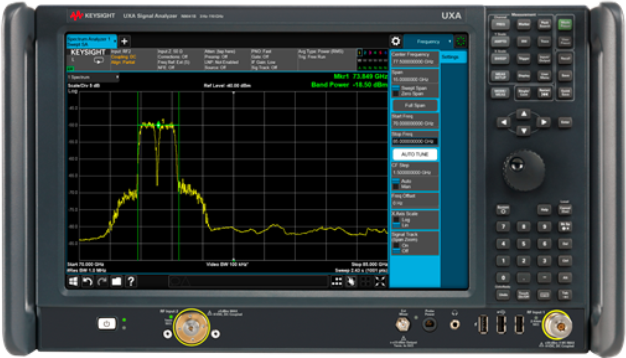
    Figure 1. The Keysight N9041B UXA X-Series signal analyzerreaches into the millimeter-wave range with continuous sweeps up to 110 GHz.

    Engineers who face such difficulties rely on test-equipment manufacturers to bootstrap their efforts by creating tools that give them easier access to accurate, repeatable measurements at ever-higher frequencies and wider bandwidths. Enabling pioneers to reach higher is part of Keysight Technologies’ heritage—and recent product introductions are helping developers succeed at 110 GHz and beyond. Today, Keysight is the industry’s leading innovator in the commercialization of tools for simulation, test and analysis at millimeter-wave frequencies (Figure 1).


    Working at the intersection of technology and demand
    Millimeter-wave technology has been in use for decades, primarily in aerospace, defense and backhaul applications where the benefits have justified the high costs of development, manufacturing and support. In recent years, advancements in the fabrication of millimeter-wave devices have been pushing down the cost of extremely high frequency (EHF) devices, making them more viable in commercial and consumer applications. For example, developers of complementary metal-oxide semiconductor (CMOS) devices have produced devices with fT greater than 500 GHz, and some are aiming to push this cost-effective technology into the 1.0 to 1.5 THz range.

    On its own, Keysight has been pursuing groundbreaking R&D in EHF components. Its in-house capabilities in microwave semiconductor technology have enabled development of a next-generation indium phosphide (InP) process that supports transistor switching frequencies above 300 GHz. This is opening up higher bandwidths in ICs and in products such as an upcoming oscilloscope that will deliver breakthroughs in real-time and equivalent-time performance.

    ELE Times Bureau
    ELE Times Bureauhttps://www.eletimes.ai/
    ELE Times provides a comprehensive global coverage of Electronics, Technology and the Market. In addition to providing in depth articles, ELE Times attracts the industry’s largest, qualified and highly engaged audiences, who appreciate our timely, relevant content and popular formats. ELE Times helps you build awareness, drive traffic, communicate your offerings to right audience, generate leads and sell your products better.

    Related News

    Must Read

    New LX4580 – Highly Integrated 24‑Channel Mixed‑Signal IC for Aviation & Defence Actuation Systems

    Microchip Technology announces the LX4580, a 24‑channel mixed‑signal IC designed...

    TI redoubles advancement of next-gen physical AI with NVIDIA

    Texas Instruments announced accelerating the safe deployment of humanoid...

    Everspin Advances High-Reliability xSPI MRAM Portfolio With Complete Production Qualification for 64Mb MRAM

    Everspin Technologies, the world’s leading developer and manufacturer of...

    R&S acquires SRS, specialists in SDR communications solutions

    Rohde & Schwarz acquired Software Radio Systems (SRS), a...

    Differentiating Between LPDDR6, LPDDR5, and LPDDR5X

    Courtesy: Synopsys Advances in memory standards are driving faster and...

    Arrow Electronics and Infineon introduce 240W USB-C PD 3.2 reference design for battery-powered motor control applications

    Arrow Electronics and Infineon Technologies AG have announced REF_ARIF240GaN, a...

    Robotics Engineering: The Architectural Evolution Behind IT–OT Convergence

    Factories today operate as dense mechanical ecosystems, whether in...

    How AI Is Transforming Network Protocol Testing in Software-Defined Networks?

    As enterprises accelerate toward cloud-native infrastructure, edge computing, and...

    What is Fashion Tech? Providing New Product Value and Customer Experiences with Technology

    Courtesy: Murata Electronics What is fashion tech? - diverse technologies...

