
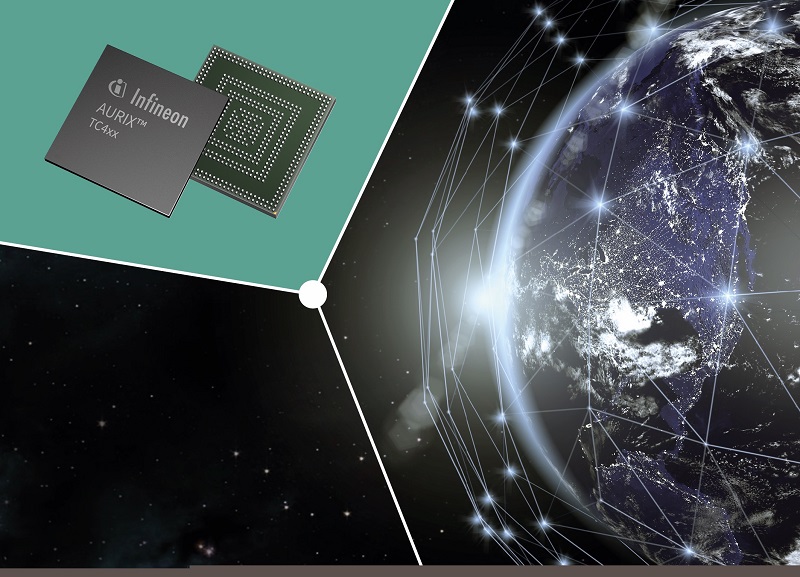
Autonomous driving (AD) and advanced driver assistance systems (ADAS) rely on the precise sensing of the vehicle’s surrounding environment to safely navigate. Manufacturers around the world have turned to advanced sensors and algorithms to enhance perception and reach unprecedented levels of safety. TERAKI, a market leader in edge sensor processing, today released the latest radar detection software that accurately identifies static and moving objects with increased accuracy and less computational power. The real traffic solution runs on ASIL-D-compliant AURIX TC4x microcontrollers from Infineon Technologies AG.
“Automotive radar system performance has drastically increased over the last product generations,” said Marco Cassol, Director of Product Marketing for Infineon Automotive Microcontrollers. “Edge AI processing is one of the many innovations that has helped us drive this increase in radar performance. TERAKI’s unique radar algorithms are now being implemented in Infineon’s new parallel processing unit (PPU) to showcase next-generation radar performance from Infineon’s AURIX TC4x devices.”




“We have refined our algorithm to achieve more with less,” said Daniel Richart, TERAKI’s CEO “With the minimum amount of data, our solutions detect and correctly classify static and moving objects with radar signals, providing AD and ADAS applications with the essential information for situational awareness and decision-making. Ultimately, we aim to ensure safety, at the edge, by reducing inference time and the required processing power of constrained devices.”
As radar turns into the industry standard for cost-effective signal processing, overcoming the limitations of this sensor technology becomes a priority. For example, interference can severely lower radar detection performance, leading to invalid detections in difficult multi-target situations, which also carry high processing requirements. Additionally, the precision required for reliable radar classifications involves more data points per frame and sub-1-degree angular resolution, if static, and moving objects are to be correctly detected and classified.
TERAKI’s machine learning (ML) approach intends to solve this challenge by working with raw data and reducing noise while acting as a cognitive function to dissect information from the radar, identify targets in a noisy environment, along with clusters and other interference, and decreasing the processing capacity at the edge. TERAKI’s ML detection delivers more points per object, leading to fewer false positives and thus, increased safety; particularly when compared to other radar processing techniques, such as CFAR.
Ported with Infineon’s AURIX TC4x, TERAKI’s ML-based algorithm reduces radar signals after the first Fast Fourier Transformation (FFT), achieving up to 25 times lower error rates of missing objects at the same RAM/fps. Compared to CFAR, classification is up to 20 percent higher in precision, and valid detections increase to 15 percent more. With this release, TERAKI is improving the chipset architecture of edge devices, ensuring real-time processing performance on AURIX TC4x, which alleviates the computing requirements by consuming 4- or 5-bit bitrates instead of 8- or 32-bits without compromising the F1-scores. This leads to up to 2 times less memory required.

