
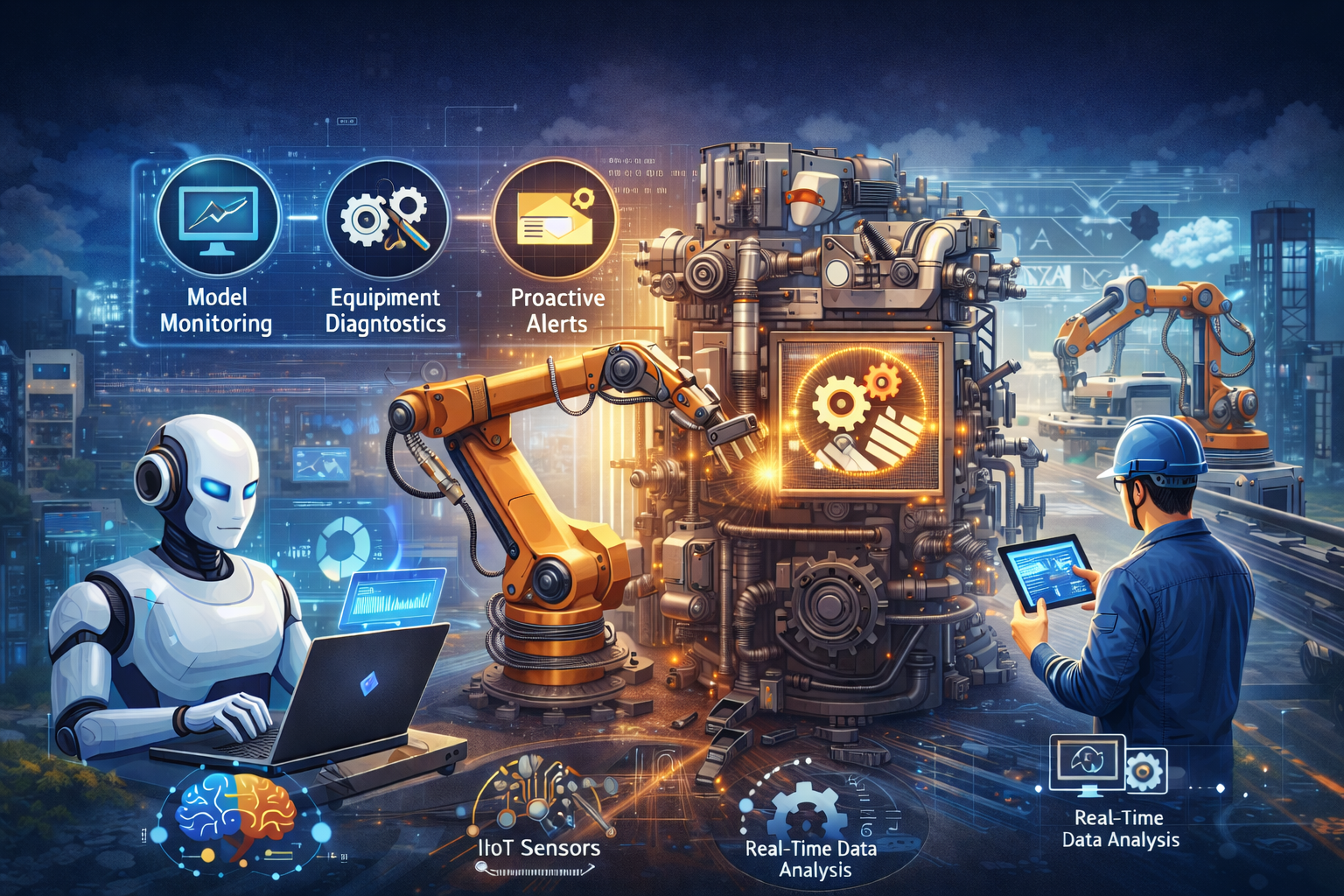
Introduction: Why Downtime Is No Longer Acceptable
Unplanned downtime remains one of the most persistent and costly challenges in modern manufacturing. Studies and industry assessments from organisations such as Siemens and the Aberdeen Group have consistently shown that unexpected equipment failures cost global manufacturers tens of billions of dollars every year, with large automotive plants, semiconductor fabs, and energy facilities losing millions of dollars per hour during major production disruptions.
In the current manufacturing landscape, where production systems operate with minimal margins and global supply chains are under continuous pressure, downtime has evolved from a technical inconvenience to a significant strategic liability.




With the advent of Industry 4.0, manufacturing facilities have transitioned from isolated mechanical environments to complex digital ecosystems comprising interconnected machines, industrial electronics, sensors, software platforms, and automation. In this context, traditional maintenance approaches, such as reactive repairs or fixed-schedule servicing, are increasingly misaligned with contemporary operational requirements.
Predictive maintenance (PdM), enabled by deep learning and industrial artificial intelligence, is fundamentally transforming approaches to reliability in manufacturing. Rather than reacting to failures, organisations can now anticipate them, plan interventions proactively, and maintain uninterrupted production. Predictive maintenance, once considered a support function, is increasingly recognised as a core strategic capability.
From Rules to Learning: How Deep Learning Predicts Failures
Earlier predictive maintenance systems relied on fixed thresholds and rule-based logic—triggering alerts when temperature, vibration, or current crossed predefined limits. While effective for detecting obvious faults, these approaches were inherently reactive and struggled to capture the complex, nonlinear behaviour of modern equipment operating under variable loads and conditions.
Deep learning signifies a fundamental transition from rule-based systems to data-driven intelligence. Instead of relying on manually encoded expert assumptions, deep learning models extract knowledge directly from historical and real-time data, identifying subtle, multi-parameter patterns that precede failures, often weeks in advance and prior to the activation of conventional alarms. These early indicators are typically undetectable when individual signals are analysed in isolation.
In addition to enhancing prediction accuracy, deep learning facilitates a strategic shift toward probabilistic and horizon-based maintenance planning. Maintenance decisions are guided by remaining useful life estimates and associated confidence levels, rather than binary fault alerts, enabling teams to prioritise interventions, manage operational risk, and align maintenance actions with production objectives. Several deep learning techniques are now widely applied in industrial environments.
Convolutional Neural Networks (CNNs)
CNNs are commonly used to analyse vibration spectrograms, thermal images, acoustic signatures, and visual inspection data. Subtle changes in these signals—often undetectable to human operators—can indicate early-stage bearing wear, imbalance, or surface degradation.
Recurrent Neural Networks (RNNs) and Long Short-Term Memory (LSTM) Networks
Manufacturing equipment continuously generates time-series data from sensors embedded in motors, pumps, gearboxes, and actuators. LSTM models are particularly effective at learning long-term temporal dependencies, making them well-suited for predicting gradual wear, fatigue accumulation, and performance drift.
Autoencoders for Anomaly Detection
Autoencoders learn the normal operating behaviour of machines. When incoming data deviates from this learned baseline, the system flags anomalies that may signal emerging faults—even when labelled failure data is limited.
Practically, these models serve as digital reliability engineers by continuously monitoring assets and providing early warnings well in advance of potential production disruptions.
However, the effectiveness of learned intelligence is fundamentally dependent on the quality of the physical systems responsible for sensing, capturing, and transmitting data from the factory floor.
The Electronics Foundation Behind Predictive Intelligence
Deep learning-based predictive maintenance does not exist in isolation. Its effectiveness depends critically on the quality, reliability, and consistency of data originating from industrial electronics and sensing infrastructure. The performance of an AI model is fundamentally bounded by the fidelity of the signals it receives, which determines how accurately physical degradation mechanisms—such as bearing wear, insulation breakdown, or mechanical imbalance—are reflected in the data domain.
High-precision MEMS vibration sensors, thermal imaging modules, acoustic sensors, pressure sensors, and current-monitoring ICs form the data backbone of predictive systems. If these sensors are poorly calibrated, noisy, or inconsistently sampled, even the most advanced deep learning models will learn misleading patterns.
At the edge, industrial gateways and AI-capable processors facilitate local, low-latency analytics, thereby reducing reliance on cloud connectivity. This capability is particularly critical in sectors such as semiconductor manufacturing, automotive robotics, and power generation, where even milliseconds of delay or brief connectivity interruptions can result in significant consequences. In this context, sensors, edge processors, and industrial communication networks are foundational enablers of predictive intelligence rather than merely supporting components.
Industry Adoption: From Pilots to Production
Across sectors, deep learning-driven predictive maintenance is moving steadily from pilot projects to full-scale deployment.
Automotive Manufacturing
Automotive manufacturers increasingly apply AI-driven analytics to robotic assembly lines, analysing torque, vibration, and process parameters. These systems reduce unplanned downtime, stabilise quality, and support a transition from fixed maintenance schedules to condition-based strategies.
Aerospace and Aviation
Rolls-Royce remains a reference point in this domain. Through its Engine Health Monitoring and Total Care programs, the company uses advanced analytics to anticipate component degradation, improve fleet availability, and enhance safety—demonstrating the long-term value of predictive intelligence in mission-critical systems.
Energy and Utilities
Power plants rely on deep learning models to detect early signs of turbine imbalance, transformer insulation ageing, and rotating equipment faults. Early detection reduces outage risk and supports more reliable grid operations.
Electronics and Semiconductor Manufacturing
In semiconductor fabs, where uptime and yield are paramount, AI-based diagnostics monitor temperature stability, vibration, and process consistency. Predictive maintenance plays a central role in maintaining the precision required for advanced chip fabrication.
Industry Perspective: Insights from the Field
According to Sanjeev Srivastava, an industry spokesperson with extensive experience in industrial automation and intelligent manufacturing systems, the evolution of predictive maintenance reflects a deeper transformation in how manufacturers approach reliability and operational efficiency.
He observes that the transition from rule-based monitoring to learning-driven intelligence enables organisations to detect early-stage stress and degradation patterns that would otherwise remain invisible until failure. In this view, predictive maintenance is no longer a standalone analytics initiative but an integral part of how modern factories manage uptime, energy efficiency, and long-term asset performance.
This perspective aligns with a broader industry consensus that deep learning–based predictive maintenance is increasingly influencing strategic decision-making at the factory level, moving beyond experimental deployments.
Practical Challenges That Still Matter
Despite its advantages, the implementation of deep learning–based predictive maintenance presents challenges that extend beyond algorithmic development. Frequently, organisational and data-related constraints are more formidable than the technological aspects.
Data Quality and Consistency
Deep learning models require large volumes of reliable data. Poor sensor calibration, noise, and inconsistent sampling can significantly degrade prediction accuracy.
Legacy Equipment Integration
Many factories operate a heterogeneous mix of new and ageing equipment that was never designed for continuous data sharing. Retrofitting sensors and integrating AI insights with existing PLCs, ERP, and MES systems requires careful engineering and cross-functional coordination.
Model Transparency and Trust
Maintenance engineers with decades of experience are unlikely to act on AI recommendations without appreciating their rationale. Explainable AI techniques are, therefore, essential for building trust and encouraging adoption on the factory floor.
Scalability Throughout Sites
Models trained in one plant may not transfer directly to another due to differences in equipment, operating conditions, and maintenance practices. Hybrid cloud–edge architectures and continuous retraining are essential for enterprise-wide deployment.
Cost constraints and return-on-investment timelines also significantly influence adoption, especially when predictive maintenance initiatives compete with other capital priorities within the plant.
The Road Ahead for Predictive Maintenance
Several trends are shaping the next phase of predictive maintenance:
- Edge AI for real-time, low-latency predictions
- Digital twins that simulate asset behaviour and support model training without disrupting production
- Federated learning to enable collaborative model improvement while preserving data privacy
- AI-driven maintenance orchestration linking predictions with scheduling and spare-part logistics
- Greater alignment with industrial standards such as IEC 62443 for cybersecurity and ISO 55000 for asset management
Digital twins provide substantial advantages; however, their effectiveness is contingent upon model fidelity and close synchronisation with real operational data. When anchored in live data rather than functioning as standalone simulations, digital twins serve as powerful tools for model training and workforce preparation without incurring downtime risks.
Edge AI, meanwhile, brings intelligence closer to the machine, enabling resilient, real-time decision-making even in connectivity-constrained environments. Together, these technologies are shaping more autonomous, responsive, and scalable maintenance systems.
Importantly, the future of predictive maintenance does not entail replacing engineers. Rather, artificial intelligence augments human expertise by managing continuous monitoring, anomaly detection, and early warning tasks at a scale unattainable by human teams alone.
Conclusion: A Strategic Shift, Not a Technology Trend
Deep learning–based predictive maintenance is transforming the management of reliability, efficiency, and risk in the context of Smart Manufacturing 4.0. Through the integration of advanced algorithms, robust industrial electronics, and edge computing, organisations are able to anticipate failures, minimise downtime, extend asset lifespans, and enhance safety.
While challenges remain, momentum across industries is unmistakable. Advances in explainable AI, digital twins, and edge intelligence are accelerating adoption and lowering practical barriers.
Engineers continue to play a critical role in interpreting predictions, balancing safety with production priorities, and making high-impact decisions. In this collaboration between human judgment and machine intelligence, predictive maintenance can be realised. Within this context, deep learning–based predictive maintenance should be regarded not as an isolated artificial intelligence initiative, but as the foundational reliability backbone of Smart Manufacturing 4.0.ng 4.0 is being built.

