

Introduction: When Data Movement Becomes the Bottleneck
Artificial intelligence now pushes computing beyond just processing power. In today’s large-scale AI systems using deep learning and transformer models, the main challenge is efficiently moving data across complex, distributed systems.
In Hyperscale data centres and high-performance AI clusters, thousands of GPUs and accelerators run in parallel, constantly exchanging data. As models and datasets grow, electrical interconnects reach physical limits on bandwidth, power consumption, and thermal management.



The industry faces a turning point. Sustaining AI’s next growth phase needs new interconnect technology. Silicon photonics, which uses light rather than electrical signals, is becoming essential to this shift.
From Electrons to Photons: Rethinking Interconnect Architecture
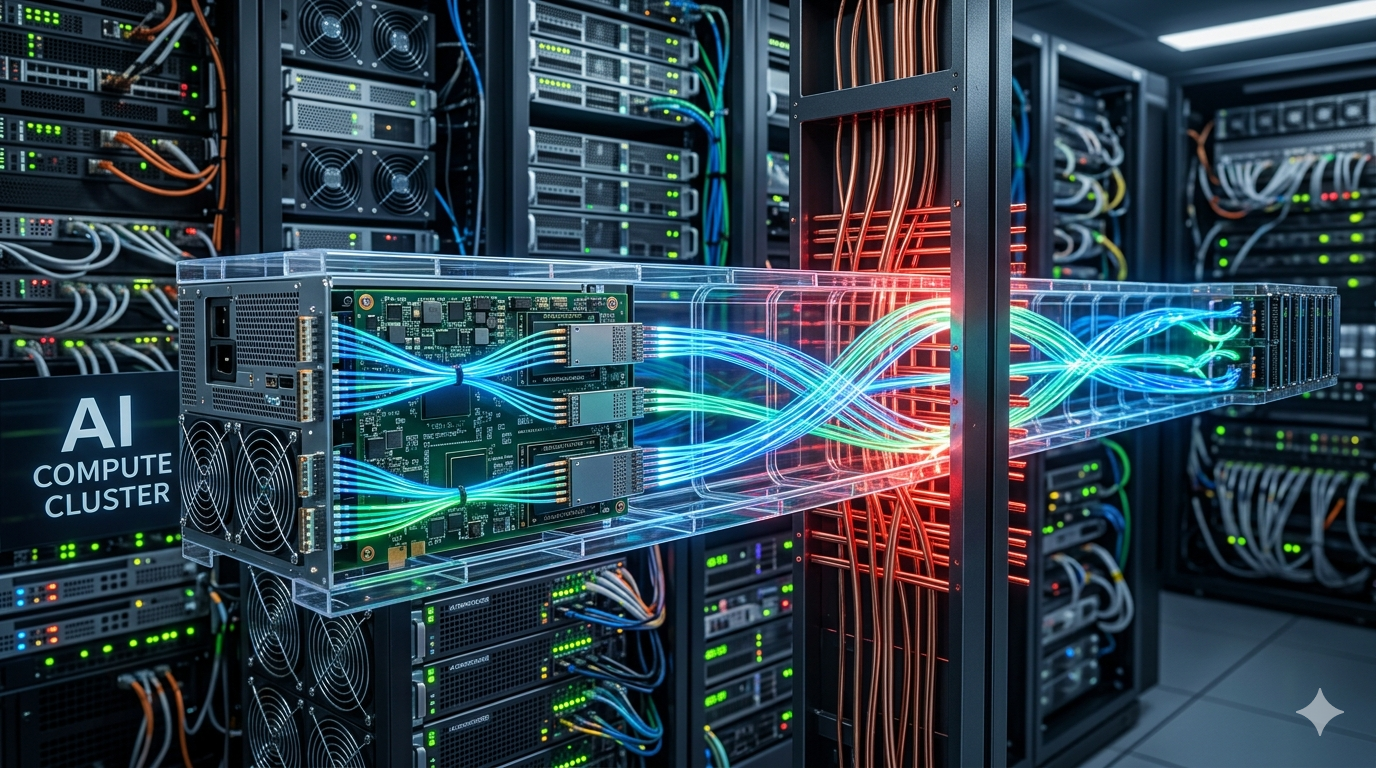
Silicon photonics introduces a paradigm shift by replacing conventional electrical signalling with optical communication. By integrating photonic components such as waveguides, modulators, and photodetectors onto silicon substrates using CMOS-compatible processes, it becomes possible to align optical communication with existing semiconductor manufacturing ecosystems.
Following this integration, optical interconnects offer clear structural advantages over traditional copper-based systems: Higher bandwidth density without proportional increases in physical complexity.
- Reduced signal degradation over longer distances
- Immunity to electromagnetic interference
Building on these benefits, a critical technique in this domain is wavelength-division multiplexing (WDM), which enables multiple data streams to be transmitted simultaneously over different wavelengths through a single optical channel. This significantly enhances throughput while maintaining manageable interconnect density.
The broader industry shift toward data-centric system design reflects a growing recognition that communication efficiency is now as important as compute performance. As Jensen Huang has noted, “The future of computing is about moving data faster and more efficiently than ever before.” This perspective underscores the growing importance of interconnectivity in AI systems.
Scaling AI Workloads: The Limits of Electrical Interconnects
Modern AI workloads are distributed. Training large models needs coordinated computation across accelerator clusters with ongoing data exchange. This strains the interconnect infrastructure.
Electrical interconnects are widely used but face scaling limits. Bandwidth saturates at higher data rates due to signal integrity.
- Disproportionate increases in power consumption with higher throughput
- Thermal challenges arising from dense, high-speed electrical signalling
Silicon photonics solves these issues with high-bandwidth, lower-energy communication. Optical signals carry more data efficiently and reduce losses from resistance and heat.
This transition is not merely an incremental upgrade; it reflects a structural evolution in system architecture. As Sundar Pichai has emphasised, “The opportunity with AI is as big as it gets.” Realising that opportunity depends on overcoming infrastructure bottlenecks, particularly those related to data movement.
Energy Efficiency: A Defining Constraint in AI Infrastructure
As AI systems scale, energy efficiency has become a primary engineering concern. Data centres supporting AI workloads are experiencing rapid increases in power demand, with interconnects contributing significantly to overall energy consumption.
Silicon photonics offers a pathway to improved efficiency by reducing the energy required to transmit each bit of data. Optical communication minimizes resistive losses and reduces the need for repeated signal amplification, particularly over longer distances.
This results in several system-level benefits:
- Lower operational energy consumption in large-scale deployments
- Reduced thermal load and simplified cooling requirements
- Improved sustainability metrics for data center operations
The importance of energy-efficient infrastructure is widely acknowledged across the industry. As Satya Nadella has stated, “Every data center must become more energy efficient as AI scales globally.” Silicon photonics directly supports this objective by enabling high-performance communication with lower power overhead.
Co-Packaged Optics: Integrating Compute and Communication
A significant architectural development enabled by silicon photonics is the emergence of co-packaged optics (CPO). Unlike traditional pluggable optical modules, CPO integrates optical components directly alongside compute silicon within the same package.
This approach reduces the distance between processing and communication layers, enabling tighter system integration and improved performance. The advantages include reduced latency, higher interconnect density, and the elimination of many electrical I/O bottlenecks.
While alternative approaches—such as advanced packaging and chiplet-based architectures continue to evolve, they primarily extend the capabilities of electrical interconnects rather than overcoming their fundamental limitations. Silicon photonics, by contrast, addresses the underlying physics constraints, offering a more scalable path forward for AI infrastructure.
From Research to Deployment: Growing Industry Momentum
Silicon photonics is transitioning from research laboratories to real-world deployment. Hyperscale data centres are increasingly incorporating optical interconnects to handle high-volume, low-latency communication across servers and racks.
Its relevance spans multiple application domains, including AI training clusters, high-performance computing environments, telecommunications networks, and emerging edge AI systems. Across these domains, the common requirement is efficient, high-speed data movement.
The growing investment from semiconductor and technology companies reflects a broader industry shift. Silicon photonics is no longer a speculative technology; it is becoming an operational necessity for scaling AI systems.
Engineering Challenges: Bridging Innovation and Implementation
Despite its advantages, silicon photonics presents several engineering challenges that must be addressed to enable widespread adoption.
- Integration complexity in co-designing photonic and electronic components
- Sensitivity of optical elements to temperature variations
- Challenges associated with efficient on-chip laser integration
- Manufacturing variability affecting large-scale production consistency
Addressing these issues requires coordinated innovation across design methodologies, fabrication processes, and system-level validation techniques. The transition to photonic interconnects is not solely a technological shift it also demands ecosystem maturity.
Future Outlook: Toward Photonics-First Architectures
Looking ahead, silicon photonics is expected to play a central role in the evolution of AI infrastructure. As distributed computing becomes the norm and model complexity continues to grow, efficient data movement will remain a critical requirement.
Emerging directions include on-chip optical interconnects, hybrid electronic-photonic systems, and new computing paradigms that leverage photonic principles for ultra-fast data processing. These developments point toward a long-term transition in which optical technologies become central to hardware design. This is not a peripheral enhancement; it is a foundational transformation.
As Elon Musk has remarked in the broader context of computing innovation, “The pace of innovation must accelerate to keep up with AI.” Achieving that acceleration will depend not only on advances in algorithms but also on the underlying hardware systems that enable them.
Conclusion: Redefining the Foundations of AI Infrastructure
In the evolution of artificial intelligence, the industry is confronting a fundamental shift: compute capability alone is no longer sufficient. The efficiency of data movement has become equally critical in determining system performance and scalability.
Silicon photonics represents a decisive step toward addressing this challenge. Overcoming the limitations of electrical interconnects enables architectures that are faster, more energy-efficient, and better suited to the demands of modern AI workloads.
This is not a peripheral enhancement; it is a foundational transformation. As AI systems continue to scale and become more complex, silicon photonics is poised to become a cornerstone of next-generation computing infrastructure, shaping how intelligent systems are built and deployed in the years ahead.

